
Meta: a turning point may be on the horizon
Related content
US bank shares fell
The third-quarter earnings season in the US has picked up pace following the release of the latest figures from US banks. Based on preliminary expectations, the third quarter is likely to have closed with strong earnings growth for S&P 500 companies, led by the energy and technology sectors. The major US banks have still achieved solid growth on an annual basis, indicating that their operations remain strong, but the pace has clearly slowed in many cases, which has tended to result in negative share price reactions.
Commodities - Technical Analysis
Gold and silver continued their downward trend, bouncing off key levels. Until their downward trends are broken, they will not be able to produce a significant rise. The fall in oil prices reversed from the $87.5 level and began a slight upward movement. Natural gas remained in an uptrend; a significant rise could even occur if it breaks out upwards. The price of copper has become stuck in a wider range, so the oversold and overbought zones may offer more favourable trading opportunities. The falling prices of wheat and corn have reached key support levels; a buying reaction from these levels could present favourable long opportunities with limited risk.
Meta has made a number of announcements in recent days that could significantly shift the stock’s sentiment in a positive direction in the short term. Significant AI-related investments have so far kept the stock’s valuation notably depressed, despite strong growth, however, with the possibility of renting unused computing capacity to outsiders, the announcement of the new Muse Spark 1.1 model—which is considered superior to Google’s in-house—and the launch of an enterprise subscription service with pricing that is significantly more aggressive than that of competitors, concerns about future returns may ease. Although the approaching quarterly earnings report poses an additional risk, it may still be worthwhile to open a trading position, given the favorable risk-reward opportunities.

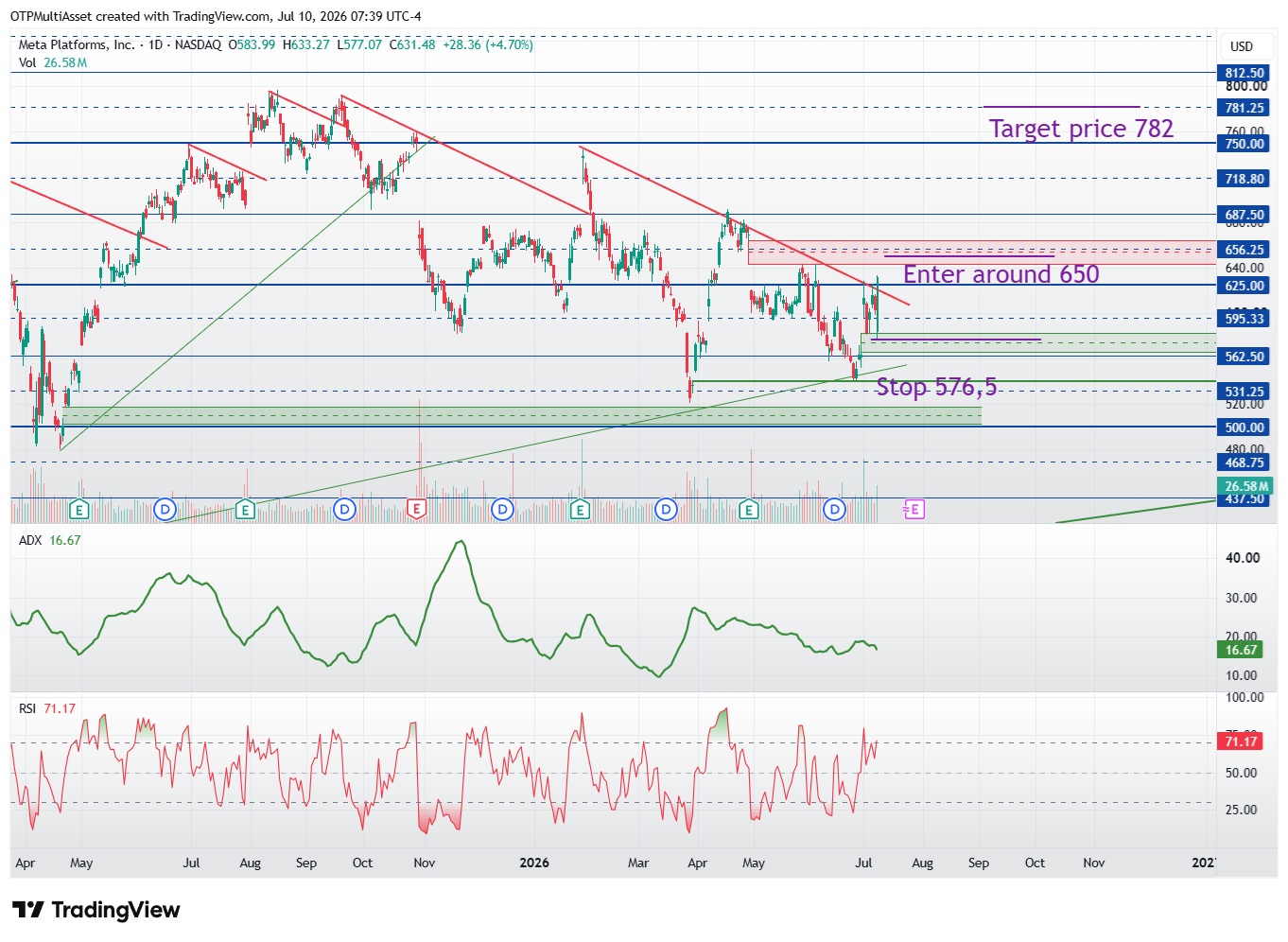
A favorable trading opportunity is emerging on Meta’s chart, as a technical pattern suggesting a reversal has formed in recent days. A week ago, the stock opened with a gap up above the 577 level, which it has not retested since—a sign of strength on the buy side. During yesterday’s trading session, the stock bounced off this support level amid heavy volume.
All of this increases the likelihood that the stock will enter a sustained uptrend and that another upward wave will begin. Accordingly, at the start of today’s trading, we recommend opening a long position around the $650 level, while placing the stop order below the low of yesterday’s candlestick. Based on the technical picture confirming the longer-term trend, we set the target price near previous highs, at $782. With this setup, the expected return is approximately 1.8 times the level of risk taken.
What happened? We’ve received several pieces of good news:
- Although, according to Zuckerberg, Muse still lags somewhat behind the solutions offered by its major competitors, OpenAI and Anthropic, development of Watermelon is already underway, and the company hopes this will help it catch up. For many tasks, however, Muse delivered better test results than Gemini, which is significant because this marks the first time the company has been able to create a model that outperforms Google’s solution in several respects.
- What may be even more interesting from an investment perspective is that Muse is not an open model; its use will be tied to a subscription for companies, meaning this could open up a new revenue stream for Meta. Moreover, the pricing will be very aggressive, with the service offered at one-quarter of the prices charged for competitors’ top models.
- Another important piece of news in recent days—which Mark Zuckerberg also confirmed (and had previously discussed)—is that if Meta’s significant investments in AI infrastructure result in excess computing capacity, the company would rent it to generate additional revenue.
- In fact, they will also explore whether, if renting yields a higher return than internal use, they will take advantage of this opportunity. At the same time, the company would enter the cloud services market (as a neocloud business), much like Amazon did 20 years ago when it launched AWS—which is now highly profitable—due to excess capacity.
Why is this good news?
Primarily because it could help turn the previously negative narrative surrounding the stock in a positive direction, at least temporarily. Among the major tech companies, Meta is trading at the lowest price-to-earnings multiples (a forward P/E of 15–16, compared to an average of 26 for the others), even though its growth outlook is by no means worse than that of its peers. One factor contributing to this may be that Meta is the tech player most reliant on a single revenue stream and most exposed to trends in the advertising and media markets, while its AI-related investments (USD 125–145 billion this year) appeared particularly high relative to this, eating into free cash flow. Partly because of this, and given the company’s lag behind frontier AI models, the return on these investments was also fraught with significant risks.
However, the recent announcements provide at least a partial response to these previous concerns: new revenue streams, such as cloud services, may emerge in the future; the current model looks quite promising; and, moreover, the introduction of a subscription service could alleviate fears regarding AI’s return on investment. Aggressive pricing also seems like a very good move for now, since—given OpenAI and Anthropic’s upcoming plans for major capital raises and IPOs—it seems less rational for them to engage in a massive price war against a player with far stronger balance sheet (and thereby risk the success of their fundraising efforts); thus, Meta, with a somewhat weaker but much cheaper service, will likely be able to carve out a market share for itself during this transitional period.
These conditions, however, create the possibility for the stock’s revaluation to begin, and as we can see, there is room for improvement on this front. We estimate a realistic price of $810 for Meta—which is also featured on our Equity Top Pick List—based on key metrics, which could even become achievable during such a process; however, we must not forget that if the stock were to catch up to Google, price levels of $900–$1,000 would not be out of the question. Of course, the likelihood of this is still low at the moment.
Taking a trading position in Meta stock right now, however, is a very risky choice, mainly because the company will release its quarterly earnings report in two weeks (after the market closes on July 29); if the results come in weaker than expected, or if the company raises its capital expenditure plans again, this could trigger a significant downward correction, potentially forcing a stop-loss on the position. Similarly, if OpenAI and Anthropic were to engage in a price war after all, that could also have an adverse effect, and of course, a market-wide sell-off—as is always the case—could also pose a threat to a trading strategy managed with strict risk control.
Get more out of your investments!
Global Markets Services
OTP Global Markets offers a broad range of services in the field of local and international money and capital markets.
Read morePrivate Banking Services
Personal care and expertise with OTP Private Banking, along with the knowledge, security, and innovations of a multinational banking group.
Read more