
Meta: Burning Cash on the AI Promise
Related content
The government plans a 4.9% deficit for next year
The government plans a 4.9% deficit for next year and will gradually reach 2.8% by 2030, under the Maastricht criteria
Commodities - Technical Analysis
Gold and silver prices continue to follow a downward trend, although the downward momentum is now much weaker than before. As long as the trend lines defining the decline are not broken, a sustained reversal cannot be expected. The price of oil has reached the 100 level, which serves as an important resistance level; however, it has remained in an uptrend for the time being. Natural gas prices, on the other hand, have broken their uptrend. Copper is stuck in a wider trading range, so the oversold and overbought zones may offer more favorable trading opportunities. In the case of wheat and corn, however, key levels have been breached that would have been essential to maintain in order for long-side entry opportunities to remain valid.
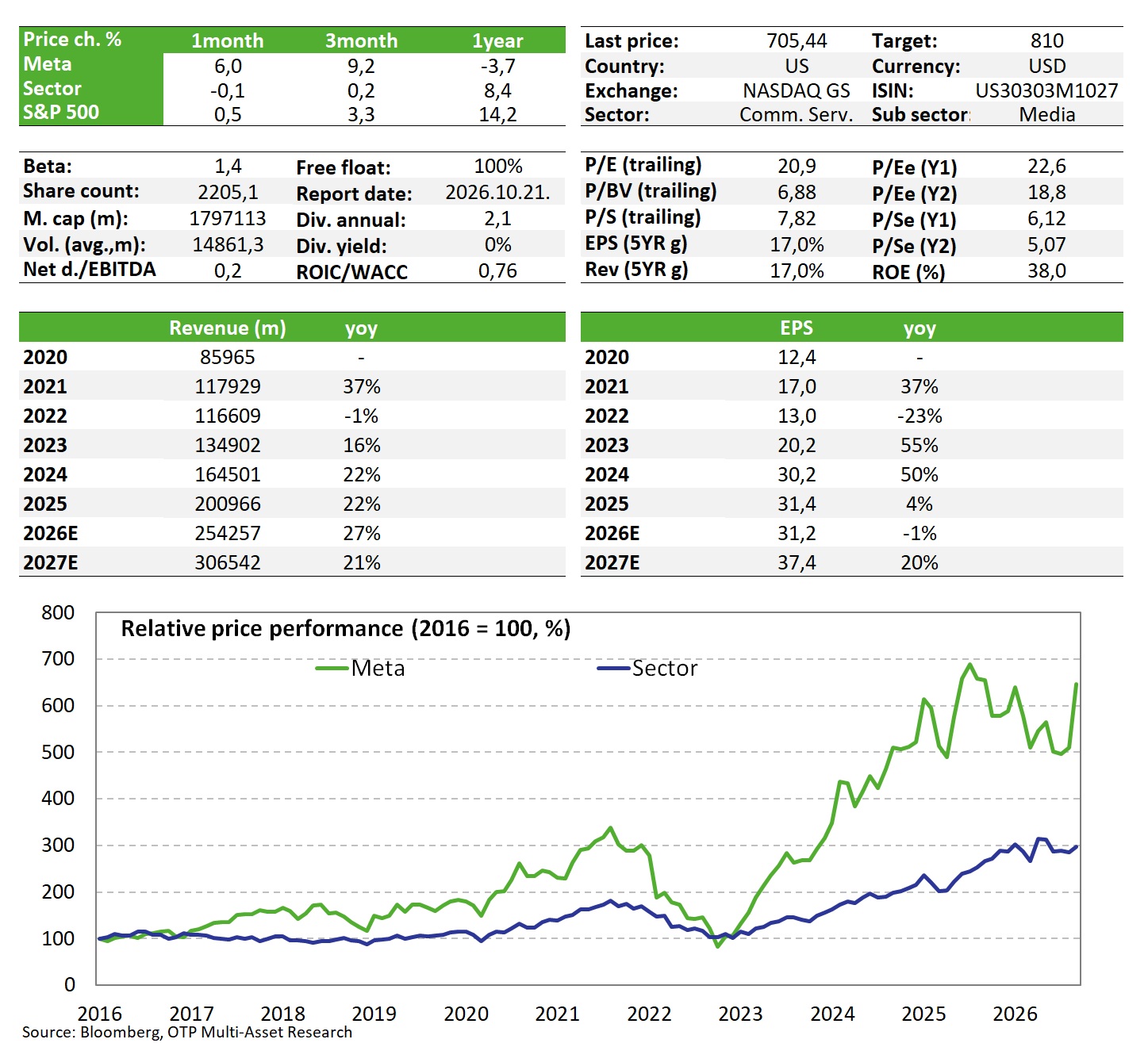
Overall, Meta’s quarterly performance continues to paint a positive picture in terms of the underlying fundamentals, while the company has also achieved significant milestones on the AI model development front. However, elevated spending is taking a substantial bite out of cash generation, with free cash flow now turning negative, which may increasingly require funding through capital market financing. Following the stock’s rally in recent weeks, valuation levels have also moved higher. In the near term, these factors may continue to put pressure on the stock, although the longer-term outlook remains constructive. Naturally, much will depend on the company’s ability to effectively monetize its investment program over time.
Meta is included in our Equity Top Pick list.
Quarterly Report
Meta’s revenue continued to grow at a strong pace in the third quarter, rising 26% year-on-year to $64.6 billion, surpassing expectations of $63.3 billion. The growth was driven entirely by advertising revenues, with ad impressions increasing by 10% year-on-year, while average ad prices also rose by 14%. Revenue expanded on a quarterly basis as well, with growth recorded across all regions, resulting in a new all-time high in revenues.
This performance was also supported by the company’s internal use of AI solutions. Through improved ad targeting and more personalized content, daily active users across its apps increased to 3.64 billion, users spent more time on its platforms, and revenue per user reached a record high. These figures provide a partial answer to the questions surrounding the monetization potential of the company’s substantial AI investments, as they clearly demonstrate that Meta is already benefiting from the efficiency-enhancing capabilities of these tools. However, more will be needed for the company to successfully monetize its record-high investment spending in its entirety while generating attractive returns.
The sharp increase in costs may reinforce investor concerns in this regard. However, it is important to note that one-off legal expenses played a significant role. The company recognized a $9.9 billion charge related to legal proceedings in the U.S. concerning the mental health impact on younger users (with additional charges potentially arising in the future). As a result, operating profit declined by 37% year-on-year. While this does not look particularly encouraging at first glance, excluding these one-off effects would imply roughly 10% growth at the operating profit level.
This strength was not visible at the net profit level, however, as the base period was depressed by provisioning costs, making the nearly fourfold increase in earnings particularly notable. As a result, EPS came in at $3.87, exceeding the consensus expectation of $3.57. The company spent nearly $35 billion on investments during the quarter. The development of AI capabilities continues to require substantial spending in the near term, which pushed free cash flow into negative territory. This is not an isolated phenomenon within the sector, however Meta remains among the companies that are already able to demonstrate revenue-side benefits from their AI investments. Nevertheless, this is not something investors are eager to see, particularly in an environment where questions surrounding the monetization and ultimate returns of AI investments remain firmly in focus.
Investments are not slowing down either. While the company maintained its annual capex guidance range, it shifted expectations closer to the upper end, narrowing the range from $130-145 billion to $135-145 billion. This came as little surprise, given that the market had already been pricing in capex spending of close to $140 billion. Moreover, guidance for fourth-quarter revenue was set at $73-76 billion, which represents a modestly positive surprise relative to the consensus of around $73 billion. The company has not yet provided specific guidance for 2027, but investment spending is expected to remain aggressive, which could significantly reduce free cash flow generation.
With weaker cash flow generation, leverage could become more of a concern, particularly when off-balance-sheet items are also taken into account. This increases the likelihood that Meta may raise capital in the future. The company has already taken a step in this direction by introducing a new class of non-voting shares, allowing Mark Zuckerberg to retain voting control while providing additional flexibility if capital is needed. Existing shareholders will receive one new share for each share held, effectively creating a stock-split-like effect, with the new share class expected to start trading in mid-January. Any future capital raise would be dilutive for existing shareholders, which is generally seen as a negative. At the same time, investor reaction will largely depend on sentiment toward AI. With concerns currently outweighing optimism, this development is likely to be viewed negatively, despite the fact that Meta is already among the companies that have been relatively successful in demonstrating the monetization potential of AI investments.
Of course, several positive factors contributed to the rise in the stock price over the past few weeks, the most significant being the launch of the Muse AI assistant, which topped the App Store’s download charts for a long time, with over 10 million downloads. A quarter of downloaders use it daily, primarily entrusting it with their purchases, which average $200 in value. In the short term, however, Muse is quite computationally intensive, but the company expects to improve cost efficiency tenfold by next year, which would certainly be an important step forward in terms of addressing concerns about return on investment.
Valuation
For now, these risks are somewhat offset by the fact that valuation metrics remain at comfortable levels. Although the stock's rally in September pushed valuation multiples higher, the company’s 2027 multiples still rank among the lower ones within the large-cap technology space (P/E: ~19, EV/EBITDA: ~15), despite earnings growth expectations that hardly justify such a discount (more than 20% EPS and EBITDA CAGR for 2026–29). Based on these metrics, we maintain our fair value estimate of $810.
Investment thesis
- Meta’s social media platforms are used by 3.5 billion people every day. Its business can be divided into two segments: on the one hand, apps such as Facebook, Instagram, Messenger, and WhatsApp, which account for the majority of its revenue; and on the other hand, products and solutions related to virtual and augmented reality (Reality Labs).
- Among the major technology companies, Meta could be one of the biggest beneficiaries of the continued advancement of AI solutions, as it can leverage these technologies across an already established and sufficiently large user base. The company has long been offering Meta AI, an AI assistant that can participate in chats, identify and edit images, and potentially serve as a real-time conversational partner, with more than one billion active users. The company’s Muse Spark language model, introduced in 2026, has outperformed Gemini in several tasks, something that had not been seen before. Shortly thereafter, Meta unveiled another development called Muse Wonder, which has already demonstrated capabilities comparable to those of leading frontier models and has achieved several hundred million downloads, exceeding even the company’s own expectations. Importantly, Meta is no longer focusing solely on open models. Instead, it has begun offering its AI solutions at competitive prices, potentially creating a new revenue stream for the company.
- The company continues to invest heavily in expanding its AI capabilities, with planned spending exceeding $100 billion this year. At the same time, personnel and other related expenses are also rising significantly. These cost pressures remain a key concern for investors, although strong revenue growth has so far supported the view that the company will eventually be able to translate these investments into earnings. Concerns about the return on these investments have been eased in recent months by the possibility that Meta could eventually lease out excess computing capacity. Such a move could effectively mark the company's entry into the cloud services market and provide an additional source of revenue.
- AI solutions can also help make advertising more targeted by identifying user behaviour and patterns, while creating opportunities for new products and services. At the same time, several of the company’s platforms still offer meaningful growth potential, particularly through the expansion of Threads and the further monetization of WhatsApp. One area that remains a hidden opportunity is the emergence and adoption of AI agents, as well as the development of the "personal superintelligence" envisioned by Mark Zuckerberg. Given the vast amount of personal data Meta has access to through users’ social media activity, the company is well positioned to deliver a truly personalized AI experience, potentially allowing it to become a leading player in the AI assistant market. The launch of the Muse AI agent was therefore also welcomed by investors. Despite some initial issues, the agent is already capable of handling a range of tasks on behalf of users, including online bookings, calendar management, email correspondence and restaurant reservations, making it one of the most advanced consumer-oriented AI agent solutions currently available. If Meta succeeds in integrating the AI agent into its smart glasses ecosystem as planned, it could represent another major step forward. Such integration would allow AI to interact directly with the physical world and could eventually enable users to engage with their AI assistant even without relying on a smartphone.
- TikTok poses strong competition to the company’s platforms, but its large scale also carries the risk of antitrust and other legal concerns and penalties (ongoing discussions with the European Commission may compel the company to make changes that could have a significant negative impact on its European revenues).
Get more out of your investments!
Global Markets Services
OTP Global Markets offers a broad range of services in the field of local and international money and capital markets.
Read morePrivate Banking Services
Personal care and expertise with OTP Private Banking, along with the knowledge, security, and innovations of a multinational banking group.
Read more