
Meta: Unable to ease investors' concerns
Related content
Meta: Burning Cash on the AI Promise
Overall, Meta’s quarterly performance continues to paint a positive picture in terms of the underlying fundamentals, while the company has also achieved significant milestones on the AI model development front. However, elevated spending is taking a substantial bite out of cash generation, with free cash flow now turning negative, which may increasingly require funding through capital market financing. Following the stock’s rally in recent weeks, valuation levels have also moved higher. In the near term, these factors may continue to put pressure on the stock, although the longer-term outlook remains constructive. Naturally, much will depend on the company’s ability to effectively monetize its investment program over time.
The government plans a 4.9% deficit for next year
The government plans a 4.9% deficit for next year and will gradually reach 2.8% by 2030, under the Maastricht criteria
Another quarterly report, and the same unanswered questions remain for Meta: when, how, and how much profit will come from AI investments? Although the company met expectations in terms of revenue, profits fell short of expectations, though one-off items did play a role in this. However, the company’s forecast for the current quarter was disappointing and may indicate that ramping up the sale of computing capacity will be a slower process than anticipated. As a result, Meta may lag behind other hyperscalers in short-term AI monetization, while its continued high investment plans could put pressure on free cash flow generation, making investors increasingly impatient.
Meta is included in our Equity Top Pick list.
Quarterly Report
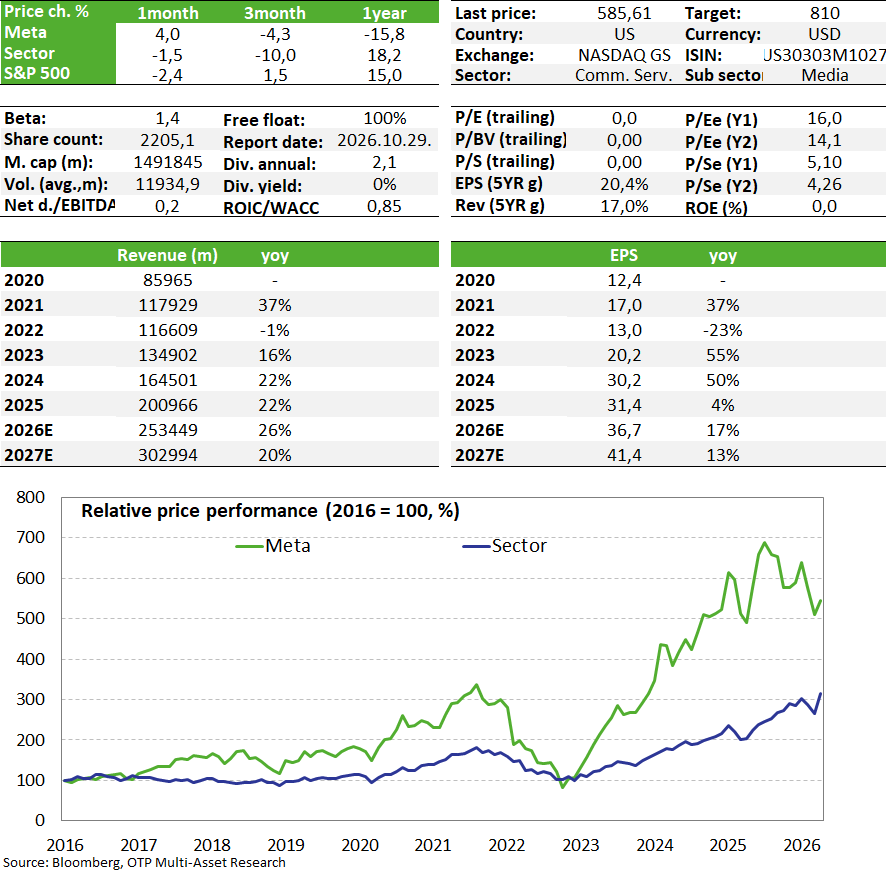
The company’s revenue reached $60.8 billion in the second quarter (+28% YoY), which just barely exceeded the expected $60.2 billion. Although revenue growth remains strong, there is a noticeable slowdown compared to the 33% growth in the previous quarter. The number of daily active users on Facebook, Instagram, and WhatsApp rose to 3.6 billion (+3.4% YoY), largely in line with expectations. Meanwhile, ad impressionsons on these platforms increased by 14%, and average ad prices rose by 12%, also matching preliminary estimates.
These figures already reflect the impact of AI investments, which enable Meta to improve ad targeting and personalization — something it can monetize even in the short term. At the same time, this alone may not be enough, as Meta has one of the lowest cash flows among tech giants, while also being one of the most aggressive investors. Google, Amazon, and Microsoft are currently trying to recoup their investments primarily by selling the computing capacity of their data centers. A similar opportunity recently arose for Meta, which gave its stock a significant boost.
However, the company’s guidance for the current quarter was disappointing ($62.5 billion vs the expected $63.2 billion), which may indicate that ramping up sales of computing capacity could take longer than previously anticipated, thereby limiting short-term monetization opportunities. The company continues to spend significant amounts on investments, but this time it did not substantially raise its annual capex plan: it merely increased the lower end of the forecast from $125 billion to $130 billion, while the upper end remained unchanged at $145 billion. Free cash flow, however, fell below $1 billion — a level not seen since 2022 — and could even turn negative in the coming quarters.
Earnings per share were $6.18, falling short of the analyst consensus of $7.14. However, this discrepancy was due to one-time items such as a $2.4 billion fine related to legal proceedings and $1.2 billion in severance costs. Excluding these items, EPS would have exceeded expectations.
Overall, based on Meta’s guidance, there still appears to be insufficient monetization of AI investments in the short term, while management was once again unable to provide a concrete answer during the post-earnings press conference regarding how AI might better contribute to profit growth in the coming years. Furthermore, the company did not disclose any new information regarding its longer-term investment plans. This uncertainty, coupled with free cash flow coming under increasing pressure in the short term, has led investors to adopt a pessimistic outlook.
Valuation
For now, these risks are somewhat offset by the fact that, following last year’s sideways movement in the stock price, valuation metrics remain at comfortable levels; in fact, the company’s multiples are the lowest among the major tech giants (P/E: ~19, EV/EBITDA: ~12), even though profit growth expectations do not justify this at all (~20% EPS and EBITDA CAGR for 2025–27). Based on these metrics, we therefore maintain our previous fair value estimate of $810.
Investment thesis
- Meta’s social media platforms are used by 3.5 billion people every day. Its business can be divided into two segments: on the one hand, apps such as Facebook, Instagram, Messenger, and WhatsApp, which account for the majority of its revenue; and on the other hand, products and solutions related to virtual and augmented reality (Reality Labs).
- Among the major tech companies, Meta may be one of the biggest beneficiaries of the ongoing development of AI solutions, as it can leverage them against an existing, sufficiently large customer base: a solution called Meta AI is already in use, which acts as a conversation partner in chats, identifies and edits images, and can even serve as a live conversation partner in theory, with an active user base of over 1 billion. There are still some reliability issues, but these can be overcome as AI advances. The development of its own internal model (Muse Spark) also serves this purpose, as it is capable of solving complex tasks in a more cost-effective manner.
- The company spends most of its advertising revenue on developing AI capabilities; this year’s budget already exceeds $100 billion, but related personnel and other costs are also rising significantly. Cost pressures hang over the stock like a sword of Damocles, but for now, thanks to strong revenue growth, investors accept that the company will eventually be able to translate these expenses into profits.
- For one thing, AI solutions—by identifying behavioral habits and patterns—can greatly help make ads more targeted, and new products could emerge based on this, while there is also further potential for growth across the company’s various platforms (expansion of Threads, tapping into WhatsApp’s potential). What remains a hidden reserve for now—and it’s not yet clear whether the company will be able to capitalize on it—is the emergence and proliferation of AI agents, as well as the development of the “personal superintelligence” envisioned by Mark Zuckerberg. Since Meta possesses a significant amount of our personal data based on our social media consumption and activity, it is well-positioned to offer a truly personalized solution, which could even propel it to a leading role in the AI assistant market. However, this requires investment, and we will only see the return on that investment later.
- TikTok poses strong competition to the company’s platforms, but its large scale also carries the risk of antitrust and other legal concerns and penalties (ongoing discussions with the European Commission may compel the company to make changes that could have a significant negative impact on its European revenues).
Get more out of your investments!
Global Markets Services
OTP Global Markets offers a broad range of services in the field of local and international money and capital markets.
Read morePrivate Banking Services
Personal care and expertise with OTP Private Banking, along with the knowledge, security, and innovations of a multinational banking group.
Read more