
Following record revenue, construction recovery would be key for Masterplast
Related content
US bank shares fell
The third-quarter earnings season in the US has picked up pace following the release of the latest figures from US banks. Based on preliminary expectations, the third quarter is likely to have closed with strong earnings growth for S&P 500 companies, led by the energy and technology sectors. The major US banks have still achieved solid growth on an annual basis, indicating that their operations remain strong, but the pace has clearly slowed in many cases, which has tended to result in negative share price reactions.
Commodities - Technical Analysis
Gold and silver continued their downward trend, bouncing off key levels. Until their downward trends are broken, they will not be able to produce a significant rise. The fall in oil prices reversed from the $87.5 level and began a slight upward movement. Natural gas remained in an uptrend; a significant rise could even occur if it breaks out upwards. The price of copper has become stuck in a wider range, so the oversold and overbought zones may offer more favourable trading opportunities. The falling prices of wheat and corn have reached key support levels; a buying reaction from these levels could present favourable long opportunities with limited risk.
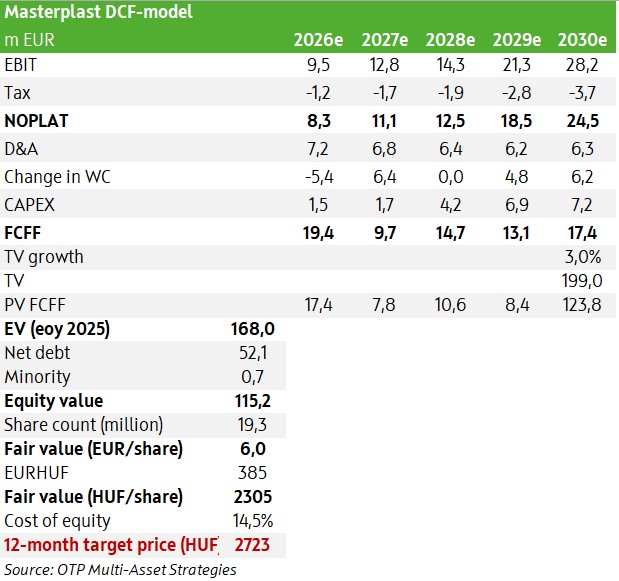
We have revised our DCF model and earnings estimates for Masterplast (a Hungarian player in the insulation business with regional presence). We have raised our 12-month target price to HUF 2723 (from HUF 2552 as of 01.07.2025), while we maintain our HOLD recommendation. The primary reason for raising the target price is that the company may be able to curb its capital expenditures more than previously expected, which supports FCFF estimates in the coming years, while we are calculating with a lower leverage beta due to the improving capital structure, which lowers WACC values.
Masterplast closed out 2025 with a strong quarter, achieving record revenue while also reaching EBITDA levels not seen since 2022; it also returned to profitability on a net income basis in Q4, excluding one-time items. However, the rise was primarily driven by strong demand for Certified Energy Savings (HEM), which may still support growth in early 2026, but we see little chance of repeating the Q4 figures. In segments independent of HEM, demand remains subdued, and the construction industry failed to show any meaningful turnaround in 2025. The number of new housing starts reached a decade-long low, though the pace of decline has slowed compared to 2024, while the number of building permits issued showed a significant increase. The Otthon Start program may also support a revival in new housing construction in the medium term, but its impact is likely to materialize only toward the end of the year at the earliest. In contrast, the Home Renovation and Rural Home Renovation Programs are expected to run out in the first half of the year. Overall, the business outlook remains characterized by significant uncertainty .
The macroeconomic outlook is mixed: revenue-weighted GDP growth forecasts for Masterplast’s markets indicate a 2.2% increase in 2026, following 1.2% in 2025. However, this forecast was 2.5% just eight months ago, and growth expectations for subsequent years are also slightly lower. In addition, the potential prolongation of the war in Iran creates further uncertainty and downside risks.
In our view, Masterplast’s liquidity position has improved since the middle of last year. With significantly higher cash reserves and the operating cash flow expected this year, the company may be able to cover its larger loan and bond repayments in 2026, assuming that short-term working capital loans are successfully extended.
Given the slower-than-expected economic recovery, we have revised our revenue forecasts downward over the longer term, although this may be partially offset by the positive impact of HEM sales in 2026. Overall, we still expect a YoY increase of approximately 6% in 2026 revenue, while the EBITDA margin could rise to 9.2%, although this still falls somewhat short of our previous expectations.
Get more out of your investments!
Global Markets Services
OTP Global Markets offers a broad range of services in the field of local and international money and capital markets.
Read morePrivate Banking Services
Personal care and expertise with OTP Private Banking, along with the knowledge, security, and innovations of a multinational banking group.
Read more