
Large swings on the South Korean stock market
Related content
The U.S. Market Offers Fewer Compelling Buying Opportunities
The major U.S. indices turned lower last week, with key trendlines also coming under pressure. In such an environment, momentum is clearly favoring the sellers, making it difficult to identify attractive buying opportunities for the time being. The key question, of course, remains whether we are witnessing the beginning of a lasting trend reversal or merely a short-lived yet sharp correction. Accordingly, although a few stocks met the predefined screening criteria this week, none of them offered a particularly compelling entry point.
International Markets - Technical Analysis
Among U.S. indices, both the S&P 500 and the Nasdaq have broken their upward trends,which had been lasting for months. There is room for a correction, so it may only be worth buying well below current levels. The Russell 2000 began its decline earlier and has continued to fall since then. The DAX and the Stoxx 600, on the other hand, are showing some reversal from their strong support levels, but this appears to be more of a correction. The index tracking emerging markets has also broken below the lower boundary of its trading range and has begun a trend-like decline.
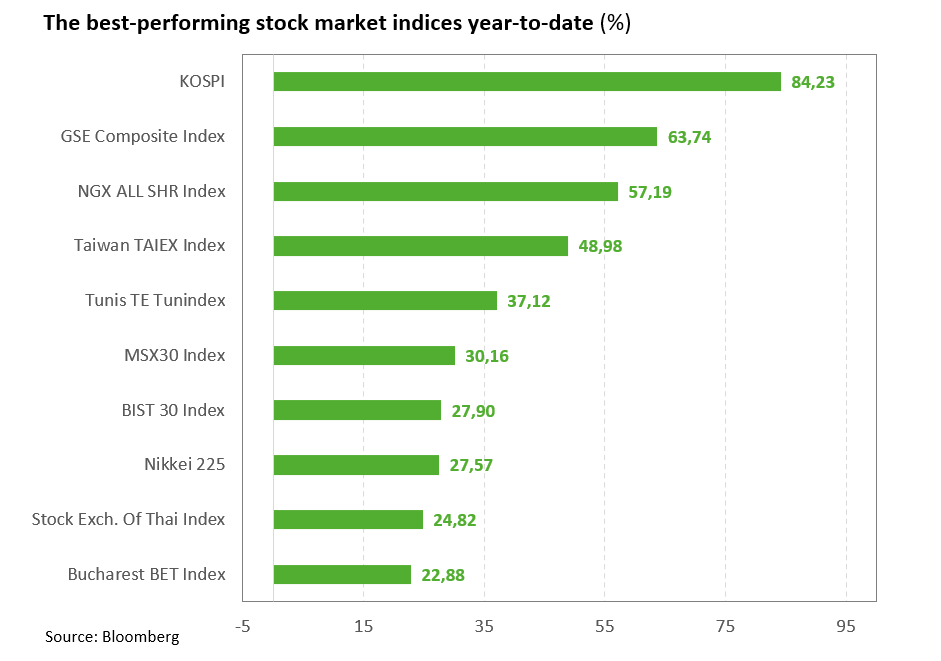
The South Korean stock market soared through early June; driven by artificial intelligence-related chip manufacturers, the Kospi index has been the best-performing stock index globally so far this year. Following the earlier sharp rise, foreign investors have recently been able to take profits, but retail investors’ purchases have broken records in the meantime. After the surge, a correction followed in early June, and the Kospi index fell sharply. However, leveraged ETFs tracking single South Korean stocks, which debuted in late May, may have caused unpleasant surprises for many local investors.
After a record high, a correction followed
The South Korean stock market has seen a massive surge this year; although its rally was temporarily halted by the conflict in the Middle East, by the end of April the KOSPI had already hit new highs, and the index rose by nearly 40 percent from there through early June. Driven largely by chip manufacturers linked to artificial intelligence, the index doubled between January and early June, making South Korea’s stock market the world’s best-performing so far this year.
However, concentration risk could not be ignored either: the market capitalization of the South Korean stock exchange had already exceeded $4 trillion (6,070 trillion won) by early May, and after reaching the most recent major milestone (a market capitalization of 5,000 trillion won) in February, the index achieved this in roughly two and a half months; however, as we previously pointed out, approximately 80 percent of the growth in market capitalization was attributable to the shares of two companies, Samsung and SK Hynix. The rise continued thereafter, and by early June, the South Korean stock market’s market capitalization had reached $5 trillion, making the local stock market the world’s sixth-largest capital market, surpassing India’s.
In addition, significant changes have recently occurred in the market’s structure, as foreign investors were net sellers for most of the period between May 7 and May 29—marking the longest selling streak since the 2008 crisis. In contrast, retail investors’ purchases set a record. Some market commentators attributed the sales by foreign investors largely to profit-taking following the rise in South Korean technology stocks.
It is also worth noting that ETFs with a 2x leverage ratio based solely on a single domestic blue-chip stock (such as Samsung or SK Hynix) made their debut in South Korea at the end of May. The South Korean financial authorities’ goal with this move was partly to redirect domestic retail investor capital flowing into foreign markets back to the South Korean market; however, contrary to earlier expectations, ETFs with three times leverage were ultimately not approved.
According to data from the Bank of Korea, retail investors’ leveraged equity investments rose to a record high (~$39 billion) by the end of May, in tandem with a significant rise in the KOSPI index. This may have been partly driven by the introduction of single-stock leveraged ETFs, and demand for these products was so strong that the Korea Financial Investment Association (KOFIA) website could barely handle the traffic when retail investors were required to complete mandatory training related to trading these products.
In advance, not only industry players but also the South Korean central bank warned that investors should exercise caution, citing the increased volatility that typically accompanies a potential downturn in the capital markets, and specifically noting that margin loans are primarily concentrated in the stocks of chip manufacturers. Amid weakness in US stock markets and the technology sector on June 5, the South Korean KORU ETF (listed on the New York Stock Exchange), which offers three times leverage, fell by more than 40 percent. After this, it came as no surprise to anyone that following the weekend, on June 8, the Kospi fell by more than eight percent (marking the index’s ninth-largest single-day drop on record). Samsung plunged 10 percent, and SK Hynix fell nearly 8 percent, while the decline was even more significant for the leveraged ETFs tracking these stocks.
Although the Kospi recovered slightly following the sharp decline, the South Korean stock market remains the best-performing stock index globally so far this year (as of the close on June 11), with a gain of more than 80% despite the drop on June 8. However, the drop highlights why retail investors should be cautious and avoid leveraged products.
What's next for South Korea?
Forward-looking earnings expectations for Samsung and SK Hynix continue to rise; the consensus expects triple-digit percentage growth in revenue, EBITDA, and profit for both companies this year. If AI-related chip manufacturers continue to perform well and the forward-looking earnings growth expectations of the two major companies (Samsung and SK Hynix) remain on track, this could continue to support the rise of the South Korean stock market. Valuations are also not stretched; the MSCI Korea’s forward 12-month P/E ratio of 6.75 is lower than that of the MSCI Emerging Markets Index (11.26).
It is worth noting that the rally in emerging markets over the past few months has not been broad-based: only 15% of the components of the MSCI Emerging Markets Index outperformed the index over the past month (compared to a historical average of 46%), and the majority of the winners were concentrated in South Korea and Taiwan. About 85% of the components underperformed the index, making this recent period one of the most concentrated emerging market rallies of the past decade.
According to some market commentators, a potential correction in the South Korean stock market could have other negative consequences: it could adversely affect consumption through the wealth effect, while a sustained deterioration in market sentiment could also cast a shadow over the investment plans of semiconductor manufacturers, among other things. Overall, the aforementioned concentration risk and volatility may continue to cause surprises and headaches for retail investors who choose leveraged ETFs over traditional stocks.
Kospi technical picture
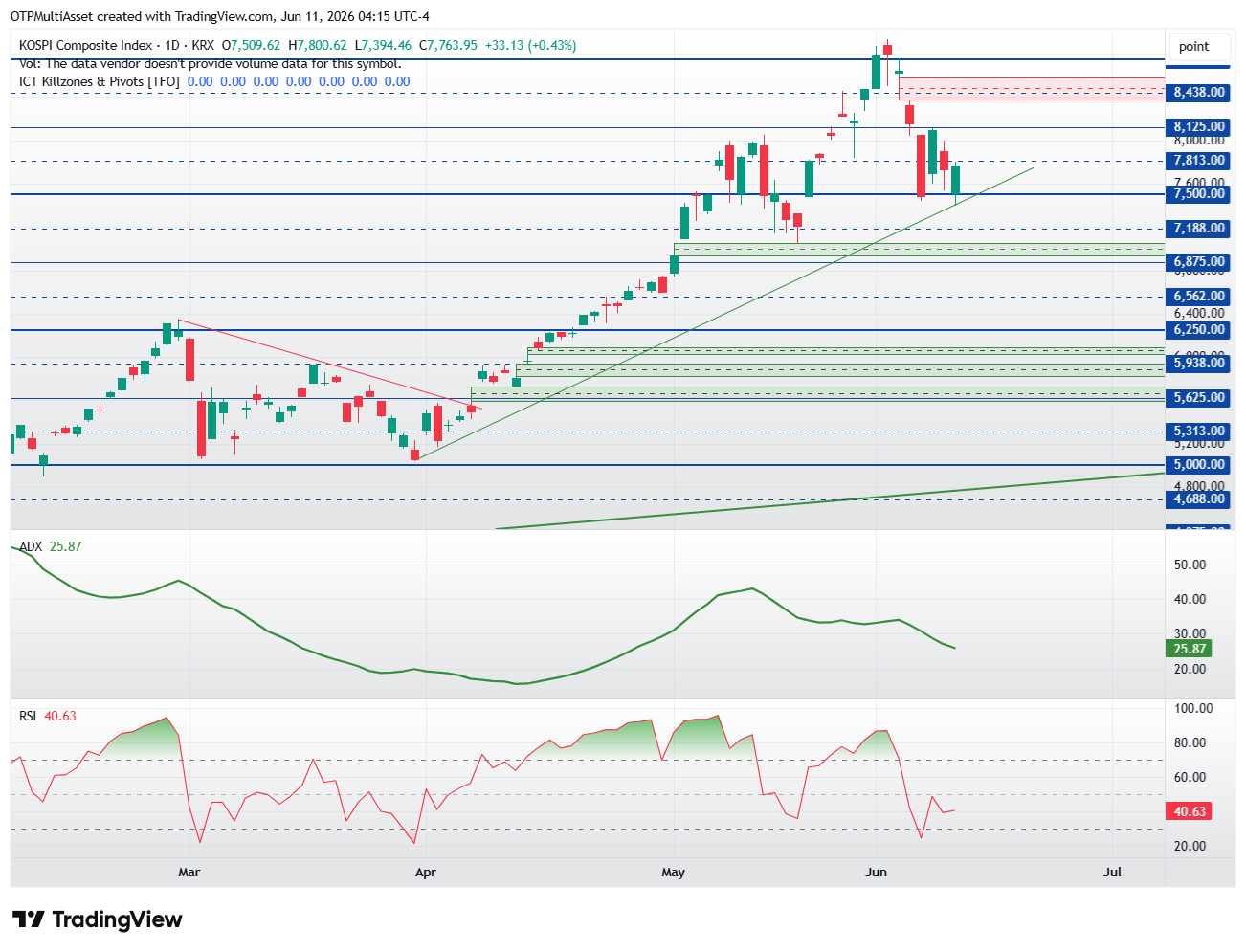
The decline began two week ago with a gap that wasn’t filled within two days, so it could exert strong downward pressure going forward. As a result, 8438 has become a strong resistance level; this could serve as the target for any rally. It would also mark a lower high, which could signal a reversal. However, there is significant support at 7500, where the uptrend line is also located. A break below this level would signal further declines. 6875 and 6250 are now within sight as strong support levels. It is advisable to wait before buying for now, as the potential return does not yet justify the risks.
Get more out of your investments!
Global Markets Services
OTP Global Markets offers a broad range of services in the field of local and international money and capital markets.
Read morePrivate Banking Services
Personal care and expertise with OTP Private Banking, along with the knowledge, security, and innovations of a multinational banking group.
Read more