
Japan prepares for early election
Related content
US bank shares fell
The third-quarter earnings season in the US has picked up pace following the release of the latest figures from US banks. Based on preliminary expectations, the third quarter is likely to have closed with strong earnings growth for S&P 500 companies, led by the energy and technology sectors. The major US banks have still achieved solid growth on an annual basis, indicating that their operations remain strong, but the pace has clearly slowed in many cases, which has tended to result in negative share price reactions.
Commodities - Technical Analysis
Gold and silver continued their downward trend, bouncing off key levels. Until their downward trends are broken, they will not be able to produce a significant rise. The fall in oil prices reversed from the $87.5 level and began a slight upward movement. Natural gas remained in an uptrend; a significant rise could even occur if it breaks out upwards. The price of copper has become stuck in a wider range, so the oversold and overbought zones may offer more favourable trading opportunities. The falling prices of wheat and corn have reached key support levels; a buying reaction from these levels could present favourable long opportunities with limited risk.
Japan's prime minister, who has only been in office since October, will dissolve the lower house of parliament on January 23, followed by early elections on February 8. The move is far from risk-free, but the ruling Liberal Democratic Party is expected to have a good chance of increasing its number of seats and could continue its pro-growth fiscal policy with a strengthened electoral mandate. In response, two opposition parties will run on a joint platform in the election, and in order to take the wind out of the new party's sails, Sanae Takaichi has floated the idea of a temporary reduction in the consumption tax on food. Although this may be well received by voters concerned about rising prices, as evidenced by the rise in Japanese long-term bond yields in recent days, market participants do not seem at all comfortable with the possible financing of the new measure and, overall, with Japan's fiscal discipline.
Early elections coming up in Japan in February
A trade agreement with the United States, a collapsing and then reforming government coalition, a new prime minister, a supplementary budget exceeding $100 billion, which was approved to finance stimulus measures not seen since the Covid pandemic, and a diplomatic dispute with China. These are just a few of the events related to Japan in recent months. Meanwhile, the Japanese stock index, the Nikkei, reached new highs one after another in the second half of the year, partly because market participants welcomed Sanae Takaichi's growth-oriented policy stance with increased optimism.
The beginning of the new year also brought surprises: the Japanese stock market (on January 9) jumped significantly after reports that the prime minister might dissolve the lower house of the Japanese parliament at the beginning of the next session, which would be followed by early elections in early February. A few days later, Takaichi informed officials of the Liberal Democratic Party and its coalition partner (Ishin) of her intention to dissolve the lower house and call subsequent elections. The official announcement was not long in coming, with the prime minister dissolving parliament on January 23 and early elections to be held on February 8. Some commentators noted that this would leave little time for the adoption of the budget for the next fiscal year, which begins in April.
Takaichi's goal is to secure a stronger mandate to implement her growth-oriented program. The prime minister can count on her high popularity to help her party win more seats in the lower house than it currently holds (the LDP lost its parliamentary majority in the 2024 elections, which were also brought forward). The LDP currently holds 199 seats in the lower house of parliament, while Ishin holds 34 seats. In the lower house referendum, 289 of the 465 parliamentary seats will be decided in single-member constituencies, where the candidate with the most votes in a given district wins. The remaining 176 seats are allocated under a proportional representation system, where voters vote for a particular party and seats are allocated based on the proportion of votes obtained in larger regional areas. A simple parliamentary majority requires 233 seats.
The situation is complicated by the fact that in anticipation of the upcoming elections, the largest opposition party, the Constitutional Democratic Party, and the LDP's former coalition partner, Komeito, have jointly founded a new party called the Centrist Reform Alliance (the two parties currently hold a total of 172 seats in the lower house). Komeito previously mobilized its nationwide support base for the LDP as part of the governing coalition, but now it may channel votes to the largest opposition force, which could spell trouble for the prime minister and her party. Some commentators believe that Takaichi's strong support will enable the ruling party to increase its number of seats, but the alliance between the two opposition parties could make a landslide victory difficult.
For Japanese voters, two areas received particular attention in the last election: fiscal support to protect households and offset price increases, and right-leaning foreign policy amid increasing geopolitical risks. Both areas feature prominently in Takaichi's program. A temporary exemption from consumption tax on food was also among the election promises. Although this would allow the ruling party to steal a march on the newly formed opposition group, which is planning a similar move, such a step would pose a risk in terms of fiscal discipline. According to the ruling party's promise, the 0% consumption tax on food would only be in effect for two years, but some commentators see further risks in how a return to the original tax rate could be implemented later.
Attention turns to the Japanese bond market
The prime minister could frame a strong election result by arguing that her pro-stimulus fiscal policy enjoys broad voter support, thereby increasing her chances of silencing the more fiscally conservative voices within her party as well. Some market players believe that there is an increasing chance of a scenario in which the LDP wins a majority as the sole party and further fiscal stimulus measures are introduced. The government plans to present a record budget for the fiscal year beginning in April. Even so, based on government communications, it appears that the administration is not particularly concerned about rising bond yields, but some market participants clearly disagree.
Although some investors have been more concerned about the weakening of the yen in recent weeks, the market focus has gradually shifted to Japanese long-term bond yields, with the ten-year Japanese bond yield rising above 2.3% (on January 20) while the 40-year yield reached 4% (the highest level since the introduction of these bonds in 2007). Based on preliminary industry calculations, the temporary suspension of sales tax on food would cost ~5 trillion yen (~$32 billion) annually, which is not much less than the total amount spent on education, science, and culture combined.
Following the minister responsible for growth strategy, the finance minister also sought to ease market tensions amid rising Japanese bond yields with a reassuring statement. According to the head of the finance ministry, in addition to reducing unnecessary spending, tax exemptions may also be reviewed to finance the tax cuts, and this will not require the issuance of additional bonds. However, until market participants have a clear picture of how fiscal stimulus and the proposed tax cuts will be financed, there is a good chance that bond market turbulence will continue.
It is also worth mentioning that the Bank of Japan is due to announce its interest rate decision on January 23. Expectations are that the interest rate will remain at 0.75% and that the central bank governor may hint at the possible timing of further rate hikes. Although the Bank of Japan is expected to wait until July for the next interest rate hike, some Japanese central bankers believe that another rate hike may be timely as early as April, as the weakening of the yen may increase inflationary pressure.
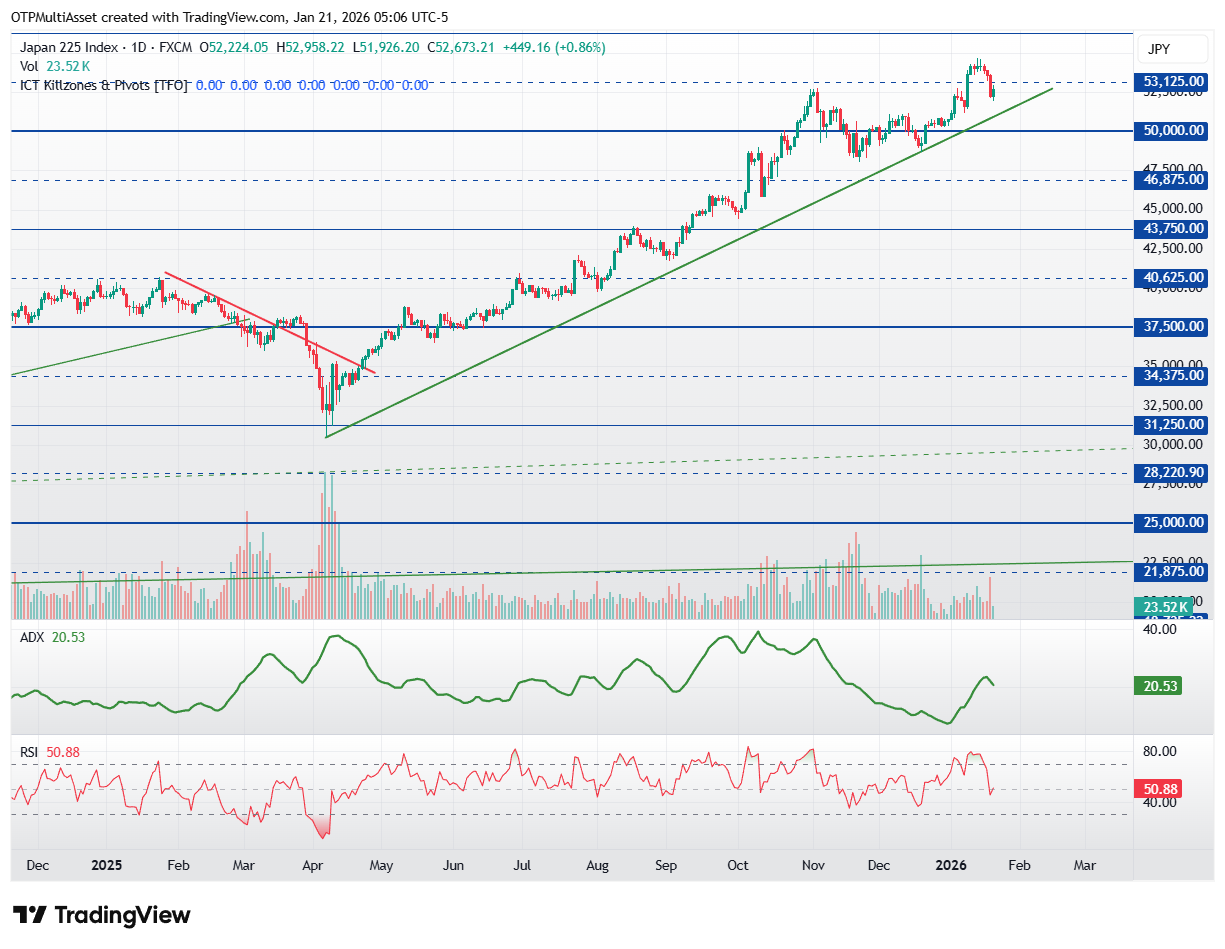
The Japanese stock market rose sharply after news of early elections broke in early January, with the index crawled to new highs before falling sharply on January 20. This may have been due to profit-taking following the official confirmation of the early elections, Japanese fiscal concerns, the US president's latest tariff threats, and news related to Greenland.
The valuation of the Japanese stock market has risen significantly in recent times: the MSCI Japan's 12-month forward P/E ratio of 17.94 is slowly approaching that of the MSCI ACWI index (19.13), with the Japanese market last reaching similar heights in early 2021. Thus, valuations currently appear to be stretched, with expectations of fiscal stimulus from the prime minister now largely priced in, but the possibility of a negative correction also appears stronger due to fiscal concerns and potential bond market turbulence.
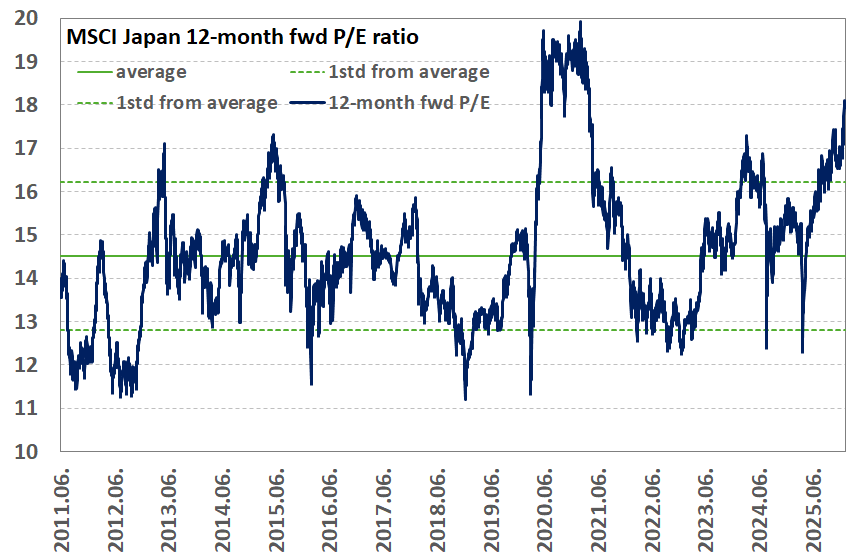
One of the most important issues in the period ahead will not only be the outcome of the early elections in Japan, but it will also be worth watching whether Japanese bond yields continue to rise and, if so, whether this could force a change in political direction. At the same time, further weakening of the yen could also carry political risks, as the weakness of the currency could increase voter dissatisfaction through its inflationary effects.
Nikkei technical picture
The uptrend is still alive, but in recent days we have seen movements that could bring about a reversal. The upward trend could be damaged by closing below the 51,562 level. If there is no rapid rebound above 53,125 in the coming days, there is a high chance of a reversal. A correction could bring the stock market back to the midpoint of the rise that began in April. Important support levels are therefore only found around 43750 and 40625.
Get more out of your investments!
Global Markets Services
OTP Global Markets offers a broad range of services in the field of local and international money and capital markets.
Read morePrivate Banking Services
Personal care and expertise with OTP Private Banking, along with the knowledge, security, and innovations of a multinational banking group.
Read more