
Investors in South Korea were thoroughly spooked
Related content
US bank shares fell
The third-quarter earnings season in the US has picked up pace following the release of the latest figures from US banks. Based on preliminary expectations, the third quarter is likely to have closed with strong earnings growth for S&P 500 companies, led by the energy and technology sectors. The major US banks have still achieved solid growth on an annual basis, indicating that their operations remain strong, but the pace has clearly slowed in many cases, which has tended to result in negative share price reactions.
Commodities - Technical Analysis
Gold and silver continued their downward trend, bouncing off key levels. Until their downward trends are broken, they will not be able to produce a significant rise. The fall in oil prices reversed from the $87.5 level and began a slight upward movement. Natural gas remained in an uptrend; a significant rise could even occur if it breaks out upwards. The price of copper has become stuck in a wider range, so the oversold and overbought zones may offer more favourable trading opportunities. The falling prices of wheat and corn have reached key support levels; a buying reaction from these levels could present favourable long opportunities with limited risk.
By the end of April, the South Korean stock market had fully recovered from the decline caused by the escalating conflict in Iran, and the index subsequently hit a series of new highs. However, the Kospi’s rise temporarily stalled after a local politician suggested that South Korea could return the additional tax revenue generated by the artificial intelligence industry to the public in the form of dividends. The suggestion was quickly clarified to state that there was no question of a windfall tax on corporate profits. The Kospi then surged to a new high, approaching the 8,000-point level. Although the index has been setting new highs in recent times, trading volume has also been gradually declining, which may indicate a weakening trend. Valuations are not stretched, but among the potential risks, in addition to the effects of the war in Iran, concentration risk is also worth mentioning, as Samsung and chipmaker SK Hynix have played a prominent role in the index’s rising market capitalization recently.
Could the South Korean stock market take the top spot this year?
At the beginning of the year, the Korean stock market rose as if on rails. Although the escalation of the conflict with Iran temporarily halted the rally in early March, by mid-May the Kospi had put the correction behind it and was hitting new highs one after another. With an 89% rise so far this year, the Kospi is the best-performing stock index globally.
Major brokerage firms have also been updating their price targets one after another: Goldman Sachs raised its Kospi target to 9,000 points in early May, just three weeks after raising it to 8,000 points. Citigroup also took action, raising its target to 8,500, while JP Morgan’s latest optimistic scenario for the South Korean stock market already included a 10,000-point target, which it justified, among other things, by improvements in the semiconductor industry cycle and corporate governance reforms.
By the end of April, the total market capitalization of the South Korean stock market had risen above $4 trillion, surpassing even the United Kingdom in terms of market capitalization. Just a few days later, South Korea’s stock market had also surpassed Canada’s, becoming the world’s seventh-largest stock market, driven largely by rising demand for artificial intelligence-related chips.
The Kospi’s market capitalization reached 6,070 trillion won ($4.2 trillion) in early May; it took the index just over two months to reach this level after the South Korean stock exchange surpassed its previous major milestone (a market capitalization of 5,000 trillion won) at the end of February. It is worth noting, however, that during this period, approximately 80% of the growth in market capitalization was attributable to the shares of two companies: Samsung and the chipmaker SK Hynix.
A politician spooked investors
This may explain why market participants are reacting so sensitively to the news flow regarding these two major South Korean companies. This week, several news stories have unsettled investors. The chief political advisor to the South Korean presidential office recently suggested that the country should develop a national dividend policy that returns the additional tax revenue generated by artificial intelligence industries to the public. This was likely the main reason behind the Korean stock market’s decline on May 12, with the Kospi’s market capitalization falling by approximately $300 billion in just under two hours.
Given this, it’s no wonder that the advisor was quick to clarify that the funds would come from the additional tax revenue generated by the artificial intelligence boom, and that there was no question of a windfall tax on corporate profits. Following this, the South Korean stock market was able to recoup some of its earlier losses. The sensitivity of the issue was underscored by the fact that shortly thereafter, the South Korean president also commented on social media regarding this matter, emphasizing that the advisor’s argument pertained exclusively to higher taxes on excess profits, not to corporate profits themselves.
The presidential adviser’s suggestion is by no means merely theoretical, given that the recent AI boom has sparked debates regarding the potential distribution of corporate profits. Chipmaker SK Hynix’s decision last year to allocate a portion of its operating profit to employees in the form of bonuses could serve as a model for other companies; however, some commentators also note that this could have an impact on the companies’ long-term competitiveness.
Samsung employees also want a larger share of the profits: at the end of April, tens of thousands gathered outside one of the company’s chip manufacturing plants, demanding that workers receive a larger share of the profits generated by the AI boom. Samsung’s labor union would allocate 15 percent of operating profit to employees in the chip manufacturing division (which, according to preliminary industry calculations, could amount to an average of about $400,000 per employee). Management was unable to reach an agreement with the union at that time, and the union subsequently threatened an 18-day strike by the end of May.
By mid-May, the company still failed to reach an agreement with the largest labor union, which estimates that an 18-day strike could affect ~40,000 workers and cost Samsung approximately $20 billion (about 11% of this year’s expected net profit). Although the government could, in principle, intervene, and the Ministry of Labor could temporarily suspend the strike if its scale were to have a detrimental effect on the economy, commentators suggest that such a move would carry significant political risks.
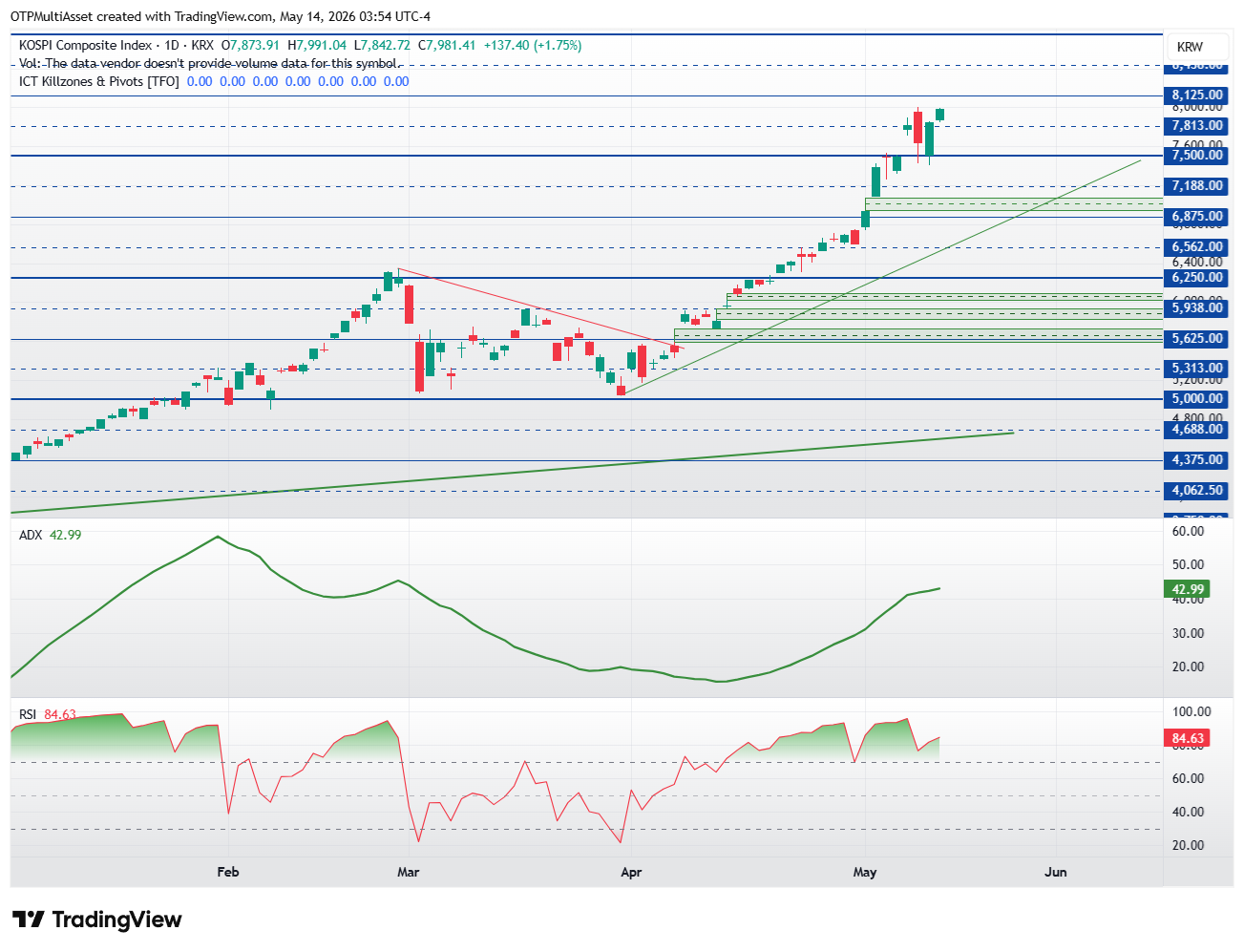
After a brief dip, the Kospi hit a new high
In addition to the significant gains seen in recent months, it is also worth noting that forward earnings expectations continue to rise sharply for both the MSCI Korea Index and the two largest components of the EWY – iShares MSCI South Korea ETF (Samsung and SK Hynix), which tracks the South Korean stock market. Valuations are also not stretched: the MSCI Korea Index’s forward P/E ratio of 7.69 is lower than that of the MSCI Emerging Markets Index (11.88) and the MSCI ACWI Index (17.97).
The risk associated with market concentration remains, and the performance of chipmakers SK Hynix and Samsung will be a key factor in determining whether the South Korean stock market will continue to rise. In the context of the conflict in Iran, rising energy prices are increasing production costs for chipmakers and their suppliers, who are heavily dependent on energy imports. Disruptions to oil and gas shipments also pose a risk to supply chains. In Samsung’s case, there is also the possibility of a strike, in response to which the company may consider modifying its chip manufacturing processes to minimize operational disruptions.
While the South Korean stock market has risen virtually continuously in recent weeks, and the Kospi has once again managed to reach a new high, trading volume has been gradually declining since March, which may indicate a weakening of the upward trend. Some foreign investors may have reduced their exposure and taken profits, while the role of local retail investors—who had partially missed out on last year’s rally—has become more prominent. Thus, while it is worth keeping the aforementioned risks in mind, the South Korean stock market remains one of the world’s best-performing capital markets for now, and we will continue to closely monitor developments in the local capital market.
Kospi technical picture
The uptrend is still intact and entered an accelerating phase two weeks ago. 8125 could be an important resistance level. A pause or correction may be coming, but this pattern does not yet suggest a sustained trend reversal or a downtrend.
Get more out of your investments!
Global Markets Services
OTP Global Markets offers a broad range of services in the field of local and international money and capital markets.
Read morePrivate Banking Services
Personal care and expertise with OTP Private Banking, along with the knowledge, security, and innovations of a multinational banking group.
Read more