
Investment Outlook Q4 2026
Related content
A constitutional crisis in Poland?
As Poland approaches the 2027 parliamentary elections, political tensions are mounting over disagreements concerning the composition of the Constitutional Tribunal. Moreover, the possibility cannot be ruled out that the governor of the central bank could soon be suspended from office in connection with a separate case, potentially deepening the political divide further. Against this backdrop, following an almost uninterrupted rally in recent months, the Polish stock market appears to be losing momentum, while the zloty has weakened to a three-year low against the euro. The domestic political situation may well have further surprises in store, while the Polish equity market, despite its strong performance so far this year, can no longer be considered particularly cheap.
Investors Shifted Toward Defensive Positions
The sharp correction weighing on technology stocks has so far had a much more limited impact on European markets. In fact, certain sectors are benefiting from the ongoing market rotation, which has been increasingly favoring defensive areas. Pharmaceutical and healthcare companies, in particular, continue to stand out. This week, we take a closer look at Koninklijke Philips, the healthcare technology and medical devices company. Alongside it, BASF, the German chemicals giant, has also moved near the top of our screen. In both cases, the current constructive technical setup has been preceded by an extended period of consolidation, potentially creating attractive opportunities for long positions as the emerging trends begin to take shape.
Despite the energy shocks, economies stayed resilient, stable growth is expected in the developed world. Corporates are experiencing significant - partly AI driven - profit gwoth, which is a strong tailwind for stock markets. However, given the rising risks, it's worth staying selective.
Macro
US economy is resilient to the energy shocks, GDP growth outlook has stabilized around 2%, and the labour market also in a "low-hire, low-fire" mode. The debt trajectory is unsustainable, fiscal policy is loose, the interest burden is rising with above target inflation. For Europe, domestic consumption is expected to remain the growth engine, if energy prices start to normalize, GDP growth could catch up next year. Energy price driven inflation will peak by the end of 2026, second-round effects may remain contained. Fed may hike the base rate 75 bps in the next year, meanwhile the ECB may deliver at least 2 increases this year. We expect short-term rates to fluctuate around 2–2.5% in the euro area and 3-3.5% in the US over the long term, which means 4.5-4.7% range could be the fundamental midpoint for US 10 year bond yield. Hungarian GDP growth is expected to accelerate to 2.5% in 2027 with 2.6% inflation. Further rate cuts will only be possible if Hungarian risk premia continue to decline, themost important catalysts could be the 2027 budget, and the mediumterm fiscal and macroeco outlook. significant depreciation of HUF is unlikely, however the appreciation potential is also limited.
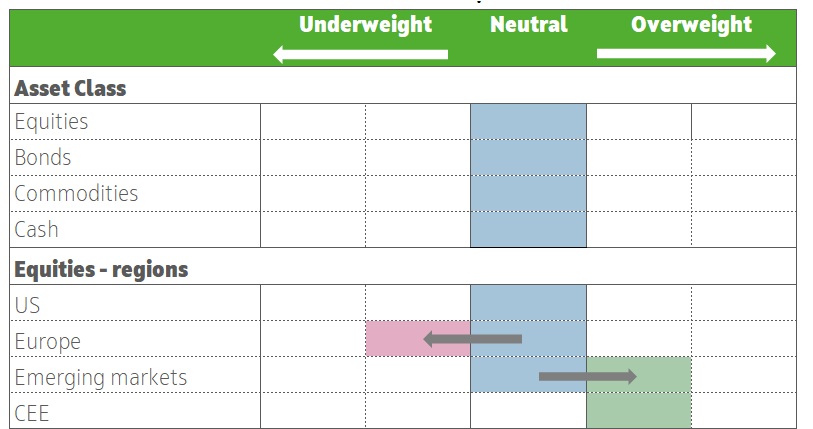
Equities
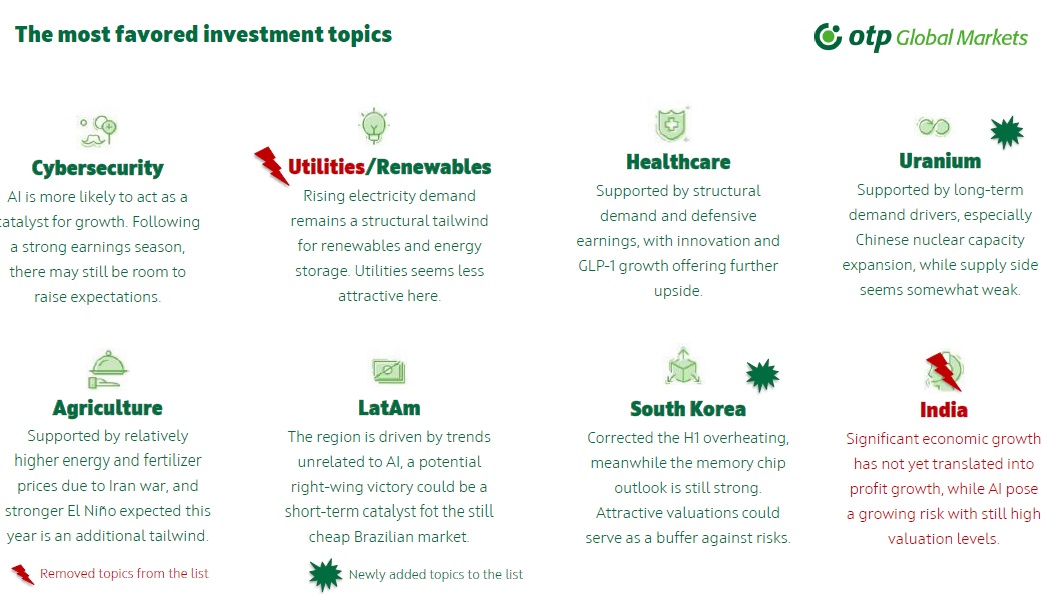
Driven by significant surprises and profit momentum, the stock market — which has been stagnant for months —is beginning to reach increasingly attractive valuation levels. For now, we would recommend taking a wait-and-see approach, as the unpredictable situation in the Strait of Hormuz, further rises in bond yields, the U.S. midterm elections, and new tech IPOs all pose downside risks. It remains advisable to stay selective and take advantage of correction phases to buy stocks. In the US, the semiconductor sector has become less overvalued, meanwhile the outlook is still strong, like the cybersecurity or healthcare sectors’. Meanwhile, Europe faces numerous structural challenges, gas prices may remain elevated for an extended period, corporate margins are low, profit growth is relatively weak, and the valuation discount is also narrowing, which could pose headwinds in the coming months. We favour EM with the unprecedented surge in profits, and attractive valuation levels, driven by the AI related regions, like South Korea. CEE weathered this year’s rise in energy prices relatively well, and in terms of profit growth, valuation, it remains to be one of the most attractive alternative – besides LatAm- without AI exposure.
Bonds
Fundamentally the rise in long bond yields in developed markets is justifiable, although yields higher than current levels are undesirable. Economic policymakers have the tools to temporarily keep the rise in yields in check, but sustained success would require fiscal adjustment. Corporate bond spreads are surprisingly stable and narrow.
Commodities
We maintain a neutral outlook on commodities, as developments in the Middle East conflict remain the key factor here and the outcome is difficult to predict. In a worst-case scenario, energy prices could rise further, but we see better risk/reward elsewhere: we favor physical agricultural commodities and uraniumover the long-term.
Get more out of your investments!
Global Markets Services
OTP Global Markets offers a broad range of services in the field of local and international money and capital markets.
Read morePrivate Banking Services
Personal care and expertise with OTP Private Banking, along with the knowledge, security, and innovations of a multinational banking group.
Read more