
Investment Outlook Q3 2026
Related content
US bank shares fell
The third-quarter earnings season in the US has picked up pace following the release of the latest figures from US banks. Based on preliminary expectations, the third quarter is likely to have closed with strong earnings growth for S&P 500 companies, led by the energy and technology sectors. The major US banks have still achieved solid growth on an annual basis, indicating that their operations remain strong, but the pace has clearly slowed in many cases, which has tended to result in negative share price reactions.
Commodities - Technical Analysis
Gold and silver continued their downward trend, bouncing off key levels. Until their downward trends are broken, they will not be able to produce a significant rise. The fall in oil prices reversed from the $87.5 level and began a slight upward movement. Natural gas remained in an uptrend; a significant rise could even occur if it breaks out upwards. The price of copper has become stuck in a wider range, so the oversold and overbought zones may offer more favourable trading opportunities. The falling prices of wheat and corn have reached key support levels; a buying reaction from these levels could present favourable long opportunities with limited risk.
Strong profit growth remains supportive for equities, which could contribute to a broadening of the market rally beyond the technology sector. However, there are several risk factors, like the hawkish Fed, midterm elections, fragile US-Iran deal, large tech IPOs, and AI return fears, that could lead to increased market volatility. Semiconductors’ long-term fundamentals are still strong, but the sector became overcrowded in the short run, and the good news are already priced in, so we removed the sector from our most favored list. We would still keep AI related exposures, like cybersecurity on the software side, but since the next bottleneck could be the power supply to data centers, we remain optimistic about the utilities and renewable energy sectors, as well as healthcare, which stands to benefit from increasingly advanced AI solutions. As we expect a short term pause in the tech rally, even in the face of a significant profit boom, we would maintain neutral exposure regarding the US and EM regions. Given the normalization of energy prices, capital may shift toward relative laggards, like India, LatAm or the CEE region, which have a much more reasonable valuation and growth characteristics.
Macro
With the reopening of the Strait of Hormuz, the worst-case economic scenario may have been averted. Growth forecasts have stabilized in the US around 2% for both 2026 and 2027, and 0.7% and 1% in the eurozone. Inflation has remained persistently high in the US, with the base of acceleration broadening rather than narrowing. In the eurozone, inflation may hover around 3%, but inflationary pressures are not expected to strengthen over the medium term. As a result, the market has already priced in two interest rate hikes by the Fed this year, and even if the central bank ultimately does not go that far, the hawkish tone is likely to persist in the coming months. The ECB has already implemented one rate hike, and may not need to carry the second one out. Hungarian yield curve still prices in four cuts for this year, even as HUF is already testing the 350 level. We believe that at current levels, the risk distribution for the exchange rate is clearly tilted toward depreciation. However, we do not expect any significant HUF weakening.
Equities
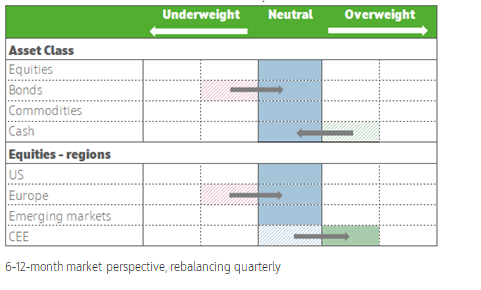
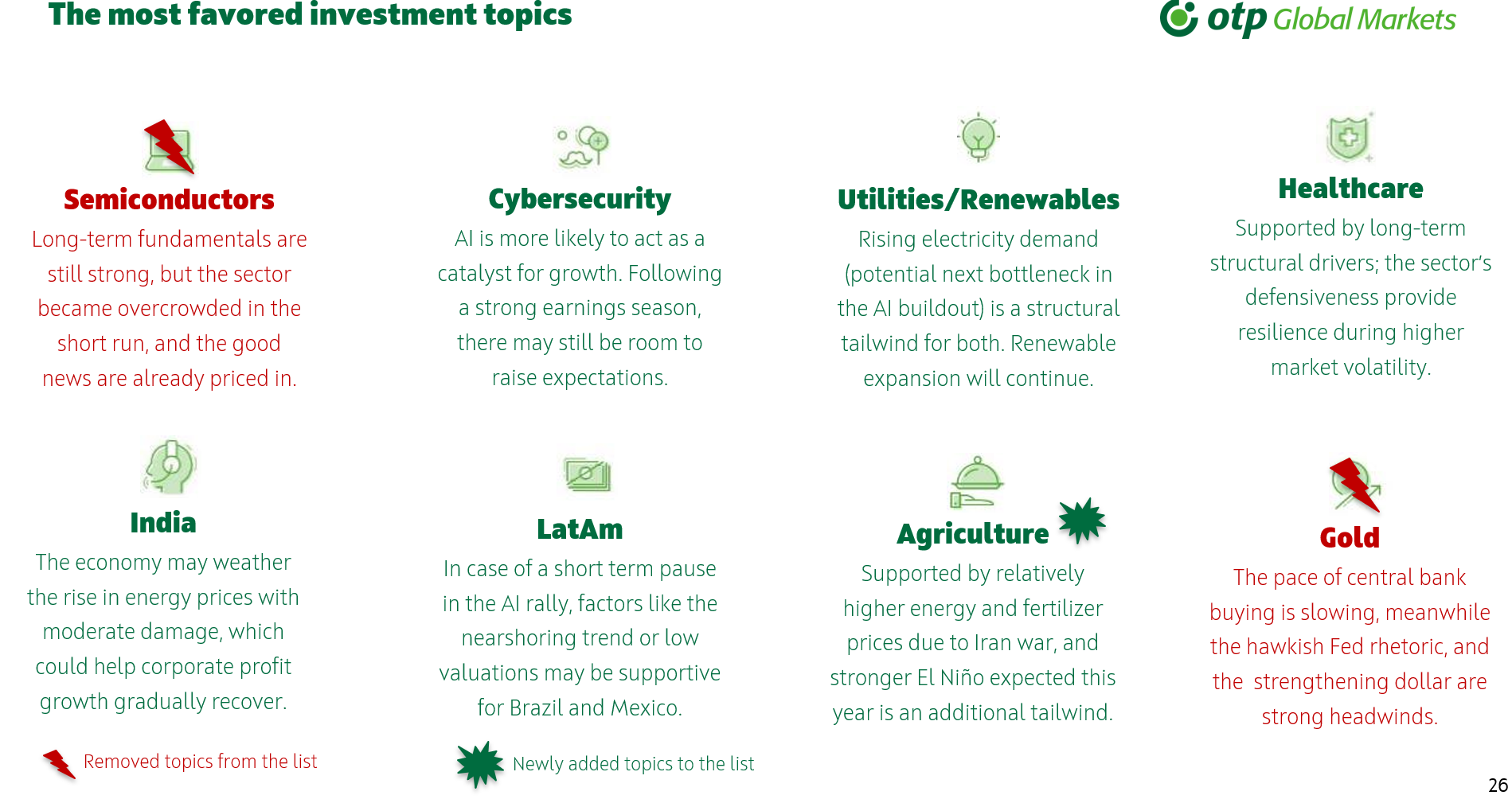
Strong profit growth remains supportive for equities, which could contribute to a broadening of the market rally beyond the technology sector. However, there are several risk factors, like the hawkish Fed, midterm elections, fragile US-Iran deal, large tech IPOs, and AI return fears, that could lead to increased market volatility. Semiconductors’ long-term fundamentals are still strong, but the sector became overcrowded in the short run, and the good news are already priced in, so we removed the sector from our most favored list. We would still keep AI related exposures, like cybersecurity on the software side, but since the next bottleneck could be the power supply to data centers, we remain optimistic about the utilities and renewable energy sectors, as well as healthcare, which stands to benefit from increasingly advanced AI solutions. As we expect a short term pause in the tech rally, even in the face of a significant profit boom, we would maintain neutral exposure regarding the US and EM regions. Given the normalization of energy prices, capital may shift toward relative laggards, like India, LatAm or the CEE region, which have a much more reasonable valuation and growth characteristics.
Bonds
The rapid normalization of energy prices is helping to mitigate inflation risks, which is why it is recommended to maintain a neutral position on long-term bonds rather than underweighting them as before. Long bond yields in both the US and the eurozone are currently within what is considered a fair range in the current macro environment.
Commodities
We maintain our neutral view on commodities, as the conflict in the Middle East is still not resolved. As with energy prices, we expect that even if a peace agreement is reached, fertilizer prices may remain relatively higher, which coupled with a stronger El Nino, provide a tailwind for agricultural commodities. We removed gold from our favored list, as the pace of central bank buying is slowing, meanwhile the hawkish Fed rhetoric, and the strengthening dollar are strong headwinds.
Get more out of your investments!
Global Markets Services
OTP Global Markets offers a broad range of services in the field of local and international money and capital markets.
Read morePrivate Banking Services
Personal care and expertise with OTP Private Banking, along with the knowledge, security, and innovations of a multinational banking group.
Read more