
Institutional Investors Still Bullish on CEE
Related content
US bank shares fell
The third-quarter earnings season in the US has picked up pace following the release of the latest figures from US banks. Based on preliminary expectations, the third quarter is likely to have closed with strong earnings growth for S&P 500 companies, led by the energy and technology sectors. The major US banks have still achieved solid growth on an annual basis, indicating that their operations remain strong, but the pace has clearly slowed in many cases, which has tended to result in negative share price reactions.
Commodities - Technical Analysis
Gold and silver continued their downward trend, bouncing off key levels. Until their downward trends are broken, they will not be able to produce a significant rise. The fall in oil prices reversed from the $87.5 level and began a slight upward movement. Natural gas remained in an uptrend; a significant rise could even occur if it breaks out upwards. The price of copper has become stuck in a wider range, so the oversold and overbought zones may offer more favourable trading opportunities. The falling prices of wheat and corn have reached key support levels; a buying reaction from these levels could present favourable long opportunities with limited risk.
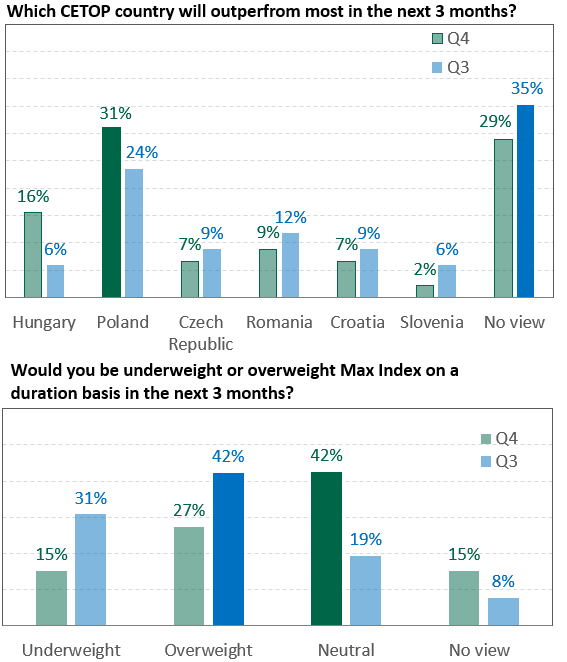
Over 30 senior financial professionals, active in CEE markets and managing more than EUR 6.5 billion in assets under direct control, participated in our Institutional Investor Survey. Here, we highlight the most notable insights.
Respondents taking higher risk relative to benchmark in equities and favoring EM and CEE exposures over the next 3 months. Institutional sentiment on CETOP country performance shows a clear rotation in expectations. Poland strengthens as the top pick for outperformance, while Hungary also gains traction.
The survey shows a clear shift toward neutrality on Max Index duration positioning as participants weigh two offsetting forces: (1) the government’s decision to raise the budget deficit target, which pushed yields higher from early November and increased perceived risk, and (2) elevated purchases of government bonds by Hungarian banks to reduce extra profit tax, which supported the demand side and helped stabilize yields.
Get more out of your investments!
Global Markets Services
OTP Global Markets offers a broad range of services in the field of local and international money and capital markets.
Read morePrivate Banking Services
Personal care and expertise with OTP Private Banking, along with the knowledge, security, and innovations of a multinational banking group.
Read more