
India is also affected by the war in Iran
Related content
Hungary: Despite the lower-than-expected headline inflation data the picture is not as rosy as it first appears
Hungary's headline inflation increased to 1.6% year-on-year in September from 1.3% in August. The published data was lower than the consensus and our forecast (both 1.8%). The lower-than-expected inflation was due to above expectation core inflation but a bigger than expected decline in food prices and a decrease in administered prices.
Commodities - Technical Analysis
Gold and silver continued their correction and even dropped below key support levels, so it’s best to postpone buying for now. The price of oil has narrowed significantly between the $87.50 level and the trend line, so any significant movement will likely require a breakout from this zone. Natural gas has retested its uptrend line, but buyers continue to show strength.Copper appears to be developing a broader trading range, making oversold and overbought zones potentially more attractive for trading opportunities. Wheat and corn continue to trade in a correction phase, while moving closer and closer to their key support levels.
Indian stock markets plummeted in early March after it became apparent that India could be one of the relative losers of the war in Iran. The country meets nearly 90 percent of its oil needs through imports, half of which came from Middle Eastern countries and, prior to the conflict, passed entirely through the Strait of Hormuz. Although India has taken steps toward diversification, if oil prices remain persistently high, this could have an impact through multiple channels, potentially reducing GDP growth while driving up inflation.
India is adversely affected by the conflict in Iran and the risk of disruptions to oil supplies, as the country meets nearly 90 percent of its oil needs through imports. About half of India’s oil imports came from Middle Eastern countries, and prior to the war, all of these shipments passed through the Strait of Hormuz. According to the government, oil supplies are currently secure, as approximately 70 percent of the country’s oil imports were already coming from outside the Strait of Hormuz by mid-March.
India meets about 50 percent of its natural gas consumption through imports, so the disruption in Qatari production will also have a negative impact on India, as about half of India’s LNG imports came from there. At the same time, more than half of India’s energy supply still comes from coal, and the country is expected to increase its coal-based electricity consumption to meet summer demand amid supply issues caused by the conflict in the Middle East. In response to the conflict, gas supplies were redirected from non-priority sectors to key consumers after liquefied natural gas (LNG) shipments through the Strait of Hormuz were disrupted. In addition, refineries were ordered to increase LPG production and reduce industrial sales to avoid shortages for household LPG users. India previously imported about 60 percent of its LPG needs from Persian Gulf countries, and according to India’s Minister of Petroleum and Natural Gas, procurement sources have now been diversified.
Following the escalation of the crisis in the Middle East, India has also proposed the establishment of an economic stabilization fund, which would provide financial flexibility to support the economy. The planned fund, amounting to 573 billion rupees ($6.2 billion), will also help the government manage unexpected disruptions in supply chains and unexpected shocks affecting the Indian economy. In addition, measures considered to protect exporters include extending the deadline for exporters to repatriate proceeds from overseas sales, relaxing rules on bank overdrafts, and introducing a moratorium on loan repayments.
How might the conflict affect India?
According to government sources, India has sufficient oil reserves to weather the short-term impacts; however, if oil prices remain above $100 for an extended period, the negative effects on inflation and trade could become more significant. In 2022, oil prices rose sharply due to the Russia-Ukraine conflict; the government then cut the excise tax on fuels so that state-owned fuel retailers could keep prices stable despite higher costs.
For India, a net oil importer, rising oil prices could have an impact through multiple channels: according to UBS’s projections, a $10 average increase in oil prices (per bbl.) could reduce GDP growth by ~15 basis points if the costs of higher fuel prices were passed on to consumers, inflation could rise by 30 basis points, while the current account deficit could increase by 0.4% of GDP. An oil price of $100 (if high oil prices persist) could hold back India’s real GDP growth by 0.3–0.4 percentage points, while annual headline inflation could rise to 5 percent if the rise in oil prices is fully reflected in prices (and the excise tax rate remained unchanged).
Gasoline and diesel prices have not changed for the time being, and following U.S. approval, Indian refiners purchased approximately 30 million barrels of Russian crude oil, thereby easing the pressure on the country’s energy needs and trade balance. Following the rise in oil prices in 2022, India has already taken steps to diversify its oil supplies: Russia is the largest supplier of India’s oil imports, and following the escalation of the Iranian crisis, the United States allowed India to temporarily increase its imports of Russian oil. It is worth noting that the U.S. had previously imposed high import tariffs on India, partly as a punishment for its purchases of Russian oil. Recently, it appeared that a trade agreement between the U.S. and India might be reached, under which U.S. tariffs on India were eased, and India subsequently reduced its purchases of Russian oil.
How might all this affect the Indian stock market?
The Indian stock market index fell by more than 10 percent from its levels at the start of the year by mid-March, and after a tentative attempt at a rebound, another decline followed. The rupee also weakened against the dollar, with the USDINR reaching a new high, while India’s foreign exchange reserves fell by the largest margin since November 2024, after the central bank likely intervened to curb the rupee’s decline during the first week of the war.
Possible government interventions could include reducing the excise tax on fuel; the government may attempt to cushion the impact of price increases for a time before passing the burden on to households. If oil prices remain high, pressure could also mount on consumer discretionary companies, airlines, chemicals, the cement industry, and the logistics sector, where higher costs could, among other things, squeeze corporate margins.
The valuation of the MSCI India Index has declined since early March (12-month forward P/E of 19.49), but remains higher than the MSCI Emerging Markets Index’s P/E ratio of 12.06. There has been no sign of a decline in the Indian index’s forward-looking earnings estimates, which continue to rise.
While, given the current state of the Middle East conflict, it appeared that Brazil could be one of the relative winners of rising oil prices due to the war in Iran, India, however, could be among the relative losers, since it covers approximately 90% of its oil needs and nearly half of its LNG needs through imports. So far, the market seems to have priced in a scenario where the Middle East conflict could be resolved in the foreseeable future and oil prices would not remain persistently high. If this were not the case, however, it could trigger further corrections in Indian stock markets in the near future. The energy shock linked to the war in Iran is casting a shadow over the outlook: higher fuel prices, household and industrial gas shortages, and shipping disruptions in the Middle East are likely to offset the benefits to India from the lower U.S. tariffs in effect since mid-February.
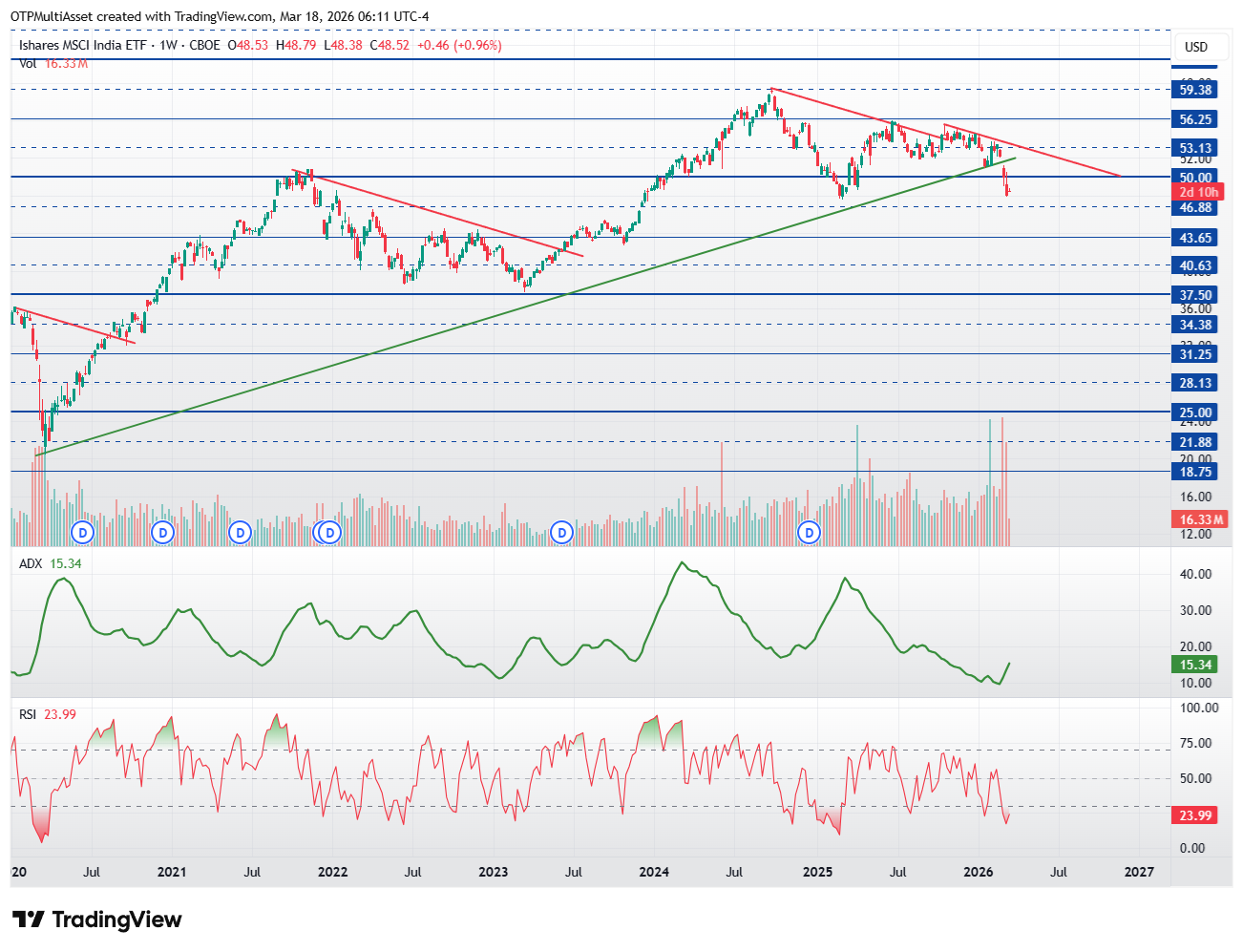
INDA - iShares MSCI India ETF technical picture
The uptrend broke two weeks ago, triggering a sharp decline; the trend is now bearish. Resistance is forming around the 53 level; a break above this level could reverse the downtrend, but the likelihood of that happening is currently low. The decline could continue toward the 43.7 level, where the chart previously broke the previous downtrend. It may be wise to wait before buying.
Get more out of your investments!
Global Markets Services
OTP Global Markets offers a broad range of services in the field of local and international money and capital markets.
Read morePrivate Banking Services
Personal care and expertise with OTP Private Banking, along with the knowledge, security, and innovations of a multinational banking group.
Read more