
India: A Changing Economy and Society
Related content
US bank shares fell
The third-quarter earnings season in the US has picked up pace following the release of the latest figures from US banks. Based on preliminary expectations, the third quarter is likely to have closed with strong earnings growth for S&P 500 companies, led by the energy and technology sectors. The major US banks have still achieved solid growth on an annual basis, indicating that their operations remain strong, but the pace has clearly slowed in many cases, which has tended to result in negative share price reactions.
Commodities - Technical Analysis
Gold and silver continued their downward trend, bouncing off key levels. Until their downward trends are broken, they will not be able to produce a significant rise. The fall in oil prices reversed from the $87.5 level and began a slight upward movement. Natural gas remained in an uptrend; a significant rise could even occur if it breaks out upwards. The price of copper has become stuck in a wider range, so the oversold and overbought zones may offer more favourable trading opportunities. The falling prices of wheat and corn have reached key support levels; a buying reaction from these levels could present favourable long opportunities with limited risk.
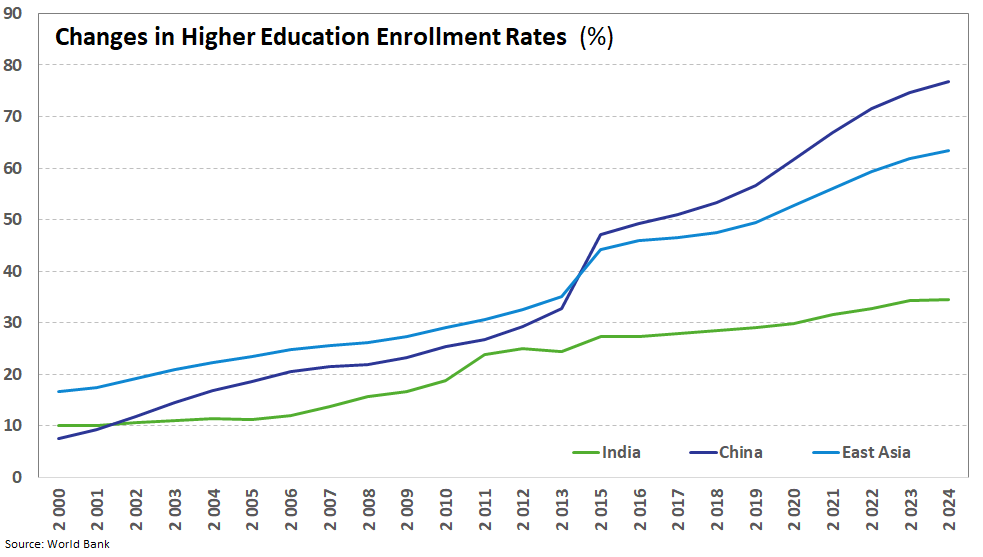
We are taking a closer look at India—which is also featured in our Investment Outlook—in a multi-part analysis. In our most recent installment, we examined the major stages of development following the country’s independence; now, in addition to the changes in India’s economic structure, we are focusing on the country’s demographics. On the positive side: India is the world’s most populous country, yet the median age is significantly lower than in China, for example. According to plans, India is set to be transformed into a developed economy by 2047, and education will play a key role in this, as the country aims to increase the number of students enrolled in higher education over the coming years.
The economic structure has undergone significant changes
Several factors may have played a key role in the growth of the Indian economy: the ratio of trade turnover to GDP showed strong growth from the early 1990s to the mid-2000s, and the country also benefited from an increase in its working-age population; the proportion of the working-age population rose by more than ten percentage points between 1970 and 2016. In addition to the rise in savings and investment rates seen through the late 2000s, the country’s financial development may also have supported growth.
The structure of India’s GDP has undergone significant changes over the years; according to World Bank data, the value added by agriculture as a percentage of GDP hovered around 40% in the early 1970s, then fell to as low as 16% by 2024 following a long, steady decline. The share of industry in GDP rose from approximately 21% to over 24% during the same period.
However, the share of services in GDP has grown significantly: it rose from 35% in 1970 to approximately 50% by 2024. The share of services in India’s GDP has risen during most of the decades since the country’s independence; starting in the 1980s, the steady acceleration of economic growth was largely driven by the expansion of the services sector. The rise in the share of services within GDP truly accelerated in the early 1990s. According to the World Bank, the extremely rapid growth of India’s service sector was largely driven by modern services—including financial services, telecommunications, and the IT sector. India was one of the preferred destinations for outsourcing by major global corporations.
Changes in Foreign Trade
It’s worth taking a closer look at India’s foreign trade data: according to statistics from India’s Ministry of Commerce and Industry, petroleum and fuels, along with their refined products, accounted for ~12% of the country’s exports (in the 2025–2026 fiscal year), while exports of electrical equipment and components were of a similar magnitude. At that time, the three most important countries for Indian exports were the United States, the United Arab Emirates, and the Netherlands. The U.S. is the most important export market, with a share of nearly 20%.
Based on available data, India’s most important import was crude oil, which accounted for approximately 17% of imports during the period in question; precious metals (gold) were also a significant import. In terms of imports, the three most important countries were China, the United Arab Emirates, and Russia, with China playing the most significant role, accounting for nearly 17% of imports.
Although India previously sourced most of its crude oil from the Middle East, the share of Russian oil in India’s imports rose following the Russia-Ukraine war. The United States later imposed high tariffs on India, partly due to its purchases of Russian oil. India later agreed to halt its purchases of Russian oil in exchange for lower tariffs, but the war in the Middle East intervened. Following the escalation of the conflict in Iran, India significantly expanded its oil import sources by the end of March, and now sources more than two-thirds of its oil imports from outside the Strait of Hormuz.
Favorable demographics could provide a tailwind for the economy
Several factors contributed to the expansion of India’s service sector: demand for services grew among both domestic and foreign consumers, and the reforms implemented in India during the 1990s, as well as technological advancements, likely played a role. The growth of India’s service exports was aided by global companies’ outsourcing and offshoring activities, as firms initially shifted certain back-office operations to India to cut costs. Over the past decade, however, these units have become increasingly specialized and have moved up the value chain.
In terms of growth in service exports between 2005 and 2023, India was among the fastest-growing countries, surpassed only by Singapore and Ireland during the period under review. Goldman Sachs expects higher real GDP in the medium term driven by the growth of India’s service exports; under a positive scenario, service exports could account for more than 12 percent of GDP by 2030.
Domestic consumption accounts for about 60 percent of GDP, and favorable demographic trends could provide a tailwind for the economy in the coming years. With a population of more than 1.4 billion, India has now become the world’s most populous country (surpassing China in the early 2020s). Although the country’s population is expected to continue growing over the next thirty years, the pace of growth has already slowed significantly, and some projections suggest that India’s population may peak in the early 2060s.
In 2024, the median age in India was under 30, which is significantly lower than the median ages in the United States and China. Approximately 67% of India’s population is between the ages of 15 and 64, while 7% is over 65 (compared to significantly higher proportions of people over 65 in the U.S. and Europe). The proportion of India’s working-age population relative to the total population is projected to reach its peak by 2030, approaching 70%, which would represent more than one billion people of working age.
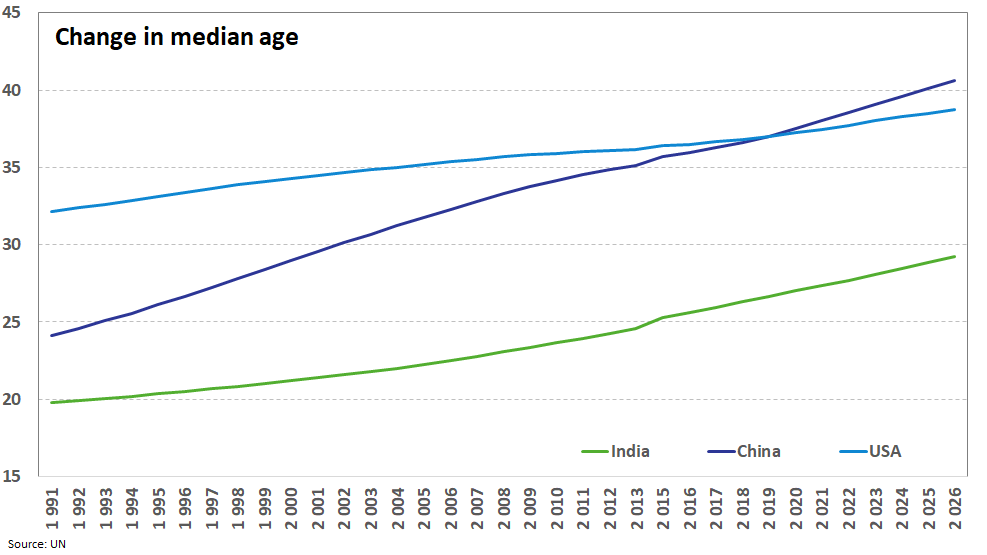
India’s relatively young population could give the country a competitive advantage in the labor market, and it is also expected to provide an opportunity for these favorable demographics to drive growth in consumption. India remains one of the world’s youngest countries, with the largest working-age population; the median age in India is expected to be 31 in 2030 (which is significantly lower than the projected median ages in China and the United States).
After the country gained independence, the education system and its development took on an important role: general and compulsory education for children aged six to fourteen was enshrined in the constitution, and in the early 2000s, primary education was made a fundamental right for this age group. The literacy rate in India did not even reach 20 percent in the early 1950s following the country’s independence, but by the early 2010s it had exceeded 70 percent, although it is worth noting that the population more than tripled during this period.
In the early 2020s, more than half of those over 60 were illiterate, but among people in their 20s, the illiteracy rate was in the single digits. The proportion of the population with a higher education degree has steadily increased in recent years, though the growth has not been uniform. By 2020, 24% of the urban population held a higher education degree (the rate was only 10% in the late 1980s), but among the rural population, this rate was only 7%.
For India, education (and human capital) plays a key role in achieving the goal of transforming India into a developed market economy by 2047. One of the objectives of the 2020 National Education Policy is for the gross enrollment rate (GER) in higher education to reach 50 percent by 2035. In 2020, this rate was slightly over twenty-five percent and has continued to rise since then. Progress in this area is evident in the longer term, yet India’s lag behind China (and the entire East Asian region) is apparent.
Get more out of your investments!
Global Markets Services
OTP Global Markets offers a broad range of services in the field of local and international money and capital markets.
Read morePrivate Banking Services
Personal care and expertise with OTP Private Banking, along with the knowledge, security, and innovations of a multinational banking group.
Read more