
The base rate was left at 6.5%; the MNB remains committed to tight monetary policy; we expect two 25-basis-point cuts in 2026H2
Related content
US bank shares fell
The third-quarter earnings season in the US has picked up pace following the release of the latest figures from US banks. Based on preliminary expectations, the third quarter is likely to have closed with strong earnings growth for S&P 500 companies, led by the energy and technology sectors. The major US banks have still achieved solid growth on an annual basis, indicating that their operations remain strong, but the pace has clearly slowed in many cases, which has tended to result in negative share price reactions.
Commodities - Technical Analysis
Gold and silver continued their downward trend, bouncing off key levels. Until their downward trends are broken, they will not be able to produce a significant rise. The fall in oil prices reversed from the $87.5 level and began a slight upward movement. Natural gas remained in an uptrend; a significant rise could even occur if it breaks out upwards. The price of copper has become stuck in a wider range, so the oversold and overbought zones may offer more favourable trading opportunities. The falling prices of wheat and corn have reached key support levels; a buying reaction from these levels could present favourable long opportunities with limited risk.
The decision: As expected, the MNB’s Monetary Council left the base rate at 6.5% at its November meeting. The MNB insists on maintaining a cautious and patient monetary policy approach and achieving price stability in a sustainable manner. Its forward guidance remained tight.
The MNB's key messages:
A cautious and patient approach remains warranted. The inflation target can be achieved in a sustainable manner under tight monetary conditions. The MNB contributes to achieving the inflation target by ensuring a positive real interest rate.
Price cap measures have had a significant disinflationary effect; however, underlying processes remain strong. Inflation expectations have slightly decreased but continue to stay at a high level.
Maintaining stability in the foreign exchange market is crucial; a stronger forint supports disinflation. The impact of the stronger forint since the beginning of the year is increasingly reflected in purchase prices, while the disinflationary effect may be slower to appear in consumer prices. Repricing at the beginning of next year will be particularly important.
Market reactions:
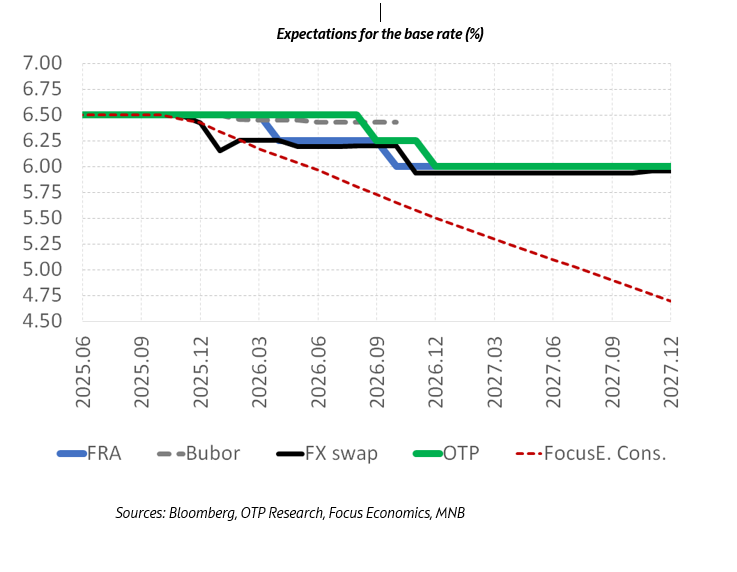
The decision was in line with expectations, therefore market rection was limited. The HUF appreciated around the time of the decision, in line with some USD weakness, but the hawkish tone of the MNB may have also played a role. Bond and IRS yields rose by 5 bps before the decision, then fell in the afternoon, in line with core fixed income markets. Since this Monday, FRAs have been pricing only 25-bps cuts looking ahead: one in Q2 and one in Q4 2026.
Before the decision: No rate change was foreseen
Market consensus and OTP Research both expected the base rate to remain at 6.5%, its level since September 2024, as neither external nor domestic processes support interest rate cuts in the near future.
In developed markets, interest rate cut expectations weakened in the past month and yields were in an uptrend, after the Fed’s warning that the December interest rate decision is not a foregone conclusion, as essentially none of the important data on the US economy have been received, owing to the government shutdown. In Europe, growth is slightly stronger and inflation is higher than expected, and now the market finds it likely that the ECB will refrain from interest rate cuts next year as well.
Interest rate cut expectations have also weakened somewhat in Hungary: the market was pricing in two 25-basis-point rate cuts next year and one in 2027. In October, the rate of inflation remained at 4.3%, for the fourth month in a row, whereas a modest uptick was expected. However, underlying inflation indicators rose – although the beneficial effect of the strong forint is still felt in food and goods inflation, services inflation has accelerated. The third-quarter GDP data still pointed to a stagnant economy. In money markets, the forint appreciated by 1%, pushing the EUR/HUF to 384, but bond yields picked up on the back of the raised deficit targets and market confusion surrounding the ‘financial shield’ mentioned after the meeting of President Donald Trump and PM Viktor Orbán in Washington.
Our assessment:We have revised our inflation projections for 2026 lower, following the appreciation of the HUF. Just like in our October report, we expect two 25-basis-point cuts in 2026H2, assuming that repricing activity remains contained early next year and the election-driven uncertainty around fiscal policy will be reduced
Because of the even stronger HUF and the recently announced new margin caps (on certain seasonal food items), we lowered our 2026 inflation forecast from 3.6% to 3.4%, while the forecast for 2025 was left unchanged at 4.5%. We think inflation will probably sink below the 3% target temporarily at the beginning of 2026 because of the delayed excise duty hikes, the expected very low re-pricing in administered prices, the strong HUF (vs the EUR), and a significant drop of the oil prices measured in HUF. But incoming data suggest that inflation persistence has still not been satisfactorily broken, so the central bank's caution remains warranted. This is especially true if we take into account that a double-digit minimum wage hike is expected at the beginning of next year, and several consumption-targeted government measures will only come into effect in the coming months.
As the central bank remains strongly committed to maintaining stability in the foreign exchange market and the government’s price control measures continue to play a significant role in inflation developments, we do not expect interest rate cuts in the coming months, despite the favourable inflationary trends and the stronger forint. If the coming months confirm that the deterioration seen in October in the underlying inflation indicators was only temporary, and repricing at the beginning of next year will also be moderate, then a window of opportunity for rate cuts might open in second half of 2026.
Get more out of your investments!
Global Markets Services
OTP Global Markets offers a broad range of services in the field of local and international money and capital markets.
Read morePrivate Banking Services
Personal care and expertise with OTP Private Banking, along with the knowledge, security, and innovations of a multinational banking group.
Read more