
Hungary: CPI stagnated at 4.3% for the fourth month in a row
Related content
US bank shares fell
The third-quarter earnings season in the US has picked up pace following the release of the latest figures from US banks. Based on preliminary expectations, the third quarter is likely to have closed with strong earnings growth for S&P 500 companies, led by the energy and technology sectors. The major US banks have still achieved solid growth on an annual basis, indicating that their operations remain strong, but the pace has clearly slowed in many cases, which has tended to result in negative share price reactions.
Commodities - Technical Analysis
Gold and silver continued their downward trend, bouncing off key levels. Until their downward trends are broken, they will not be able to produce a significant rise. The fall in oil prices reversed from the $87.5 level and began a slight upward movement. Natural gas remained in an uptrend; a significant rise could even occur if it breaks out upwards. The price of copper has become stuck in a wider range, so the oversold and overbought zones may offer more favourable trading opportunities. The falling prices of wheat and corn have reached key support levels; a buying reaction from these levels could present favourable long opportunities with limited risk.
Hungary's headline inflation stagnated at 4.3% year-on-year (YoY) for the third consecutive month. This figure matched our forecast, but it was slightly below the market consensus (4.4%). Food inflation, especially seasonal food inflation was lower, but service inflationand alcohol beverages’ inflation were higher than we had forecasted.
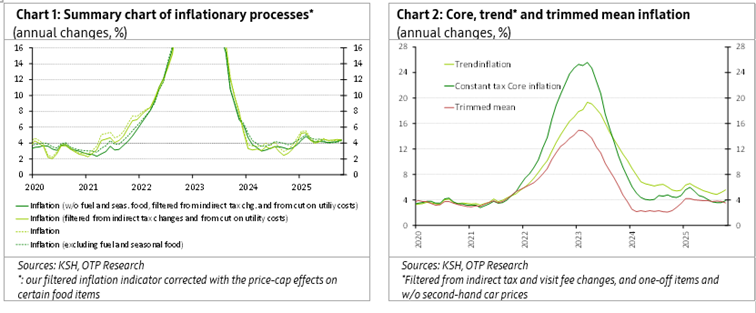
Underlying indicators accelerated in October. The MNB’s constant tax core inflation increased from 3.6% to 3.9% YoY while sticky price inflation accelerated from 5.1% to 5.3% YoY. The MNB’s core inflation without processed food inflation and the profit margin cap’s effect measure has also increased and clearly stuck above 5% YoY. The latter underlying indicator of the MNB is very similar to our trend inflation indicator, but it still contains the mainly backward-looking pricing of telecom and financial services, which are also affected by the "voluntary" price freezes proposed by the government. Hence, we think our trend inflation indicator is the better underlying gauge in the current environment as it does not contain telecommunication and financial services, therefore it is not affected by any administrative measures. The annualized MoM change of our trend inflation indicator decreased from 6.5% to 5% (see Chart 11), but we should highlight that the unusually low seasonal drop in the prices of trips abroad lifted the September figure about by 3 ppts. Taking into the account this fact, our trend inflation indicator also accelerated in October, from around 3.5% (6.5% less 3%) to 5%. This acceleration was clearly a consequence of the development of service inflation, as annualized MoM service inflation without telecom and financial services accelerated from 7.5% to 9% in October. It is the highest figure since April 2025.
The positive development of food inflation helped a lot to keep the headline CPI stable in recent months. Our food inflation indicator (see Chart 10), which filters out the impact of profit margin caps and excludes volatile seasonal foods, has shown a clear improvement since early spring 2025. In addition, seasonal food’s inflation – which is much more volatile than the previously mentioned food price category and it kept the total food inflation around 4% during the summer – has also helped in recent months, as the seasonally adjusted price level of seasonal foods (fruit, vegetables, potatoes) has fallen by 4% over the past two months.
Because of the even stronger HUF and the recently announced new margin caps (on certain seasonal food items), we lowered our 2026 inflation forecast from 3.6% to 3.4%, while the forecast for 2025 was left unchanged at 4.5%. We think inflation will probably sink below the 3% target temporarily at the beginning of 2026 because of the delayed excise duty hikes, the expectedly very low re-pricing in administered prices, the strong HUF (vs the EUR), and a significant drop of the oil prices measured in HUF. But incoming data suggest that inflation persistence has still not been satisfactorily broken, so the central bank’s caution remains warranted. This is especially true if we take into account that a double-digit minimum wage hike is expected at the beginning of next year, and several consumption-targeted government measures will only come into effect in the coming months.
If the coming months confirm that the deterioration seen in October in the underlying inflation indicators was only temporary, and repricing at the beginning of next year will also be moderate, then a window of opportunity for rate cuts might open in second half of 2026.
Get more out of your investments!
Global Markets Services
OTP Global Markets offers a broad range of services in the field of local and international money and capital markets.
Read morePrivate Banking Services
Personal care and expertise with OTP Private Banking, along with the knowledge, security, and innovations of a multinational banking group.
Read more