
Hungary: Another low inflation print ahead of the energy price shock
Related content
US bank shares fell
The third-quarter earnings season in the US has picked up pace following the release of the latest figures from US banks. Based on preliminary expectations, the third quarter is likely to have closed with strong earnings growth for S&P 500 companies, led by the energy and technology sectors. The major US banks have still achieved solid growth on an annual basis, indicating that their operations remain strong, but the pace has clearly slowed in many cases, which has tended to result in negative share price reactions.
Commodities - Technical Analysis
Gold and silver continued their downward trend, bouncing off key levels. Until their downward trends are broken, they will not be able to produce a significant rise. The fall in oil prices reversed from the $87.5 level and began a slight upward movement. Natural gas remained in an uptrend; a significant rise could even occur if it breaks out upwards. The price of copper has become stuck in a wider range, so the oversold and overbought zones may offer more favourable trading opportunities. The falling prices of wheat and corn have reached key support levels; a buying reaction from these levels could present favourable long opportunities with limited risk.
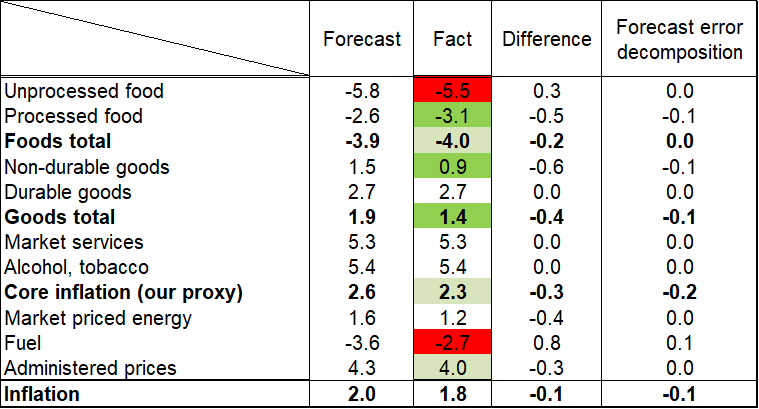
Hungary's headline inflation increased from 1.4% year-on-year in February, to 1.8% in March. The published data came as a surprise as it was lower than both the consensus (2.2%) and our forecast (2%). The downward surprise mostly came from lower-than-expected non-durable goods and processed food inflation, while fuel prices were slightly higher-than-foreseen. Core inflation edged down from 2.1 to 1.9%.· The March data do not yet reflect the impact of the Iran war. Even before the sharp increase in energy prices, we expected inflation to reach its annual low in February, followed by a gradual acceleration. The acceleration in inflation is largely driven by fuels and by the waning disinflationary effect of food prices, although prices in both categories are still declining on a year-on-year basis. By contrast, inflation in goods and services that determine inflation over the longer term eased further. The outlook largely depends on the outcome of the Iran war, in our new baseline we think inflation could be around 3% this year.
In our baseline scenario—where oil remains at USD 90–95 and gas at EUR 50–55 for around two months, followed by a normalization—we expect a relatively moderate additional inflationary impact of higher energy prices in 2026, below 0.5 percentage points. One reason for this is that the “starting” inflation environment prior to the energy price shock was relatively favorable: we observed restrained price setting at the beginning of the year among goods and services that determine inflation over the longer term, reinforced by strong disinflationary effects from food prices, as European meat and dairy markets are currently characterized by substantial oversupply. Another reason is that household products in principle directly affected by rising energy prices, such as fuel and household energy are regulated, which may keep the direct inflationary impact limited. On the other hand, indirect effects—through a weaker exchange rate and pass-through via production chains—appear much more slowly in inflation than direct effects. Furthermore, tight monetary policy and the weak business cycle position of the economy limit the cost pass-through. As a result, even under the assumed rise in energy prices in the baseline scenario, inflation could average around 3% in 2026. In 2027, however, inflation may rise above 3.5%, as we expect the currently favourable food price trends to reverse by then, and pass-through effects via production chains to generate additional inflation in 2027, especially during early-year price resets.
The main risk is a further escalation of the war in Iran, leading to a prolonged closure of the Strait of Hormuz and persistently elevated extreme energy prices. In such a scenario, the effects of the energy price shock could easily become non-linear. If the magnitude and/or duration of the shock were to exceed the level that firms can absorb through lower profits and governments through higher budgetary spending, both the speed and the extent of energy price pass-through would increase significantly. Moreover, the larger the energy price shock, the higher the probability of spillovers to other markets, including agricultural commodities. However, yesterday’s announcement of a temporary ceasefire and the continuation of negotiations reduce the likelihood of this adverse risk scenario.
We will publish the usual detailed assessment of the data tomorrow.
Get more out of your investments!
Global Markets Services
OTP Global Markets offers a broad range of services in the field of local and international money and capital markets.
Read morePrivate Banking Services
Personal care and expertise with OTP Private Banking, along with the knowledge, security, and innovations of a multinational banking group.
Read more