
Agriculture weighed on economic growth, which stagnated at 1.7% YoY. Underlying growth has accelerated, but the mid-term outlook remains dependent on the fiscal adjustment
Related content
One Step Closer to a New World: Brazil
Elections were held in Brazil in early October, during which Flávio Bolsonaro, the challenger to incumbent President Lula, performed better. The second round of the presidential election will follow in late October, when it will be decided which of the two will become Brazil’s next president. Currently, Flávio Bolsonaro appears to be the favorite to win, and based on market reactions, investors may already started pricing in this scenario. If Flávio Bolsonaro is elected president, it could pave the way for the fiscal turnaround anticipated by market participants, and relations between Brazil and the United States could also improve, which over time could even lead to lower Brazilian tariffs.
Südzucker: little sweet, little sour earnings
Südzucker, which is one of the world’s largest sugar producers and a leading player in European biofuel production, released its latest interim report, which contained both pleasant and slightly negative surprises. On the one hand, there has been a significant improvement in financial performance on an annual basis, three out of five business segments posted excellent results, and losses in the sugar production division also narrowed thanks to cost-efficiency measures. On the other hand, management raised its annual forecasts only moderately despite strong business performance, which may have disappointed some investors. However, in our view, the outlook for the sugar market remains favorable, so the sugar production segment’s profitability may improve in the coming period. Overall, we are keeping the stock on our Equity Top Pick List.
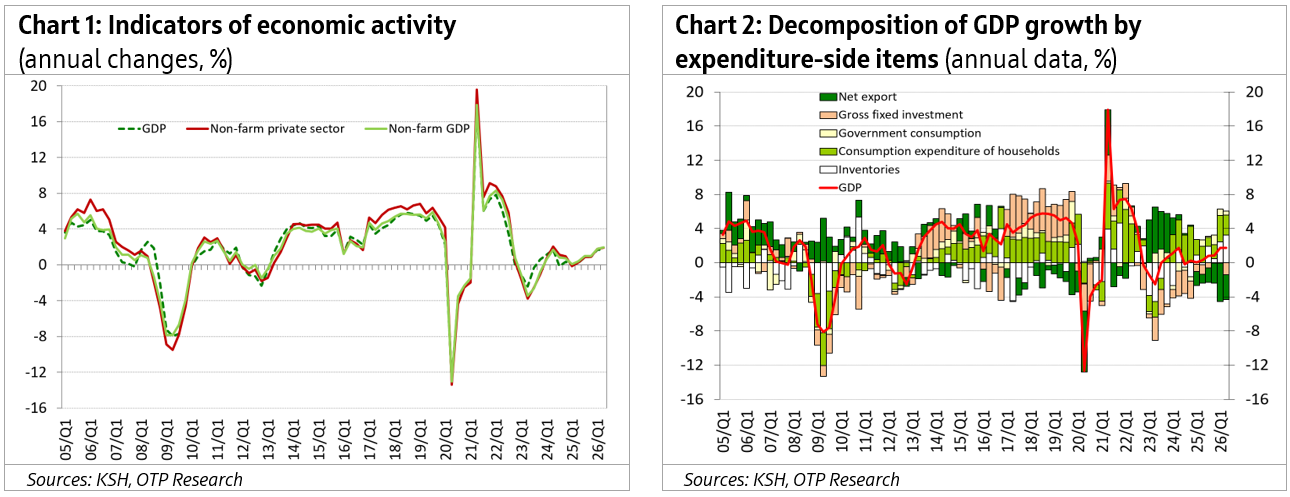
In Q2 2026, Hungary's gross domestic product grew by 1.7% year-on-year (unadjusted), which is in line with the preliminary estimate. As a reminder: the preliminary GDP growth data was a little lower than our forecast (1.8% YoY) but higher than the market consensus (1.4% YoY). On a quarterly basis, GDP growth slowed from 0.8% to 0.5% in Q2 according to KSH’s data. Our in-house seasonal adjustment shows somewhat more modest growth as the QoQ rate declined from 0.7% to 0.4%. With 12% YoY decline the agriculture was significant drag on growth as the non-farm GDP growth accelerated from 1.7% to 2.1% YoY and it stagnated at 0.7% QoQ.
· The promising growth momentum which we saw in Q1 has remained in Q2 if we filter out the negative impact of agriculture, but one-offs still had an effect, which was positive in case of construction while negative in case of services. Manufacturing growth gained momentum (+3.7% YoY), helped by the ramp-up of the production of the BMW iX3 model in Debrecen, and by faster European and German GDP growth. The growth of market services has declined (from 2.4% in Q1 to 1.8% YoY) which is suspected to be tied to the government change, as two sub-branches helped by government policies (communication and leisure and sport) has declined compared to the previous quarter, along with real estate which is in a longer negative trend. Meanwhile transport and financial services performed well.
· On the expenditure side, consumption remained robust and exports seem to turn around due to capacity extensions and an improving external environment while investment is still struggling. We expected consumption to remain the main driver of growth in 2026, with investment also rebounding after four years of contraction. We expected the contribution of net exports to decline due to higher imports driven by strong consumption and increasing investment, but we expected export growth to return after two years of decline.
· So far, in the first half of the year consumption growth was strong even considering the deceleration in Q2 (4.5% YoY, after 5.5% in Q1, and 1% QoQ after 1.5% in Q1). Surprisingly low inflation helps to maintain the robust real wage growth despite decelerating nominal growth rate. Although the employment prospects did not improve, consumer confidence stays at similar level than in 2017-2018 (years of “good old days”) and the current high level of the saving rate and strong consumer lending help to maintain the robust consumption growth. In the light of the H1 figure we think the consumption growth can be closer to 4.5% than to our current 4% forecast.
· Export growth has also returned as expected (1.8% YoY, after -1.8% in Q1), helped by the fact that the BMW plant in Debrecen ramped-up production and the improving external environment.
Looking ahead, the current strong exchange rate is unlikely to significantly dampen Hungarian export growth, as the exchange rate depreciation seen in previous years has so far not had a meaningful positive effect on exports. In fact, Hungarian exports have tended to lag behind those of other countries in the region. Instead, the stronger exchange rate will reduce exporters’ profits, which may help anchor wage increases at a level consistent with the inflation target. Due to the acceleration in export growth in Q2, we think export growth could be closer to 2% than to the 1% we had expected earlier. Surprisingly, quarter-on-quarter import growth remained higher than export growth despite declining machinery investment. Strong import growth may be the reason for the increasing growth contribution of inventory accumulation. If this is the case, we should see weaker import figures in H2. However, higher electricity imports in Q3 due to the temporary shutdown of the Paks nuclear power plant may also distort the big picture. Overall, we expect import growth to be around 5% in 2026, instead of our previous forecast of 3.5%. Consequently, after these revisions, the contribution of net exports to growth appears likely to be lower than we had previously expected, as we have revised import growth upward by a larger extent than export growth.
· Investment activity was worse than our expectation and fell further (-6.3% YoY after -0.1% in Q1). This is likely largely because the government was much less able to spend on investments than we had anticipated due to the elections, while private-sector investment has also struggled in Q2. The latter was reflected in the 1.3% YoY decline of machinery investment after rising in the preceding four quarters, and the 19.5% decline in manufacturing investment (-10% QoQ). The latter are most likely the consequences of the closure of a large manufacturing investment and not a sign of generally weak investment activity. But due to the abovementioned reasons we need to reduce our 2026 fixed capital forecast. Currently, we expect investment to decline by around 3% in 2026, instead of growing at a similar magnitude as previously expected.
· As Q2 GDP growth came in only slightly below our nowcast (1.8% YoY), the 1.7% reading is consistent with our medium-term outlook, which points to around 1.8% GDP growth for 2026 as a whole. We think the temporary shutdown of the Paks nuclear power plant will have only minor effect (<=0.1%) on the whole year growth figure, but it will reduce the Q3 growth in some extent, indeed. Based on the data released so far, we therefore maintain our view that growth in the 1.5–2% range is achievable this year. In our baseline GDP trajectory, we expected strong Q1 performance to be followed by weaker quarter-on-quarter growth in Q2 due to post-election effects. However, the deceleration was due to the weaker than expected performance of agriculture, meanwhile the underlying growth was better than expected. We also highlight, the new government reached HUF 1000 bn budgetary surplus in it’s first three months (May-July). This was partly achieved by temporary shutdown of public procurements or investments due to the full overhaul of the budget. In the rest of the year these spending may also normalize that gives some support to the economic growth.
· We expect growth to accelerate to 2.4% in 2027. If we consider that non-farm GDP grew at an annualized rate of 2.4% in H1, and that the economy can maintain this pace while benefiting from a more favorable agricultural season in 2027, our GDP forecast appears rather conservative. However, we should not overlook the fact that a significant fiscal adjustment is set to begin in 2027. As the Tisza Party appears committed, at least based on its current positions, to maintaining several of the deficit-expanding measures introduced by Fidesz, such as the extension of personal income tax exemptions for mothers with two children and the gradual introduction of a 14th-month pension, while also likely introducing a tax refund scheme for low-wage earners next year, private consumption is likely to remain the main driver of economic growth. At the same time, we expect the government to use a large portion of the unblocked EU funds for deficit reduction rather than for economic stimulus. Consequently, the key question is how much fiscal space can be created through a reduction in corruption and an improvement in the efficiency of public spending. If a substantial share of the required fiscal adjustment can be achieved through cuts to less productive expenditures, lower interest costs, and the use of EU funds to support deficit reduction, the impact of fiscal consolidation on medium-term growth could be limited. Moreover, a well-designed fiscal adjustment program, by strengthening the credibility of Hungary's path toward euro adoption, could boost both business and consumer confidence, further mitigating the adverse growth effects of fiscal tightening.
Get more out of your investments!
Global Markets Services
OTP Global Markets offers a broad range of services in the field of local and international money and capital markets.
Read morePrivate Banking Services
Personal care and expertise with OTP Private Banking, along with the knowledge, security, and innovations of a multinational banking group.
Read more