
How might the Iranian conflict affect Brazil?
Related content
US bank shares fell
The third-quarter earnings season in the US has picked up pace following the release of the latest figures from US banks. Based on preliminary expectations, the third quarter is likely to have closed with strong earnings growth for S&P 500 companies, led by the energy and technology sectors. The major US banks have still achieved solid growth on an annual basis, indicating that their operations remain strong, but the pace has clearly slowed in many cases, which has tended to result in negative share price reactions.
Commodities - Technical Analysis
Gold and silver continued their downward trend, bouncing off key levels. Until their downward trends are broken, they will not be able to produce a significant rise. The fall in oil prices reversed from the $87.5 level and began a slight upward movement. Natural gas remained in an uptrend; a significant rise could even occur if it breaks out upwards. The price of copper has become stuck in a wider range, so the oversold and overbought zones may offer more favourable trading opportunities. The falling prices of wheat and corn have reached key support levels; a buying reaction from these levels could present favourable long opportunities with limited risk.
The Brazilian stock market started the year strongly, but then the Brazilian stock index also turned downwards as a result of the escalating conflict in Iran. This is mainly due to global risk aversion and the effects of high positioning, as Brazil can be considered the relative winner of the Iranian war overall. Higher oil prices result in higher government revenues and have a positive impact on growth prospects, but there are, of course, factors that have a negative impact.
How might the Iranian conflict affect Brazil?
The Brazilian stock market started the year strongly, with the Bovespa index reaching new highs several times by the end of February and the real strengthening nicely against the dollar, until the war in Iran intervened. In line with global risk aversion, the Brazilian stock index also turned down, and the real began to weaken against the dollar, but Donald Trump's comments hinting at a near end to the war were followed by a positive turnaround.
The effects of the Iranian conflict are impacting Brazil in several ways. The most positive aspect is that Brazil is a net oil exporter and the world's seventh largest oil producer, meaning it benefits from rising energy prices. The importance of the energy sector has grown over the past ten years, with Brazilian crude oil and refined product exports accounting for ~1.3% of GDP. Assuming all other factors remain unchanged, rising oil prices would increase export and tax revenues, as well as dividends flowing into the federal treasury.
On the other hand, the protracted conflict could set back Brazilian trade with the Gulf Cooperation Council (GCC) and Iran, which together accounted for about 10 percent of Brazil's $68 billion trade surplus last year. Brazil exports meat, iron ore, and sugar to the GCC, and corn and soybeans to Iran. However, higher oil prices also affect domestic fuel prices, and rising diesel prices could push up inflation due to increased transportation costs. In addition, fertilizer imports are crucial for local agriculture, and the price of natural gas is very important in their production; if the conflict in the Middle East were to cause a lasting increase in gas prices, rising global costs could make the raw materials needed for agricultural production more expensive for Brazil.
Overall, regarding the potential economic impact of the Iranian crisis, JP Morgan estimated that every 10% increase in oil prices would increase Brazil's GDP by 0.1 percentage points, increase inflation by 0.2 percentage points, reduce the budget deficit as a percentage of GDP by 0.2%, and reduce the current account deficit by 0.1%. Even if the oil price increase were to be fully passed on, local characteristics would mean that only about one-third of the price increase would be reflected in local gasoline prices, partly because the majority state-owned oil company Petrobras sets domestic fuel prices independently of market forces (as is the case in many other countries).
Uncertainty remains high
For Brazil, a possible rise in inflation is one of the risks associated with the conflict in Iran. According to a previous study by the Brazilian central bank, a 10% increase in oil prices (in local currency) increases headline inflation by ~0.4%. Preliminary industry estimates suggest that an oil price of USD 80 could raise inflation by ~0.6 percentage points over a twelve-month period, while an oil price above USD 100 could increase inflation by more than two percentage points. This would not come at a good time, as investors are currently expecting central bank interest rate cuts due to disinflationary processes.
With inflationary pressures cooling and growth slowing, the central bank is still likely to cut its 15% interest rate in March, but looking ahead, it is unclear at what pace the easing could continue. According to central bank comments, the situation in the Middle East cannot be ignored, but its consequences within the relevant time horizon remain uncertain. The consensus currently expects inflation of 4% for this year, but persistently high oil prices, especially if coupled with a weakening currency, could pose an upside risk. According to the latest central bank survey, market participants still expect inflation of 3.91% by the end of this year, but expectations for the central bank's interest rate at the end of the year have risen slightly to 12.13% (compared to 12% in the survey a week earlier).
How might this affect the stock market?
Among the largest components of the EWZ ETF, which tracks the Brazilian stock market, Petrobras (with a weight of ~13.12% in the ETF for preferred and common shares) has limited direct operational exposure to the conflict in Iran and the oil company may benefit from higher crude oil and refined product prices. According to preliminary industry estimates, a $5 per barrel increase in oil prices could boost Petrobras' free cash flow by a single-digit percentage. In the case of iron ore producer Vale, rising fuel prices could hurt the company's margins, among other things, through higher operating costs (Vale's weight in the ETF is 10.4%). For Nu Holdings (the parent company of Brazilian neobank Nubank), the impact could be indirect, through a possible rise in inflation, which could have a negative effect on Brazilian consumer spending, among other things. However, if growth prospects improve but interest rates decrease more slowly than expected, this could represent an overall favorable scenario in the short term (Nu Holding has a 9.4% weighting in the ETF). Overall, thanks to the sector composition of the Brazilian stock market, it is likely to emerge as a winner from an environment characterized by higher energy prices.
The Brazilian stock market has fallen from its new high at the end of February, with the index returning to the levels seen at the end of January. In the case of MSCI Brazil, the steady rise in forward earnings expectations since the beginning of the year seems to have stalled for now. The big question is how quickly a positive turnaround could occur if global risk aversion eases and there is a chance for the Iranian conflict to be resolved in the near future. The MSCI Brazil index's 12-month forward PE ratio of 9.89 has returned below its long-term average (10.8), and the Brazilian stock market’s valuation is lower compared to the MSCI EM's PE ratio of 12.30.
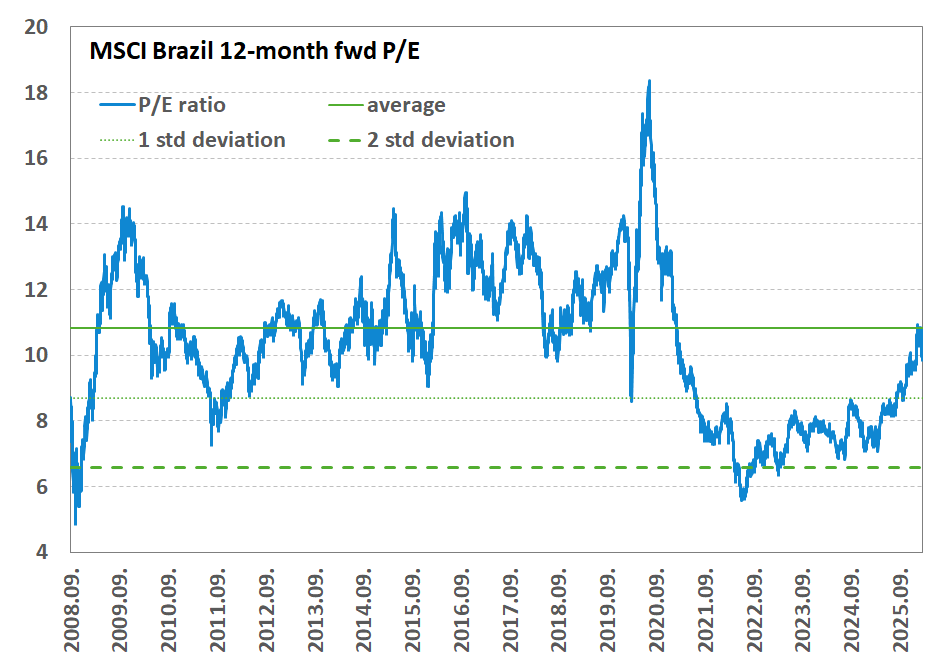
Global risk aversion and the potential strengthening of the dollar have been a headwind for emerging markets, causing the Brazilian stock market to fall despite being one of the potential winners in relative terms due to rising oil prices caused by the war in Iran. If the worst-case scenario does not materialize in relation to the situation in Iran (and Donald Trump's statements a few days ago, which cooled fears of war, helped in this regard), the next period could be about investors looking for relative winners and losers, with the Brazilian stock market starting from a good position. The next important milestone will be the autumn elections, with current president Lula leading in the polls, although his likely challenger from the right, Flavio Bolsonaro, appeared to be catching up by early March.
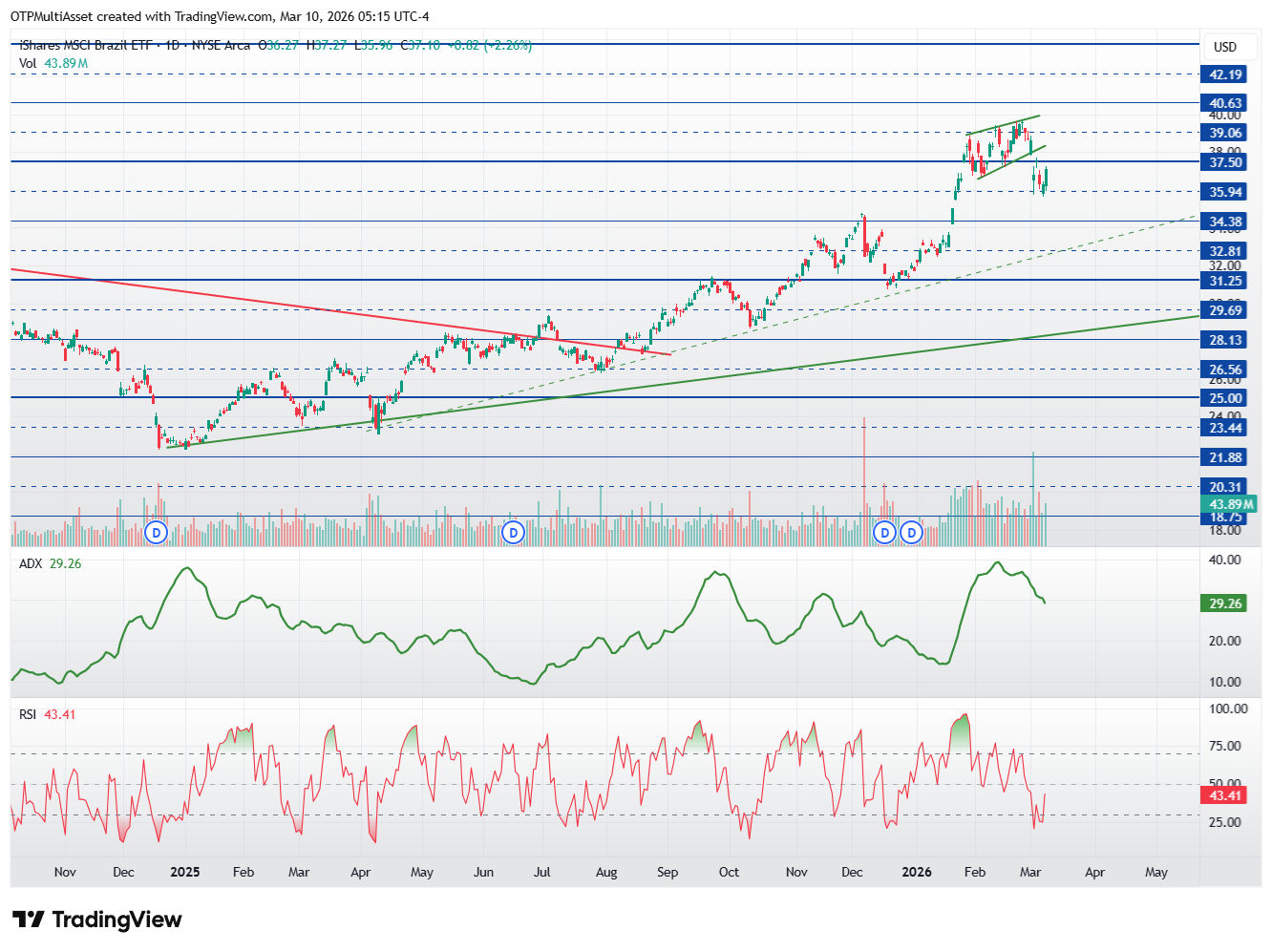
EWZ - iShares MSCI Brazil ETF technical picture
The curve gave long closing signals a week ago, then broke out of a minor wedge formation. The decline was preceded by a sharp loss of momentum and a decrease in buying power. Despite this, however, the price has barely fallen. There is still room for the decline to continue, and it may correct back to the dotted uptrend line. There is strong support around the 34.38 level.
Get more out of your investments!
Global Markets Services
OTP Global Markets offers a broad range of services in the field of local and international money and capital markets.
Read morePrivate Banking Services
Personal care and expertise with OTP Private Banking, along with the knowledge, security, and innovations of a multinational banking group.
Read more