
Gen Digital: strong figures and positive outlook
Related content
US bank shares fell
The third-quarter earnings season in the US has picked up pace following the release of the latest figures from US banks. Based on preliminary expectations, the third quarter is likely to have closed with strong earnings growth for S&P 500 companies, led by the energy and technology sectors. The major US banks have still achieved solid growth on an annual basis, indicating that their operations remain strong, but the pace has clearly slowed in many cases, which has tended to result in negative share price reactions.
Commodities - Technical Analysis
Gold and silver continued their downward trend, bouncing off key levels. Until their downward trends are broken, they will not be able to produce a significant rise. The fall in oil prices reversed from the $87.5 level and began a slight upward movement. Natural gas remained in an uptrend; a significant rise could even occur if it breaks out upwards. The price of copper has become stuck in a wider range, so the oversold and overbought zones may offer more favourable trading opportunities. The falling prices of wheat and corn have reached key support levels; a buying reaction from these levels could present favourable long opportunities with limited risk.
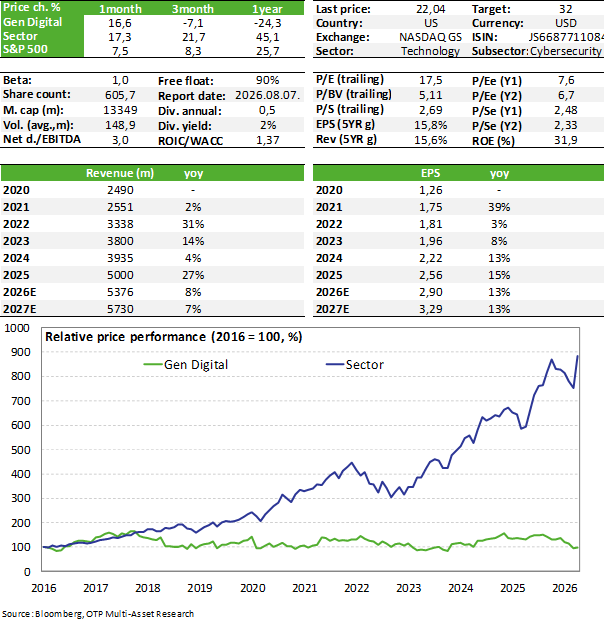
Gen Digital’s earnings report delivered better-than-expected figures across key performance metrics, and management’s forecast also provided a positive surprise. As a result of the stock’s price decline this year, valuations have fallen to even more favorable levels, while the company’s cybersecurity business appears fundamentally less vulnerable to AI solutions, though artificial intelligence could serve as a positive catalyst. At the same time, it is worth noting that the business model of MoneyLion, a financial advisory service acquired last year, could be particularly vulnerable in this regard, which could pose risks in the longer term.
Quarterly report
Gen Digital’s shares have lost approximately 19% of their value since early 2026, primarily due to widespread investor concerns related to AI disruption, particularly among companies operating on a subscription-based software model. In this context, the company’s earnings report was of significant importance, especially given that among its direct competitors, both Datadog and Fortinet had published results exceeding consensus estimates prior to the report. The overall industry sentiment was thus supportive, to which Gen Digital’s performance also contributed significantly, without disrupting the positive narrative that had developed in the cybersecurity segment.
The company’s subscriber base grew by 16% in the first quarter (year-over-year), from 68 million to 79 million, marking an acceleration from the 11% growth recorded in the previous quarter. Revenue grew by 27% year-over-year, which is a very strong pace, but is largely due to the fact that, following the acquisition of MoneyLion in mid-April of last year, this was the third full quarter in which it appeared on the books; in other words, this revenue generation was still missing from the base period. Had it been included, the so-called pro forma growth would have been more modest, at 9%. The acquisition of MoneyLion was the engine of growth; without it, growth would have been even lower. However, this still reflects a stronger performance than expected, allowing the company to slightly exceed the consensus estimate overall (USD 1.28 billion versus the expected USD 1.24 billion).
The operating margin declined from 58% in the base period to 50%, though the effects of the transaction also played a role in this. While earnings per share rose 14% year-over-year, the figure of 67 cents slightly exceeded analysts’ expectations of 64 cents. Management emphasized that its strategic focus is on integrating artificial intelligence capabilities and expanding its partnership ecosystem—an ecosystem that already includes players such as ChatGPT and xAI—to strengthen the competitiveness of its product portfolio and enhance customer engagement. In addition, growing cybersecurity risks, particularly consumer concerns related to AI-based attacks, could serve as a further driver for the expansion of the paid customer base.
Overall, the company is performing strongly; even excluding the effects of the acquisition, organic growth figures appear to be better than expected. Management is confident about the company’s continued trajectory, forecasting pro forma revenue growth of 8–10% and EPS growth of around 14% for fiscal year 2027. The guidance exceeded market consensus on both revenue and earnings, which, combined with favorable sector sentiment, resulted in a significant, approximately 12% share price increase following the earnings release. This marks the third consecutive quarter in which management has raised its expectations, indicating a high level of execution and strong momentum. This is encouraging from a longer-term perspective and may help spread the narrative that AI is more of a tailwind than a risk.
Valuation
Within the technology sector, and specifically among software companies, Gen’s valuation metrics remain relatively depressed (PE: around 8 vs. sector: 23, EV/EBITDA: 8 vs. sector: 18). Although expected growth is also somewhat lower—15% and 9% (at the EPS and EBITDA levels)—than the sector average (and the gap would be even wider if we looked at organic, weaker single-digit growth), even these figures do not necessarily justify such a significant pricing gap. Our metrics-based fair value estimate is $32, which, while lower than our previous estimate of $35 (primarily due to substantially declining valuation multiples across the sector as a whole), still implies upside potential relative to the current share price.
Investment story
- The company provides protection against cyber threats (viruses, malware, ransomware, phishing, hacker attacks) to PCs, tablets, and smartphones through globally recognized brands such as Norton, Avast, Avira, and LifeLock. Norton LifeLock acquired its rival Avast in 2022 and is now the market leader in its field under a new name, Gen Digital.
- The company has a customer base of 500 million, mostly residential, of which 65 million are monthly/annual subscribers. The company is also developing in the field of machine learning and AI, has its own patents, and already offers solutions based on these to its customers.
- The company's free service user base (>400 million) is one potential source of new subscription growth, but customer retention and increased sales through partners could also contribute to the planned average annual revenue growth of around 5% over the next three years.
- The acquisition of MoneyLion was completed last year, representing a cash outflow of $1 billion (at what appears to be fair pricing levels: 9-11X EBITDA multiple) and, subject to certain conditions, could even have a dilutive effect (with the issuance of 1.5% new Gen shares). The company operates an app offering retail financial products and has 20 million users, with little overlap with GEN's customer base. However, the emergence and spread of AI agents could pose a serious challenge to the platform's business model, which could be a significant risk that could also cloud its growth prospects.
- However, cross-selling opportunities are visible for the time being, and with annual revenues of USD 546 million, the new company could make a positive contribution (14% of that amount) from day one, and it is also profitable in terms of earnings. With the closing of the transaction, Gen began to return to its own share purchases at the end of last year (USD 300 million, 2% of capitalization), as we had expected, which had been temporarily suspended due to the acquisition.
Get more out of your investments!
Global Markets Services
OTP Global Markets offers a broad range of services in the field of local and international money and capital markets.
Read morePrivate Banking Services
Personal care and expertise with OTP Private Banking, along with the knowledge, security, and innovations of a multinational banking group.
Read more