
Forty Days of Madness on the South Korean Stock Market
Related content
Hungary: Despite the lower-than-expected headline inflation data the picture is not as rosy as it first appears
Hungary's headline inflation increased to 1.6% year-on-year in September from 1.3% in August. The published data was lower than the consensus and our forecast (both 1.8%). The lower-than-expected inflation was due to above expectation core inflation but a bigger than expected decline in food prices and a decrease in administered prices.
Commodities - Technical Analysis
Gold and silver continued their correction and even dropped below key support levels, so it’s best to postpone buying for now. The price of oil has narrowed significantly between the $87.50 level and the trend line, so any significant movement will likely require a breakout from this zone. Natural gas has retested its uptrend line, but buyers continue to show strength.Copper appears to be developing a broader trading range, making oversold and overbought zones potentially more attractive for trading opportunities. Wheat and corn continue to trade in a correction phase, while moving closer and closer to their key support levels.
The South Korean stock market posted an astonishing rise in the first half of the year, driven largely by the artificial intelligence-related semiconductor boom that benefited both Samsung and SK Hynix. As foreign investors became net sellers, the role of local retail investors has become increasingly prominent in recent times. However, the introduction of leveraged ETFs tracking a single stock further exacerbated the already mounting volatility in South Korea’s stock market. Following a sharp rally, a reversal occurred in mid-June, followed by a significant correction in July. In light of these developments, we examined what might happen next on the South Korean stock market.
A massive rally, a significant correction
The South Korean stock market posted a massive rise in the first half of the year; although the KOSPI index began to experience increasingly sharp fluctuations in mid-May and early June, it managed to climb to new highs time and again through mid-June. Looking solely at the index’s first-half performance, with a 101% increase, the KOSPI was the best-performing stock market index globally; the local stock market’s market capitalization exceeded 8,000 trillion won (~$5300 billion), making the South Korean capital market the sixth-largest in the world, with the KOSPI index already trading above 9,000 points in June.
After that truly astonishing streak of record highs, a negative correction was certainly on the cards (and as can be seen in the chart below), volatility also rose sharply in tandem with the index’s first-half rally; however, the sell-off that hit in mid-June was ultimately followed by a massive, month-long decline. The index fell by 36.9% between June 18 and July 30.
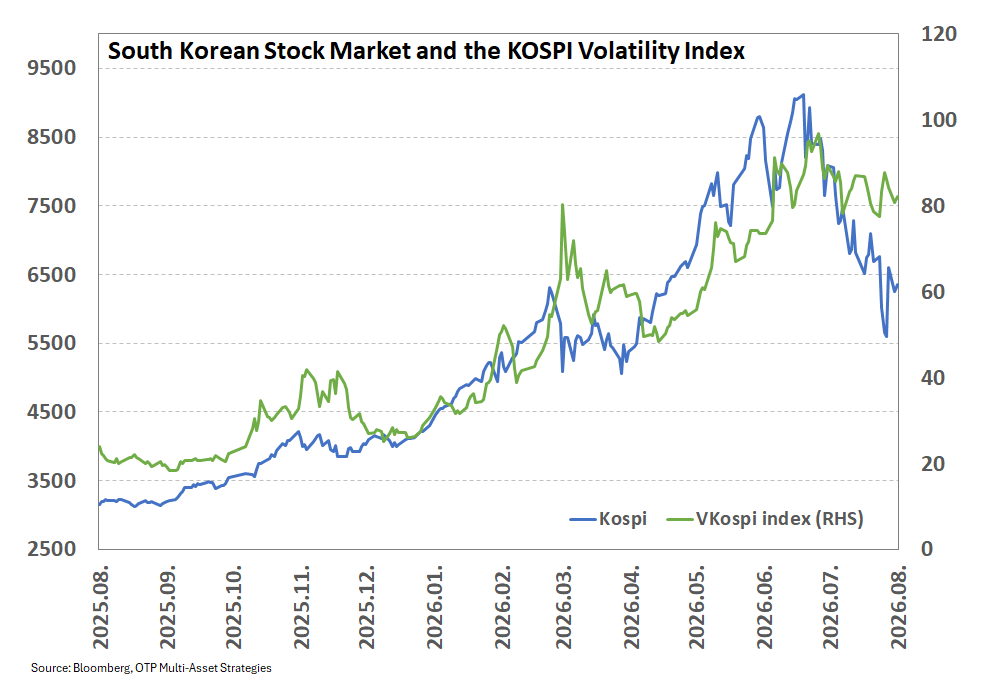
We have previously written about the existing concentration risk: by mid-June, the combined market capitalization of Samsung and chipmaker SK Hynix already accounted for more than half of the Kospi index. The two companies saw an astonishing surge in the first half of the year due to the artificial intelligence-driven semiconductor boom, and changes in their outlook are critical to the Kospi’s performance given their combined weight in the index. In addition to profit-taking (and portfolio rebalancing) following the earlier rally, some market participants may have been concerned not only about the sustainability of investments in AI data centers but also about the possibility of new supply entering the memory chip market (and the resulting decline in pricing power).
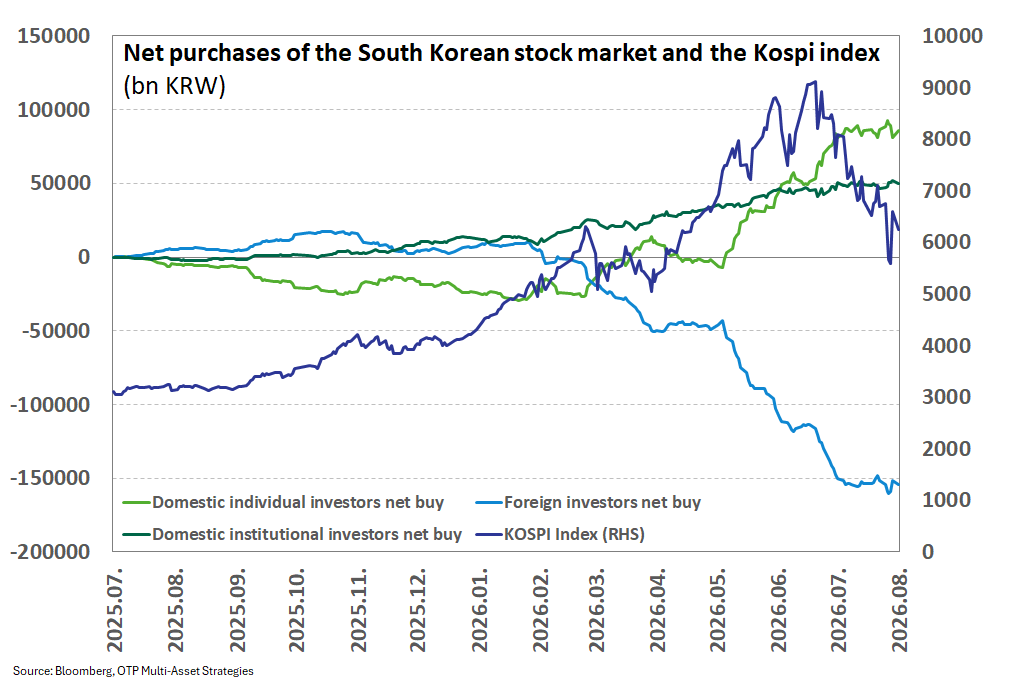
At the same time, significant changes have also taken place in the market’s internal structure (as shown in the chart below): sales by foreign investors have clearly intensified since the spring, while the role of South Korean market participants has become increasingly prominent, and retail investors have literally flocked to the local stock market. Amid the KOSPI’s rally at the beginning of the year, some retail investors likely feared missing out on further gains, and many may have purchased stocks with borrowed money in the hope of quick profits. Investor concerns related to the artificial intelligence narrative exacerbated the sharp swings, and the situation was further worsened by the May launch of leveraged ETFs tracking individual stocks (such as Samsung or SK Hynix), which further amplified volatility in the South Korean stock market.
Leverage as an Additional Risk
The KOSPI managed to climb to a new high in June, and the balance of margin loans taken out to finance stock purchases peaked at the end of June (at nearly 39,000 billion won). Amid the correction in Samsung and SK Hynix that began in mid-June—and the massive downturn that subsequently unfolded in the South Korean stock market—many investors may have suffered serious losses; according to a Citibank estimate from late July, local retail investors may have suffered losses of approximately 56,000 billion won (nearly 39 billion dollars) through their investments in leveraged products.
Faced with rising retail investor losses in the wake of sharp stock market volatility, the local financial regulator could not stand idly by: among other measures, it temporarily suspended the listings of leveraged ETFs tracking a single stock and raised the margin requirements for them. Then, at the end of July, further restrictions were imposed: investors would be allowed to hold no more than 20 percent of their assets in leveraged ETFs, and the educational requirements for purchasing these products were also expanded.
After the correction on the South Korean stock market that began in mid-June (following regulatory tightening of leveraged ETFs), the level of leveraged positions also declined by the end of July. According to the Korea Financial Investment Association, the balance of margin loans taken out to finance stock purchases fell to 33.4 trillion won ($22.6 billion) by mid-July, marking the lowest level since mid-April.
However, this goes beyond the capital markets: the head of South Korea’s financial regulator acknowledged as early as June that the regulator had acted too hastily when it approved the introduction of leveraged ETFs, and about a month later, the finance minister also apologized for this. For the South Korean president, all of this could also pose a political risk, given that Lee Jae Myung had previously campaigned on the promise that the KOSPI index would reach the 5,000-point level during his presidential term; and several reform measures have been implemented to boost the local stock market (and eliminate the so-called “Korea discount”). Although the next parliamentary elections are not due until the spring of 2028, it remains to be seen whether the disappointment of local retail investors, who have been steered toward stock investments, will persist until then—and if so, how many votes this might ultimately cost the president and the Democratic Party.
What might happen next?
It is also worth noting that the two South Korean companies mentioned above released their latest financial results at the end of July. Although SK Hynix’s second-quarter revenue and operating profit both fell short of expectations, the latter rose by more than 500 percent year-over-year. Revenue, operating profit, and net income all hit record highs for the quarter, but even this was not enough for market participants, and the stock price ultimately closed sharply lower following the earnings report. According to SK Hynix’s CEO, the memory chip shortage is likely to persist even after 2030; at the same time, some investors were likely disappointed by the lack of details regarding shareholder payout plans.
Samsung then released its final quarterly figures: revenue for the period between April and June rose to a new high, as did operating profit, which reached 89.5 trillion won (~$62 billion)—a nineteen-fold increase compared to the same period last year. Almost all of this came from the semiconductor division, which benefited from rising chip prices driven by demand for servers used in artificial intelligence. It is worth noting that Samsung is exploring ways to increase shareholder returns, and the company promised in early August that it would soon release further details on this matter.
At the same time, SK Hynix is expected to finalize its specific shareholder payout plans by the end of the year. For both Samsung and SK Hynix, forward earnings expectations continue to rise sharply. Meanwhile, the South Korean stock market is cheap, with the MSCI Korea Index’s forward P/E ratio of 4.52 lower than that of the MSCI Emerging Markets Index (9.94).
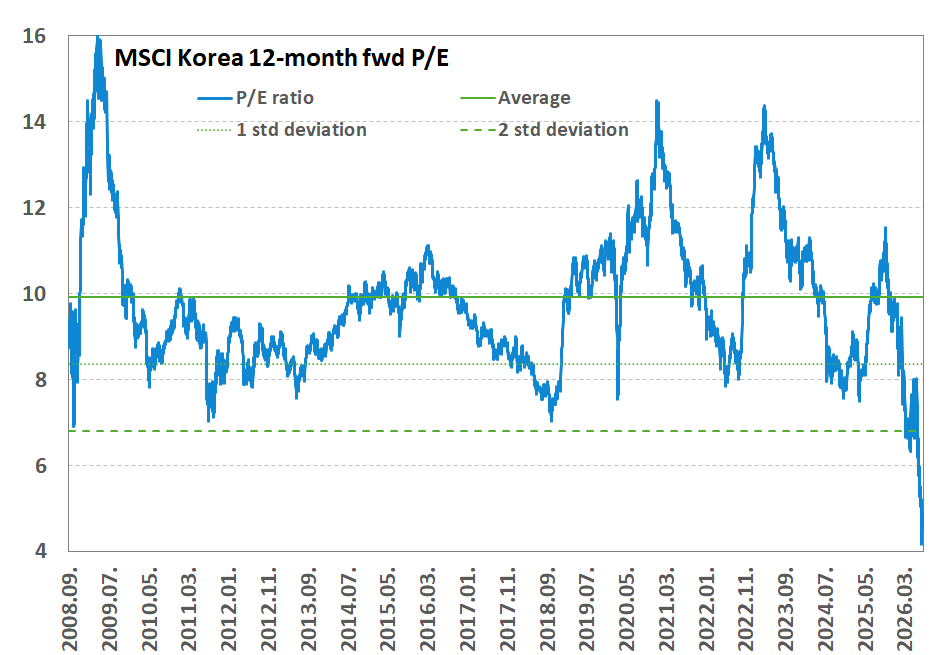
The regulatory restrictions on leveraged ETFs tracking a single stock are certainly a positive development, although retail investors are likely to be more cautious following the significant decline in recent weeks, while the increased volatility of the local stock market may also prompt institutional investors to exercise greater caution. That said, there are still reasons to be optimistic about the South Korean stock market; although it now appears that the massive surge seen at the beginning of the year may not be repeated, there may still be some room for rise later on.
Given Samsung and SK Hynix’s dominant roles in the artificial intelligence hardware supply chain (and the significant weight these two companies carry in the index), some market participants have increasingly viewed the South Korean stock market index as an “AI barometer” in recent times. Thus, there is a good chance that the Kospi’s short-term direction will be increasingly influenced by market reactions sensitive to developments in the field of artificial intelligence.
Kospi index technical picture
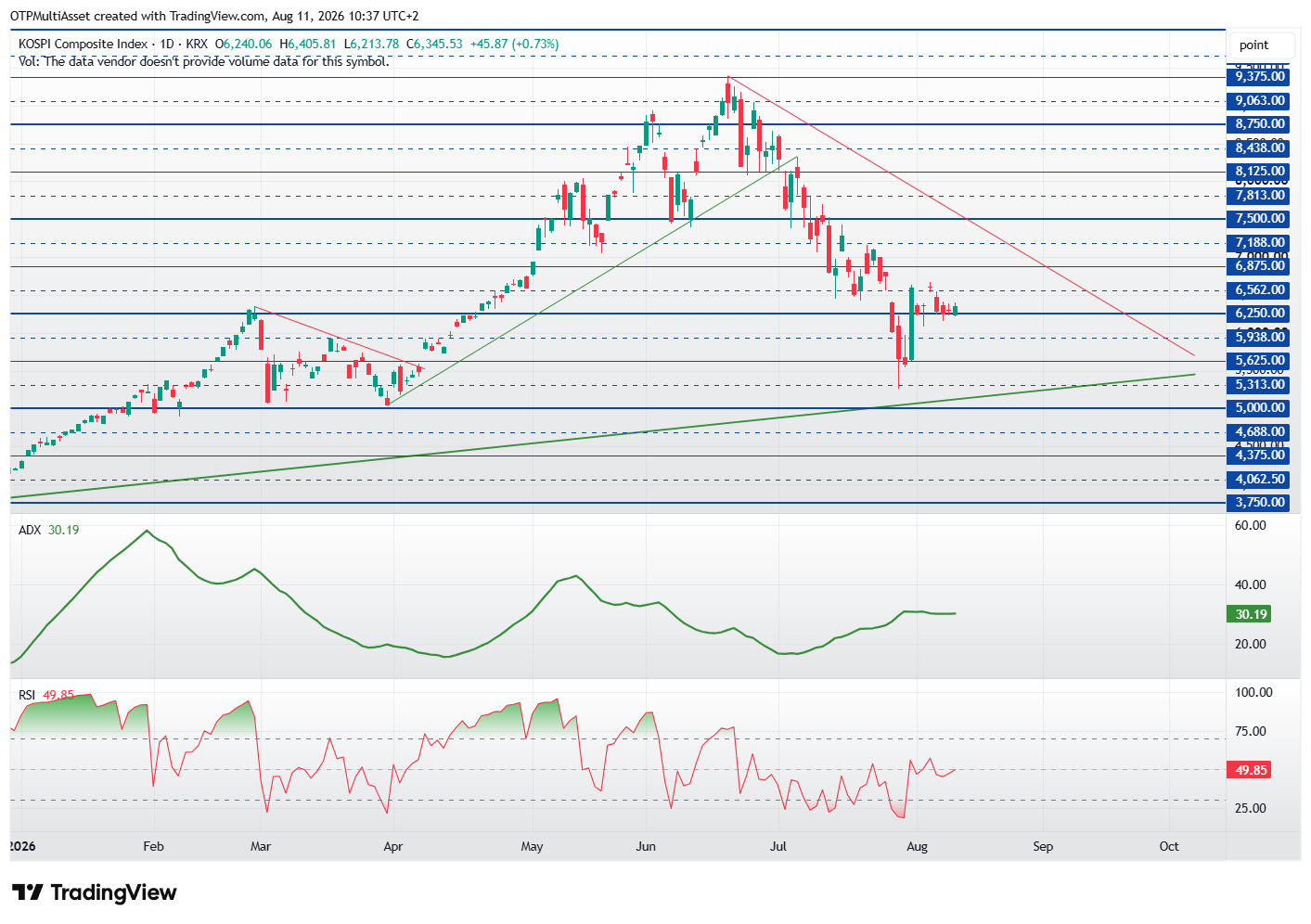
The index broke its uptrend on the first trading day of July and has been in a downtrend ever since. A dip below 5,625 was expected following the decline, and a minor rebound followed after that level was tested. This pattern is not yet sufficient to signal a structural change; it still needs to develop further. The thin red trendline is the key indicator, so as long as the index remains below it, we can only speak of corrections, not a trend reversal. The zone between 5,000 and 5,313 is considered very strong support.
Get more out of your investments!
Global Markets Services
OTP Global Markets offers a broad range of services in the field of local and international money and capital markets.
Read morePrivate Banking Services
Personal care and expertise with OTP Private Banking, along with the knowledge, security, and innovations of a multinational banking group.
Read more