
Our Fixed Income Top Picks
Related content
US bank shares fell
The third-quarter earnings season in the US has picked up pace following the release of the latest figures from US banks. Based on preliminary expectations, the third quarter is likely to have closed with strong earnings growth for S&P 500 companies, led by the energy and technology sectors. The major US banks have still achieved solid growth on an annual basis, indicating that their operations remain strong, but the pace has clearly slowed in many cases, which has tended to result in negative share price reactions.
Commodities - Technical Analysis
Gold and silver continued their downward trend, bouncing off key levels. Until their downward trends are broken, they will not be able to produce a significant rise. The fall in oil prices reversed from the $87.5 level and began a slight upward movement. Natural gas remained in an uptrend; a significant rise could even occur if it breaks out upwards. The price of copper has become stuck in a wider range, so the oversold and overbought zones may offer more favourable trading opportunities. The falling prices of wheat and corn have reached key support levels; a buying reaction from these levels could present favourable long opportunities with limited risk.
Although forint-denominated assets are currently performing exceptionally well, we still consider it important to diversify the bond portfolio by currency, which should be achieved through euro- and dollar-denominated regional government bonds, as well as euro- and dollar-denominated securities issued by highly rated companies. Currency diversification is not a stance against forint-denominated assets, but is necessary to reduce concentration risk. In our analysis, we have selected instruments linked to fundamentally stable issuers that offer acceptable yields in the current market environment.
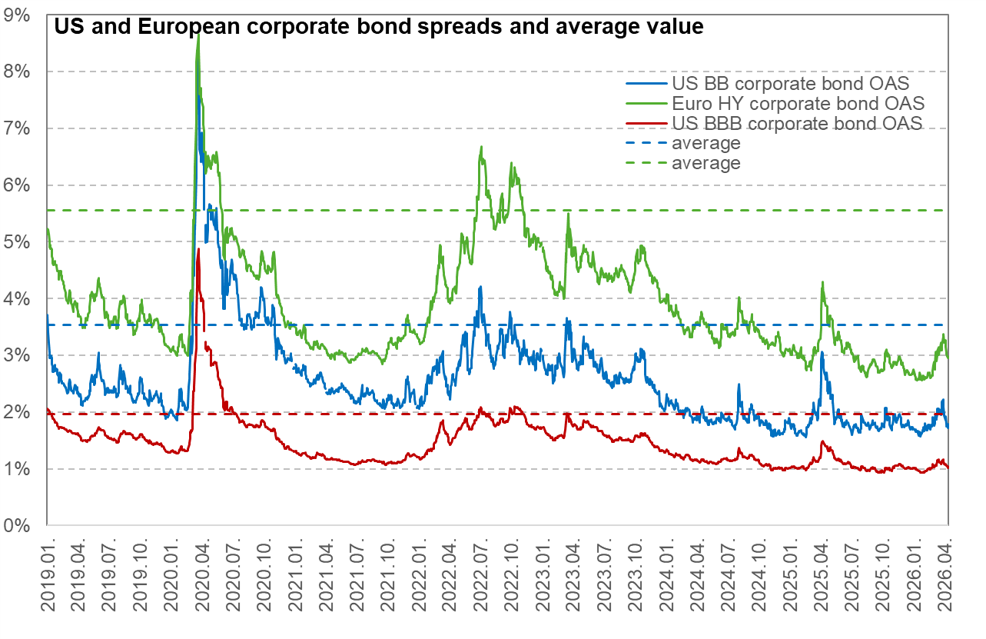
Historically, U.S. corporate bond spreads remain at very low levels, although they have risen slightly recently due to the conflict in Iran. Spreads for investment-grade (BBB) bonds are hovering just above 1%, while those for BB-rated bonds (1.72%) are also close to their lows (1.56%). We saw similar movements in the European high-yield bond segment; the spread rose from 2.60% in February to as high as 2.96% by mid-April, but it remains well below the long-term average.
Euro-Denominated Corporate Bonds
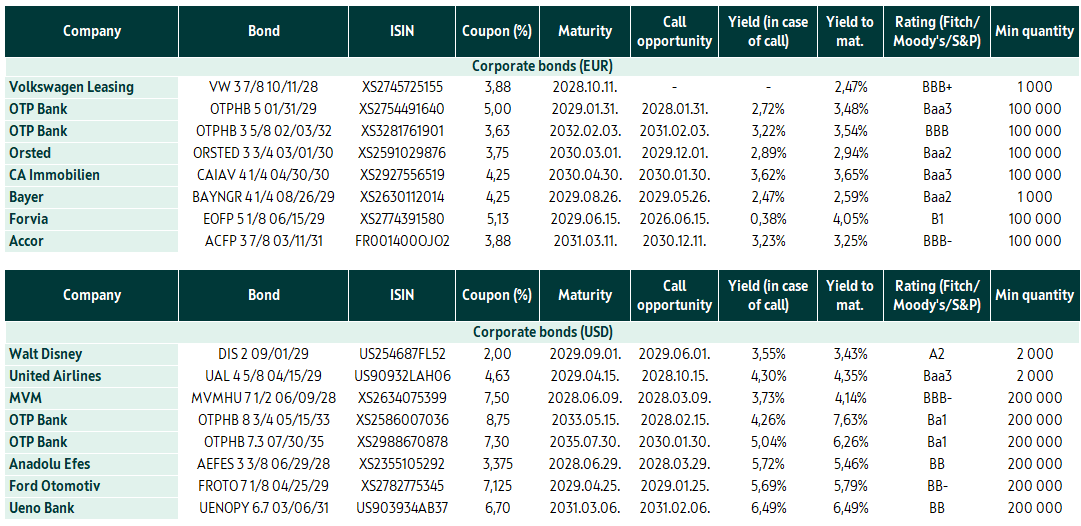
Yields on corporate bonds remain at low levels, even though the conflict in Iran has caused a slight increase. At the same time, as we get closer to the end of the war, risk appetite is returning to the capital markets. There is only a very minimal yield premium, if any at all, for euro-denominated high-yield (HY) securities compared to the investment-grade category. Therefore, one must consider whether it is worth taking on greater risk for a relatively small premium.
Dollar-Denominated Corporate Bonds
Companies in the region typically issue bonds in euros, so the supply available in dollars is much more limited. The list includes two bonds linked to OTP, a subordinated instrument maturing in 2033 and another in 2035, as well as a Hungarian-issued bond, namely MVM’s note maturing in June 2028.
Get more out of your investments!
Global Markets Services
OTP Global Markets offers a broad range of services in the field of local and international money and capital markets.
Read morePrivate Banking Services
Personal care and expertise with OTP Private Banking, along with the knowledge, security, and innovations of a multinational banking group.
Read more