
Strong performance from Expedia
Related content
Hungary: Despite the lower-than-expected headline inflation data the picture is not as rosy as it first appears
Hungary's headline inflation increased to 1.6% year-on-year in September from 1.3% in August. The published data was lower than the consensus and our forecast (both 1.8%). The lower-than-expected inflation was due to above expectation core inflation but a bigger than expected decline in food prices and a decrease in administered prices.
Commodities - Technical Analysis
Gold and silver continued their correction and even dropped below key support levels, so it’s best to postpone buying for now. The price of oil has narrowed significantly between the $87.50 level and the trend line, so any significant movement will likely require a breakout from this zone. Natural gas has retested its uptrend line, but buyers continue to show strength.Copper appears to be developing a broader trading range, making oversold and overbought zones potentially more attractive for trading opportunities. Wheat and corn continue to trade in a correction phase, while moving closer and closer to their key support levels.
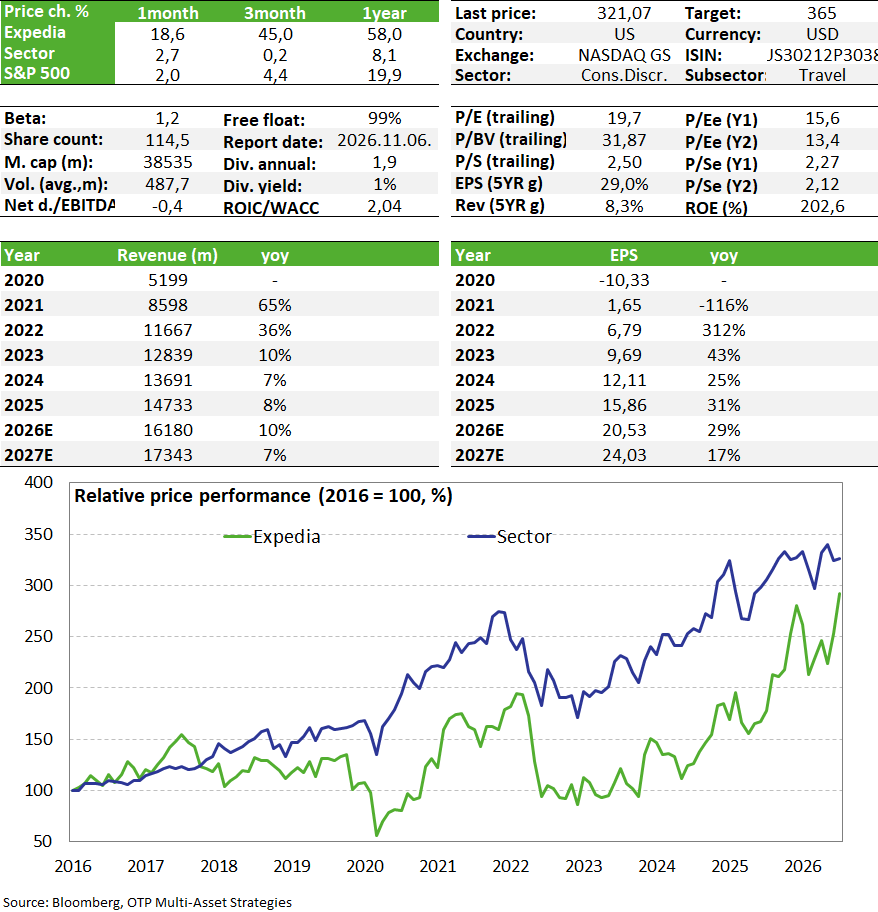
Despite the war in the Middle East and rising energy prices, U.S. consumer spending—and, by extension, travel DEMAND—proved to be sufficiently resilient in the second quarter, from which Expedia also benefited greatly. The company beat analysts’ expectations across all major metrics, with revenue growing by 14%, while also successfully maintaining its strategic goal of cost control, resulting in profit growth of over 20%. Cash generation is very strong, which is being used to repurchase shares, and for now, there's no sign of a slowdown on the demand side, leading the company to raise their full-year expectations for this year. Given the improving fundamentals, we are raising our fair value estimate to $365.
Expedia remains on our Equity Top Pick List.
Quarterly Report
Expedia has posted a second quarter that exceeded expectations and delivered strong growth. The year-over-year growth rate in gross bookings was 12%, which significantly exceeded management’s forecast of 7–9% made three months ago. A key factor in this was that U.S. consumer spending on travel remained strong, despite higher airfare and lodging prices caused by the war in the Middle East. Of course, geopolitical risks may have steered Americans toward domestic travel, and the World Cup also had a slightly positive impact at the end of the quarter (which will partly carry over into the third quarter).
The increase in gross bookings was driven by a 6% rise in booked room nights, a further 5% increase in the average daily rate (where the effects of the World Cup were most evident), and higher airfare prices. Revenue thus totaled $4.3 billion, growing at a healthy annual rate of 14% thanks to favorable currency movements and shifts in the product mix. Management had previously forecast a range of 9–11% (though this may have been somewhat conservative due to the effects of the war), while the market had expected $4.17 billion, meaning the company managed to exceed all expectations.
As in the past, the B2B segment once again posted the higher growth rate—23%—(with double-digit percentage growth in every region), compared to 8% for B2C. In the B2C segment, however, the U.S. region posted strong results, with the highest growth rate in nearly four years. Competition in the B2B segment is very strong, but so is the potential market size, which Expedia is capitalizing on well, with revenue rising to a new high of 1.5 billion.
On the cost side, meanwhile, the company is able to exercise control in line with its strategic goals; the 10% increase in marketing expenses is smaller than the revenue growth, while payroll costs were kept at last year’s level. As a result, the EBITDA margin improved to nearly 26% from last year’s 24% (which is significantly higher than the company had anticipated) and the resulting EBITDA of 1.12 billion exceeded the expected 1.04.
Adjusted EPS rose 36% to $5.76, compared to the expected $5.25, and free cash flow also proved to be very strong. Over the past year, it has already totaled $4.5 billion, a new high, from which the company has continued to make outlays: $0.2 billion in dividends to date and a total of $1.6 billion in share buybacks (of which $200 million was allocated to this quarter, which is lower than the $700 million in the first quarter). Calculated on a trailing basis, this represents a payout yield of 4.8%; moreover, the company has ample capacity—and the authorization—to pay out even larger amounts than this.
The outlook remains encouraging, and the company continued to see strong demand trends at the start of the third quarter; as a result, it raised its full-year revenue forecast from the previous range of 15.6–16 billion to 16.05–16.22 billion, which projects annual growth of 9–10%. In terms of the EBITDA margin, the company now expects an increase of 150–175 basis points, up from the previously projected 100–125 basis points. However, the third quarter will see a slowdown in momentum, as the positive effects of previous cost-cutting measures will no longer be factored into the base; in any case, a slight improvement is expected again in the fourth quarter compared to this.
Valuation
Just as fears surrounding the AI challenge have eased in the software industry in recent months, travel marketplaces have also been able to rebound from their earlier decline. Since Expedia has managed to outperform expectations, it appears to be slightly outperforming its peers, causing its stock price to recently reach a new all-time high. Given that earnings growth is also particularly strong and the outlook remains positive for now, we continue to view the stock’s P/E ratio of 13–15 and EV/EBITDA ratio of 9–10 as undervalued, while the sector averages P/E multiples of around 18–20 and EV/EBITDA multiples of around 13–15. Of course, part of this discount can be explained by the company’s smaller size or market position, but since its growth outlook is on par with or slightly better than the sector’s, we consider the extent of the discount to be excessive overall.
Given that the company’s fundamental performance is improving—and at a rate exceeding expectations—and that the external environment remains supportive and the outlook is positive, we are raising our previous fair value estimate of $272, determined using a multiple-based approach, to $365.
Investment thesis
- Expedia is one of the world’s leading online travel marketplaces (most comparable to Booking). Three-quarters of its revenue comes from accommodation booking fees earned for acting as an intermediary, with the remainder coming from airline ticket sales, advertising, and other services.
- Expedia’s commission revenue is largely influenced by trends in tourism spending. Rising real wages driven by falling inflation also have a positive impact, while geopolitical tensions pose a risk.
- The company recently launched a single global loyalty program (One Key) to tap into the potential for cross-selling across its platforms. This cross-brand loyalty program is unique compared to competitors, which partly explains the recent growth in revenue and margin expansion—a trend that is expected to continue having positive effects in the future. Ariane Gorin, the former head of the B2B segment, took over as CEO in May 2024. Since then, the transformation has proven successful; the company has achieved solid growth, and with the AI-based solutions introduced, it has managed to keep pace with the market, with the first signs of this already visible in terms of efficiency.
- Earnings and cash generation are strong, and the company recently resumed dividend payments that had been suspended due to COVID-19, although this represents an annualized yield of less than 1%. The most significant item remains the share buyback program: over the past year, the company spent $1.6 billion of its $4.5 billion in free cash flow, which represents ~4.5% of its market capitalization. Given the strong performance, this trend is likely to continue; moreover, a new $5 billion share buyback program has been approved, providing strong support for the stock price.
- However, the concerns among software service providers regarding AI developments may also raise questions about Expedia’s business model. If the role of AI agents in travel planning and booking begins to grow, it could significantly undermine the growth prospects of intermediary companies. This is a serious risk that could negatively impact investor sentiment toward the stock and the sector even within the next year or two.
Get more out of your investments!
Global Markets Services
OTP Global Markets offers a broad range of services in the field of local and international money and capital markets.
Read morePrivate Banking Services
Personal care and expertise with OTP Private Banking, along with the knowledge, security, and innovations of a multinational banking group.
Read more