
Earnings season kicks into higher gear
Related content
US bank shares fell
The third-quarter earnings season in the US has picked up pace following the release of the latest figures from US banks. Based on preliminary expectations, the third quarter is likely to have closed with strong earnings growth for S&P 500 companies, led by the energy and technology sectors. The major US banks have still achieved solid growth on an annual basis, indicating that their operations remain strong, but the pace has clearly slowed in many cases, which has tended to result in negative share price reactions.
Commodities - Technical Analysis
Gold and silver continued their downward trend, bouncing off key levels. Until their downward trends are broken, they will not be able to produce a significant rise. The fall in oil prices reversed from the $87.5 level and began a slight upward movement. Natural gas remained in an uptrend; a significant rise could even occur if it breaks out upwards. The price of copper has become stuck in a wider range, so the oversold and overbought zones may offer more favourable trading opportunities. The falling prices of wheat and corn have reached key support levels; a buying reaction from these levels could present favourable long opportunities with limited risk.
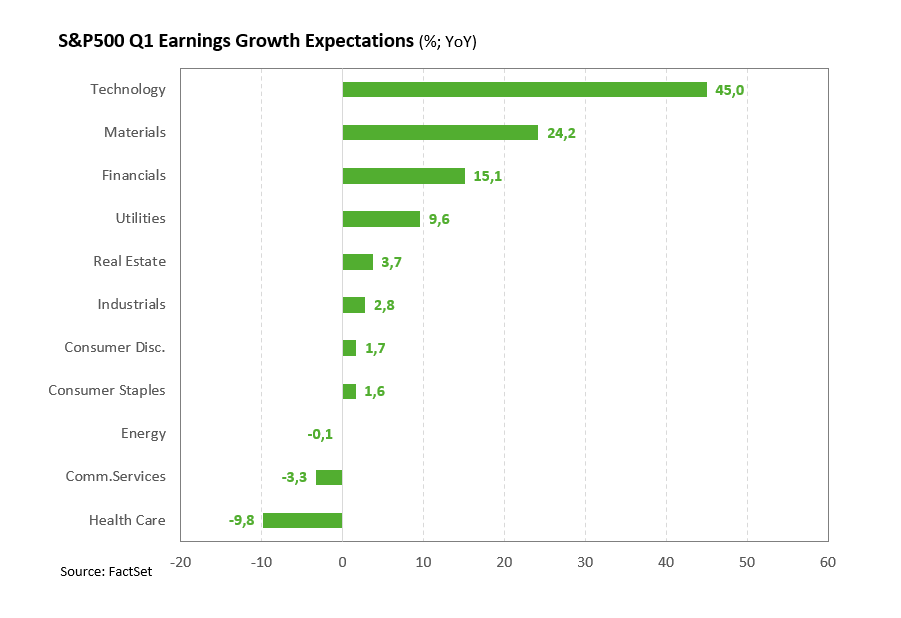
Amid the Iran conflict, the first-quarter earnings season kicked off in the US last week. According to FactSet, the estimated earnings growth rate for the S&P 500 in the first quarter could reach 12.6%. In terms of the index sectors, the quarter may have closed with significant earnings growth in the technology sector, and market participants also expect strong, double-digit earnings growth in the materials and financial sectors. Earnings season will shift into high gear this week, with the latest reports from major overseas banks arriving first at the start of the week.
Amidst the Iranian conflict and the recently agreed-upon but seemingly fragile ceasefire, the first-quarter earnings season has just begun in the US. Overall, the companies in the S&P500 index could have ended the quarter on a strong note, earnings growth is expected to have been strongest among technology companies, while companies in the materials and financial sectors also likely saw double-digit quarterly earnings growth.
With the rebound following the March decline, the S&P 500 has now managed to recoup part of its earlier losses. For the S&P 500, the year-end analyst price target is currently 7,457 points, while the median forecast in January was 7,550. Looking at current expectations, Oppenheimer’s year-end target of 8,100 points is the highest, while BCA’s is the most pessimistic (6,375); the majority of price target expectations fall within the 7,300 to 7,700 point range. This year’s annual EPS expectations for the index are 0.69% higher than the median earnings expectations from January.
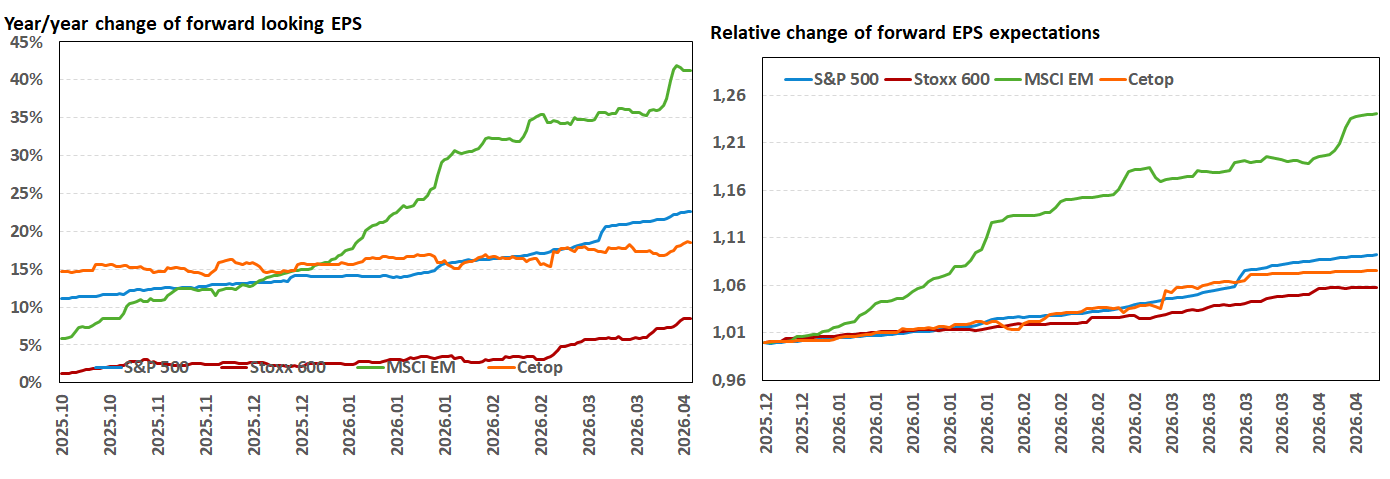
Earnings season kicked off in the US last week with Delta Air Lines’ results. Although Delta’s first-quarter revenue and profit both exceeded consensus estimates, the company now expects adjusted EPS of $1.00 to $1.50 for the second quarter, instead of the analyst’s forecast of $1.45; according to the company, rising jet fuel prices in the wake of the Iran conflict will increase costs by more than $2 billion in the June quarter. Due to uncertainty regarding the duration of the rise in fuel prices, the company has not yet released an updated annual forecast. According to the airline, despite the uncertainty, bookings were generally strong in the premium and business travel segments, as well as for transatlantic flights. This week, the earnings season will continue with earnings reports from major US banks: Goldman Sachs will report on Monday, Citigroup and JPMorgan on Tuesday, followed by Morgan Stanley and Bank of America on Wednesday.
As of noon on Monday, approximately 4% of S&P 500 companies have released their latest earnings figures so far. The 18 companies that have already released their earnings reports reported revenue that was, on average, 3.9% above expectations, while in terms of EPS, the companies that have already reported posted results that were, on average, 17.4% above expectations.
Looking at the S&P 500 index, the estimated earnings growth rate for the first quarter is 12.6% (year-over-year) according to FactSet, which is higher than the ten-year average earnings growth rate of 10.3%. Among the index components, 51 companies have issued negative EPS forecasts for the first quarter, while 58 have issued positive ones. The estimated earnings growth rate for the S&P 500 index for the full year is expected to be 17.6%.
Looking at the eleven sectors of the S&P 500, eight sectors are expected to see earnings growth (year-over-year) in the first quarter, led by the technology, materials, and financial sectors; based on current expectations, three sectors may see a decline in earnings for the quarter. Earnings growth in the technology sector could be very strong at 45% in the first quarter, while within the sector, companies in the semiconductor industry are expected to see the largest earnings growth (95%, year-over-year).
S&P500 technical picture
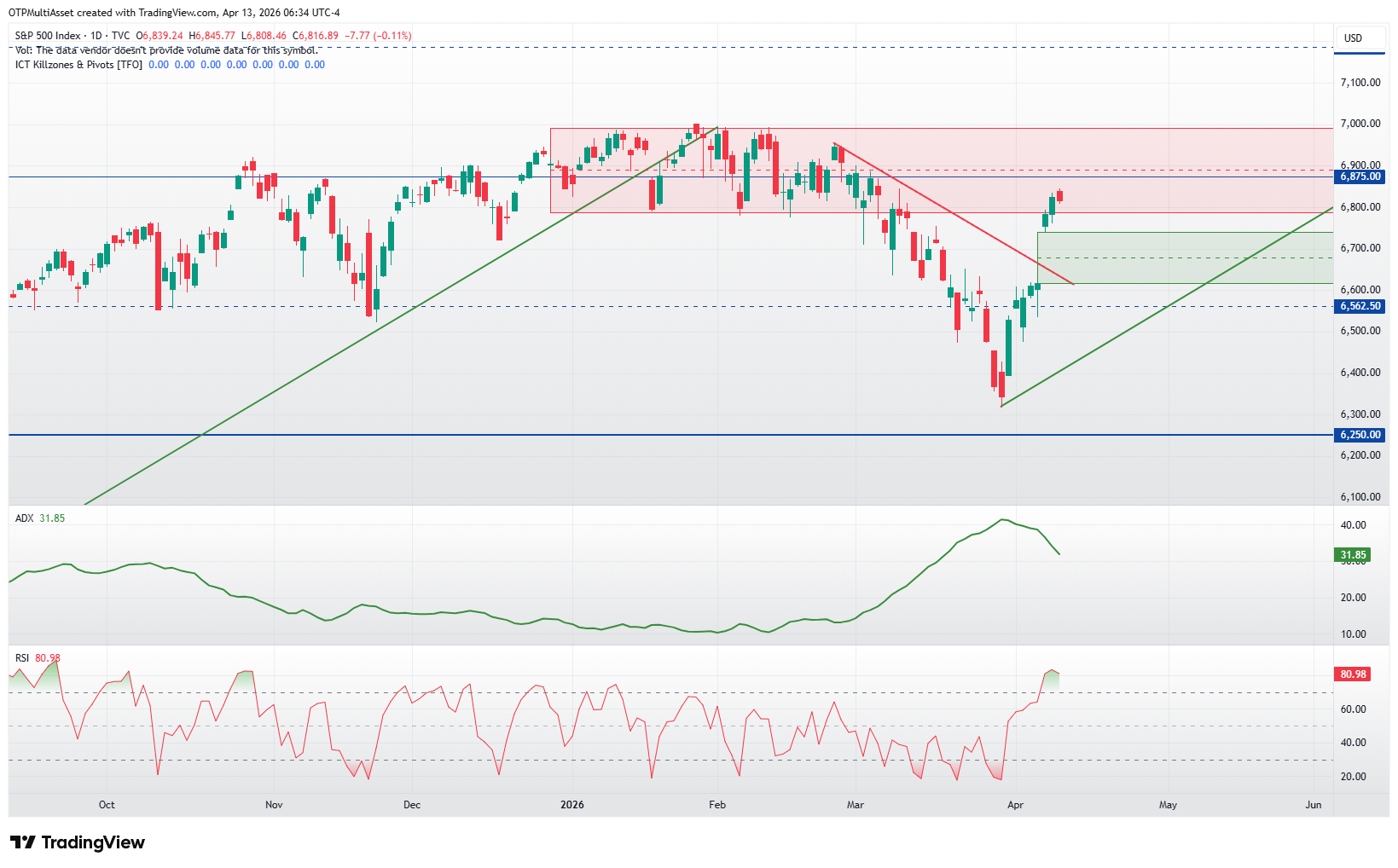
In the short term, the index has broken through and may have re-entered the zone that previously acted as resistance. 6875 could be an important resistance level, and the uptrend line will soon be at 6562. The index may move within this range in the short term. Later, if it breaks the uptrend after turning down from a lower high, a more significant change could occur.
Get more out of your investments!
Global Markets Services
OTP Global Markets offers a broad range of services in the field of local and international money and capital markets.
Read morePrivate Banking Services
Personal care and expertise with OTP Private Banking, along with the knowledge, security, and innovations of a multinational banking group.
Read more