
Despite the government crisis, the Romanian stock market is near record highs
Related content
US bank shares fell
The third-quarter earnings season in the US has picked up pace following the release of the latest figures from US banks. Based on preliminary expectations, the third quarter is likely to have closed with strong earnings growth for S&P 500 companies, led by the energy and technology sectors. The major US banks have still achieved solid growth on an annual basis, indicating that their operations remain strong, but the pace has clearly slowed in many cases, which has tended to result in negative share price reactions.
Commodities - Technical Analysis
Gold and silver continued their downward trend, bouncing off key levels. Until their downward trends are broken, they will not be able to produce a significant rise. The fall in oil prices reversed from the $87.5 level and began a slight upward movement. Natural gas remained in an uptrend; a significant rise could even occur if it breaks out upwards. The price of copper has become stuck in a wider range, so the oversold and overbought zones may offer more favourable trading opportunities. The falling prices of wheat and corn have reached key support levels; a buying reaction from these levels could present favourable long opportunities with limited risk.
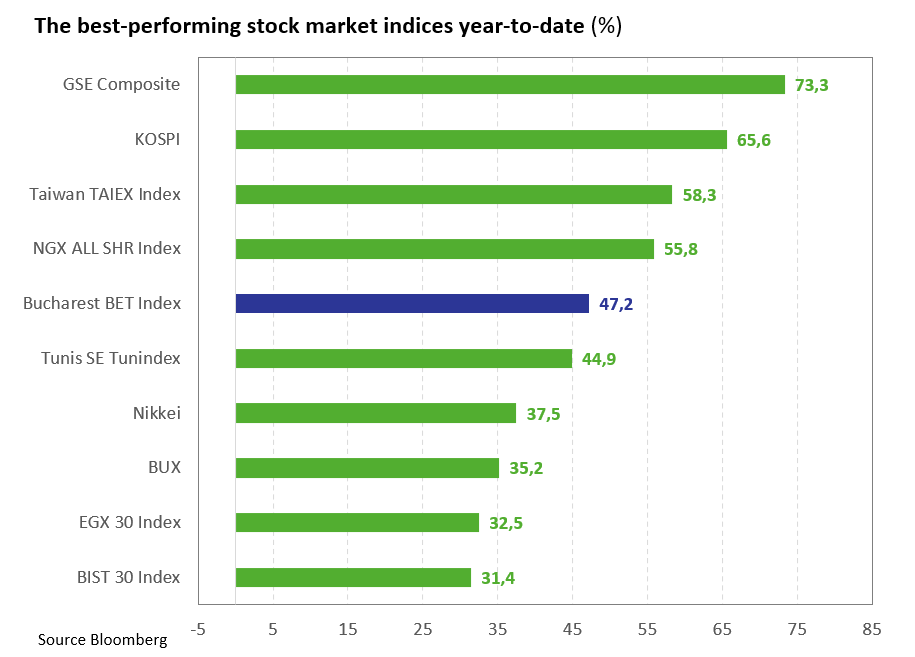
Romania has been under a caretaker government since early May, after the Social Democratic Party, together with an opposition party, successfully tabled a no-confidence motion, thereby bringing down the Romanian government. Subsequent attempts to form a government have been unsuccessful, and for now, it is unclear how the government crisis might be resolved. Despite the political uncertainty, the Romanian stock market has performed very well so far this year; the BET index is currently the fifth-best-performing stock index globally. With that in mind, we examined what might happen next in Romania.
Government Crisis in Romania
Romanian domestic politics has gone through a period full of twists and turns, but to understand the current government crisis, it is worth briefly recalling how we got to this point. After the 2024 parliamentary elections, the Social Democratic Party (PSD) formed a coalition government with the National Liberal Party (PNL) and the Democratic Alliance of Hungarians in Romania (RMDSZ), but following the results of the first round of the 2025 (repeated) presidential election, Prime Minister Marcel Ciolacu resigned and the PSD withdrew from the governing coalition. Nicusor Dan ultimately won the presidential election, and through his mediation, a coalition comprising four pro-EU parties was formed (with the participation of the PNL, the PSD, the RMDSZ, and the Save Romania Union (USR)).
Then, in late April of this year, the PSD withdrew its confidence from Prime Minister Ilie Bolojan, after which the PSD ministers resigned from the four-party coalition government. In early May, the PSD, together with the far-right opposition Alliance for the Union of Romanians (AUR), submitted and passed a motion of no confidence in Parliament, thereby bringing down the Romanian government.
Shortly thereafter, the Romanian president tasked his advisor, EU Parliament member Eugene Tomac, with forming a government; but Tomac returned the mandate a few days later. The president then entrusted Adrian Vestea (then vice president of the PNL) with forming a government (without consulting the PNL), however, the Romanian Parliament did not grant a vote of confidence to the cabinet proposed by Vestea.
The parties subsequently proposed additional candidates for prime minister, but the president rejected all of the proposals, explaining that none of them would have had the necessary majority in the subsequent parliamentary vote of confidence. According to the president, the main point of contention among the parties was not the identity of the prime minister, but rather the composition of the future governing coalition. Ilie Bolojan is currently leading Romania as acting prime minister, and as the political stalemate drags on, the possibility of early elections has been raised on several occasions. According to the relevant constitutional provisions, dissolving Parliament would require two unsuccessful attempts to form a government within sixty days (one such attempt has taken place so far, at the end of June).
Romania Has Avoided a Credit Rating Downgrade for Now
International credit rating agencies are also closely monitoring developments in Romania’s domestic political situation; Romania’s debt rating is at the lowest level of the investment grade category according to all three major rating agencies. For now, Romania has narrowly avoided being downgraded to junk status; after the Romanian government appealed the decision and provided Fitch with additional information, the rating agency ultimately maintained Romania’s BBB- rating (with a negative outlook).
Moody’s then also affirmed Romania’s rating (Baa3, with a negative outlook), acknowledging the faster-than-expected decline in the Romanian budget deficit following last year’s assessment, while emphasizing the need for continued fiscal consolidation, as any stall in this process carries a risk of a downgrade. S&P (whose next credit rating decision is due in early October) expects the Romanian economy to stagnate this year, with GDP growing at a rate of 2.5% next year. The consensus currently forecasts stagnation for this year, followed by 2.3% GDP growth in 2027.
Furthermore, it could not be ruled out that the government crisis might also slow down the reforms necessary for Romania to secure European Union funds, so it was good news that, at the end of July (before the late-August deadline), the Romanian parliament was able to pass several of the laws required to unlock EU RRF funds, which amounts to more than four billion euros in funding for Romania.
The Romanian stock market is performing well this year
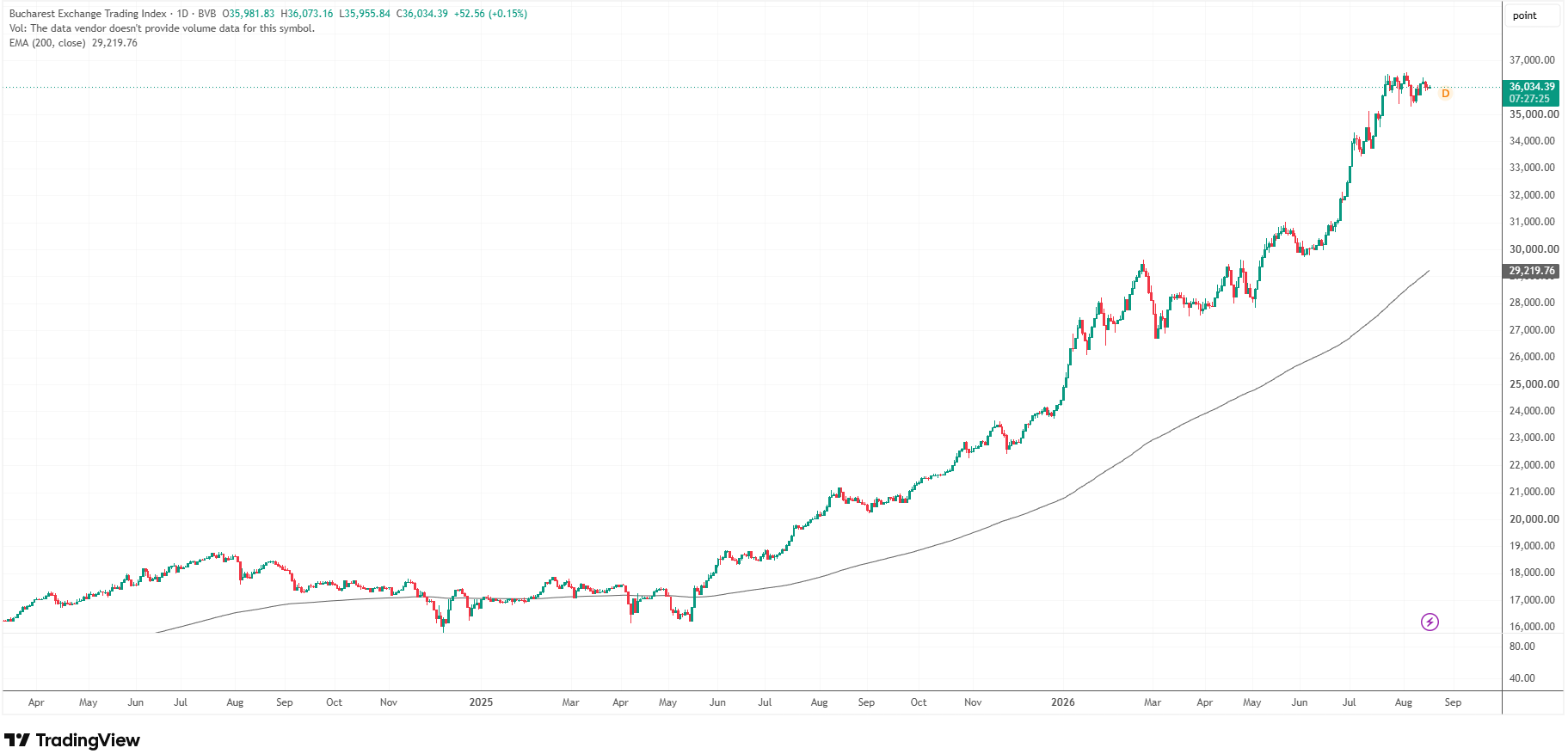
Domestic political uncertainty had unsettled market participants before: the 2024 presidential election, followed by the decision to invalidate its first round, and then the repeat election—rich in twists and turns—held a year later may have prompted investors to adopt a wait-and-see approach. The Romanian stock market essentially traded sideways between September 2024 and May 2025, but after pro-European Nicusor Dan won the presidential election, the Bucharest index began to rise again.
Overall, the Romanian stock market had a strong year last year, rising by approximately 45%, and the rally on the Romanian stock exchange has continued this year. So far this year, the BET index has gained more than it did in all of 2025 combined. Despite domestic political uncertainty, the local stock index has risen 47% so far this year (as of August 17), making the BET Index currently the fifth-best-performing stock index globally (based on the indices’ performance measured in their local currencies).
The three largest companies on the Bucharest Stock Exchange—Banca Transilvania, OMV Petrom, and Romgaz—collectively account for nearly 50 percent of the index. All three companies have performed very well so far this year: Romgaz has posted the strongest performance this year with a 90% increase. Looking ahead, Romgaz’s revenue and EPS are expected to grow at single-digit percentage rates this year, while the consensus currently forecasts double-digit percentage growth on both lines next year. For the second-best-performing company, Banca Transilvania (+41%), the consensus expects revenue growth of nearly 9% this year, accompanied by an EPS decline of about 5%. Looking at the third-best-performing company in the index so far this year, OMV Petrom (+29%), market participants expect revenue growth of about 15% this year, along with EPS growth of more than 80%, while analysts expect an approximately 8% decline in revenue alongside nearly 15% EPS growth in 2027.
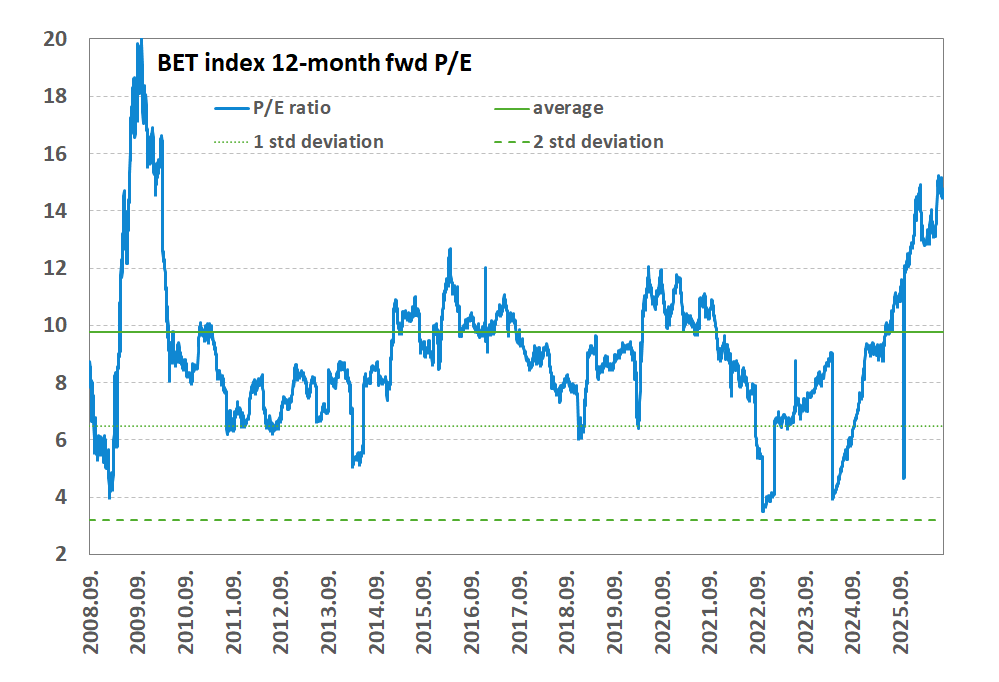
In addition to the significant weight of the energy and banking sectors in the Romanian stock index, the index provides direct exposure to the Neptun Deep gas project through companies such as OMV Petrom, Romgaz, and Transgaz. These companies are expected to benefit from the ramp-up of the Neptun Deep offshore natural gas production project, which is set to begin next year. In terms of valuation, the Romanian stock market’s forward P/E ratio of 14.6 is higher than the index’s historical average and the MSCI Emerging Markets Index (10.1x).
According to the leader of the Social Democrats, there may be better chances of forming a government after the parliamentary summer recess, although he also acknowledged that the necessary number of votes from members of parliament to secure approval for the next cabinet is not currently available. If a government can be formed this fall and Romania is able to avoid early elections, market participants will once again be able to focus on the fundamentals. However, if domestic political uncertainty were to intensify further, it could cast a shadow over the Romanian stock market’s performance down the road.
BET index
Get more out of your investments!
Global Markets Services
OTP Global Markets offers a broad range of services in the field of local and international money and capital markets.
Read morePrivate Banking Services
Personal care and expertise with OTP Private Banking, along with the knowledge, security, and innovations of a multinational banking group.
Read more