
Cybersecurity: should we really be worried about Anthropic’s solutions?
Related content
US bank shares fell
The third-quarter earnings season in the US has picked up pace following the release of the latest figures from US banks. Based on preliminary expectations, the third quarter is likely to have closed with strong earnings growth for S&P 500 companies, led by the energy and technology sectors. The major US banks have still achieved solid growth on an annual basis, indicating that their operations remain strong, but the pace has clearly slowed in many cases, which has tended to result in negative share price reactions.
Commodities - Technical Analysis
Gold and silver continued their downward trend, bouncing off key levels. Until their downward trends are broken, they will not be able to produce a significant rise. The fall in oil prices reversed from the $87.5 level and began a slight upward movement. Natural gas remained in an uptrend; a significant rise could even occur if it breaks out upwards. The price of copper has become stuck in a wider range, so the oversold and overbought zones may offer more favourable trading opportunities. The falling prices of wheat and corn have reached key support levels; a buying reaction from these levels could present favourable long opportunities with limited risk.
The impact of artificial intelligence on cybersecurity has become one of the key investment issues of the year, as Anthropic’s new models have amplified fears regarding the industry’s long-term transformation. Although current AI solutions fundamentally affect only a narrow segment of the market and tend to appear in the form of partnerships, the pace of technological development alone was enough to significantly increase uncertainty surrounding the sector. As a result, cybersecurity stocks have underperformed this year, as the market is primarily pricing in potential future risks rather than current solutions.
In early April, another wave of sell-offs hit the cybersecurity sector after Anthropic unveiled its new AI model, dubbed Mythos. The model is capable of independently identifying vulnerabilities (security flaws) in operating systems, browsers, and other software at a higher rate than programmers or any other algorithm previously. The new solution has amplified fears that artificial intelligence could replace cybersecurity services in the long term. According to Anthropic’s own research findings, the model identified thousands of previously unknown security vulnerabilities; therefore, its publication has been postponed for the time being, given the potential risks of misuse (for example, if it were to fall into the hands of cybercriminals).
Instead, Anthropic launched an initiative called the Glasswing Project, through which it shared the technology with 12 companies — including several leading cybersecurity firms. The goal of the collaboration is to allow partners to familiarize themselves with the model, identify potential security vulnerabilities in their own algorithms, and implement product improvements. The program could have an indirect positive fundamental impact on larger cybersecurity companies, such as Palo Alto and CrowdStrike, which are among the participants. All of this weakens the market narrative that artificial intelligence will eventually replace cybersecurity services in the long term, and instead reinforces the view that AI integration will take the form of partnerships and technological collaborations.
Mythos delivers approximately 20% higher software development performance compared to previous models, which could provide a competitive advantage over current market solutions in the areas of vulnerability assessment and security information and event management (SIEM). However, these segments together account for only about 10% of the global cybersecurity market. The vast majority of corporate IT security spending continues to be directed toward protecting workloads, networks, and endpoints, where LLM-based solutions currently lack the real-time data and telemetry necessary for effective threat prevention. As a result, artificial intelligence can currently only address limited areas of cybersecurity.
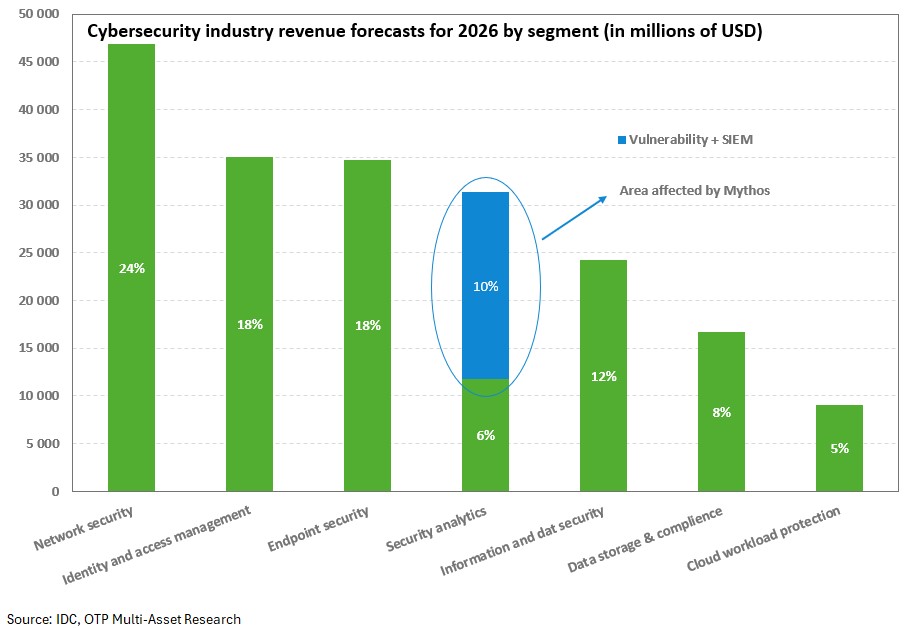
Another factor limiting the widespread adoption of the model is the significantly higher usage cost, which is approximately five times that of previous-generation models per token. This cost level may already pose an economic barrier in high-volume enterprise use cases — especially under heavy workloads — while continuous, real-time threat detection may also entail disproportionately high operational expenses. Taken together, these factors can significantly limit the scalable and cost-effective applicability of AI-based cybersecurity solutions in the short term.
At the same time, technology is advancing faster than ever; Anthropic unveils new developments practically on a weekly basis, so it cannot be ruled out that AI models comparable in efficiency to current ones will emerge in the medium term and become economically viable to operate. Although current artificial intelligence solutions are not yet suitable for fully replacing cybersecurity services, the potential for this in the future has significantly increased technological risk in the sector. This uncertainty has clearly prompted investors to exercise caution, leading to risk-averse behavior and contributing to the cybersecurity industry’s relative underperformance within the broader stock market this year.
Overall, the direct impact of artificial intelligence on the cybersecurity industry is currently limited to only a narrow segment, while Anthropic’s moves point more toward cooperation and ecosystem-based partnerships rather than toward replacing the services of market players. In addition, the high operational costs of AI solutions may continue to hinder widespread and cost-effective adoption in the short term. For these reasons, we believe the problem for cybersecurity on the AI front lies not with the solutions we have seen so far, but with what is yet to come — and it is primarily this risk that the market has priced in so far this year. However, we currently see that the leading segments of the cybersecurity market remain difficult to displace, partly due to AI solutions’ limited access to real-time data and telemetry, and partly due to structural barriers stemming from the regulatory environment.
Get more out of your investments!
Global Markets Services
OTP Global Markets offers a broad range of services in the field of local and international money and capital markets.
Read morePrivate Banking Services
Personal care and expertise with OTP Private Banking, along with the knowledge, security, and innovations of a multinational banking group.
Read more