
Could the Indian stock market rebound?
Related content
Take-Two: GTA VI Success Could Trigger a Technical Turnaround
Last week’s decline occurred amid extremely strong negative momentum. In such an environment, it is natural that on the buy side—especially when using momentum-based screening—we find very few potential candidates. Accordingly, we are unable to recommend any stocks this week that would show a clear buy signal. Take-Two, however, which appears on our list of Favorite Stocks, could come close to a buy signal if certain conditions are met. The stock is holding up well despite the negative market sentiment, so it’s worth keeping on your watchlist, as it could benefit from a broad market turnaround. In addition, GTA VI’s better-than-expected sales figures could serve as a significant growth catalyst for the company.
International Markets - Technical Analysis
Despite last week’s sharp sell-off, U.S. stock markets had already been moving in a downward correction trend. If the current pace continues, they may soon reach levels from which they could stage a meaningful upward correction. In contrast, the DAX and Stoxx 600 indices only experienced a strong sell-off last week, which broke their upward trends during the week and also altered the market structure. The emerging markets index has so far shown only a moderate correction, but even it could not avoid the decline. The target of the downward trend-confirming pattern that has formed may soon be reached for this index as well.
The Indian stock market did not perform well in the first half of this year, but a dramatic turnaround began in late October, and the ETF tracking the country’s stock market surged, so that with the gains of the past few weeks, it has now recouped most of this year’s losses. Recently, due to questions surrounding the artificial intelligence trade, India’s role as a potential AI hedge may have gained prominence. For the rally to continue, in addition to improving local earnings dynamics, an easing of headwinds related to high oil prices may also be necessary going forward.
The Indian stock market saw a major turnaround in October
The Indian stock market did not perform well in the first nine months of the year. Early in the year, the focus shifted rapidly from US-India trade negotiations to the conflict in the Middle East and rising oil prices, given that nearly half of India’s crude oil imports passed through the Strait of Hormuz. Although India has taken steps to diversify its imports, overall, creeping inflation, the weakening rupee, and rising global yields have also posed headwinds.
In October, however, a marked turnaround began; net portfolio investments by foreign market participants in the local stock market have totaled nearly $10 billion so far this month, surpassing the previous monthly record set in November 2020. The iShares MSCI India ETF (INDA) has risen more than 15% from its October low. More than $300 million in fresh capital flowed into the ETF during the week ending November 13, while inflows exceeded half a billion dollars in the first two weeks of November.
Although the Indian stock market—which had previously taken a back seat due to limited exposure to AI, more subdued corporate earnings growth, and higher energy prices—has once again become the focus of attention amid a slump in global tech stocks, while local earnings prospects appear to be improving. For the fiscal year ending in March, some forecasts project that earnings for companies in the MSCI India Index are expected to grow by ~16% (compared to growth rates of 12% and 10% in the previous two years).
Is there still room for further rise?
Market participants increasingly view the liquid, high-volume Indian stock market as an “AI hedge,” and the shift toward Indian equity markets may also have been supported by the drop in oil prices in November, which may have provided some relief to India’s current account balance and eased the pressure on input costs in oil-intensive sectors.
Investor’s optimism regarding India was clearly reflected in Citi’s decision to raise its 12-month price target for the Nifty50 (which could represent an ~8 percent upside potential from current levels), while HSBC and Goldman Sachs also upgraded their recommendations on the Indian stock market to “overweight.” This shift was also reflected in investor positioning: according to Bank of America’s Asia Fund Manager Survey, a net 5% of fund managers were overweight in Indian stocks during the period between November 6 and 12 (for the first time since January).
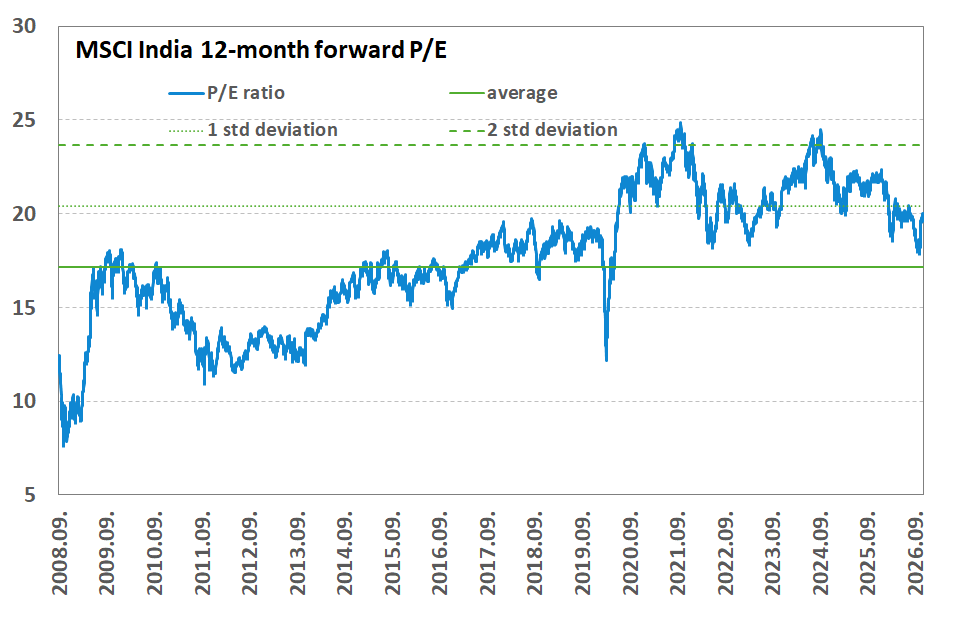
Although the MSCI India Index’s forward P/E ratio of 20 remains higher than that of the MSCI Emerging Markets Index (7.55) and the index’s long-term average (17.15), valuations have clearly moderated compared to the local highs reached in 2024. At the same time, forward earnings expectations for the MSCI India Index are also rising steadily.
It is also worth mentioning that tax changes that could support the local stock market may be on the agenda: the finance minister recently seemed open to the possibility of changes regarding the securities transaction tax and the long-term capital gains tax, although a favorable decision cannot yet be taken for granted. The proposals include a 50% reduction in the securities transaction tax levied on the purchase and sale of shares, as well as a reduction in the long-term capital gains tax, which is currently 12.5%.
Overall, the Indian stock market suddenly surged relatively sharply in a short period of time; amid the uncertainties surrounding the artificial intelligence trade, India’s role as a potential AI hedge may have been reevaluated. Even if the uncertainties surrounding the artificial intelligence trade were to subside over time, for optimism toward the Indian stock market to intensify, it may require not only improving local earnings dynamics but also an easing of the headwinds associated with high oil prices. Meanwhile, the signing of a trade agreement between the US and India could also serve as a positive catalyst down the road.
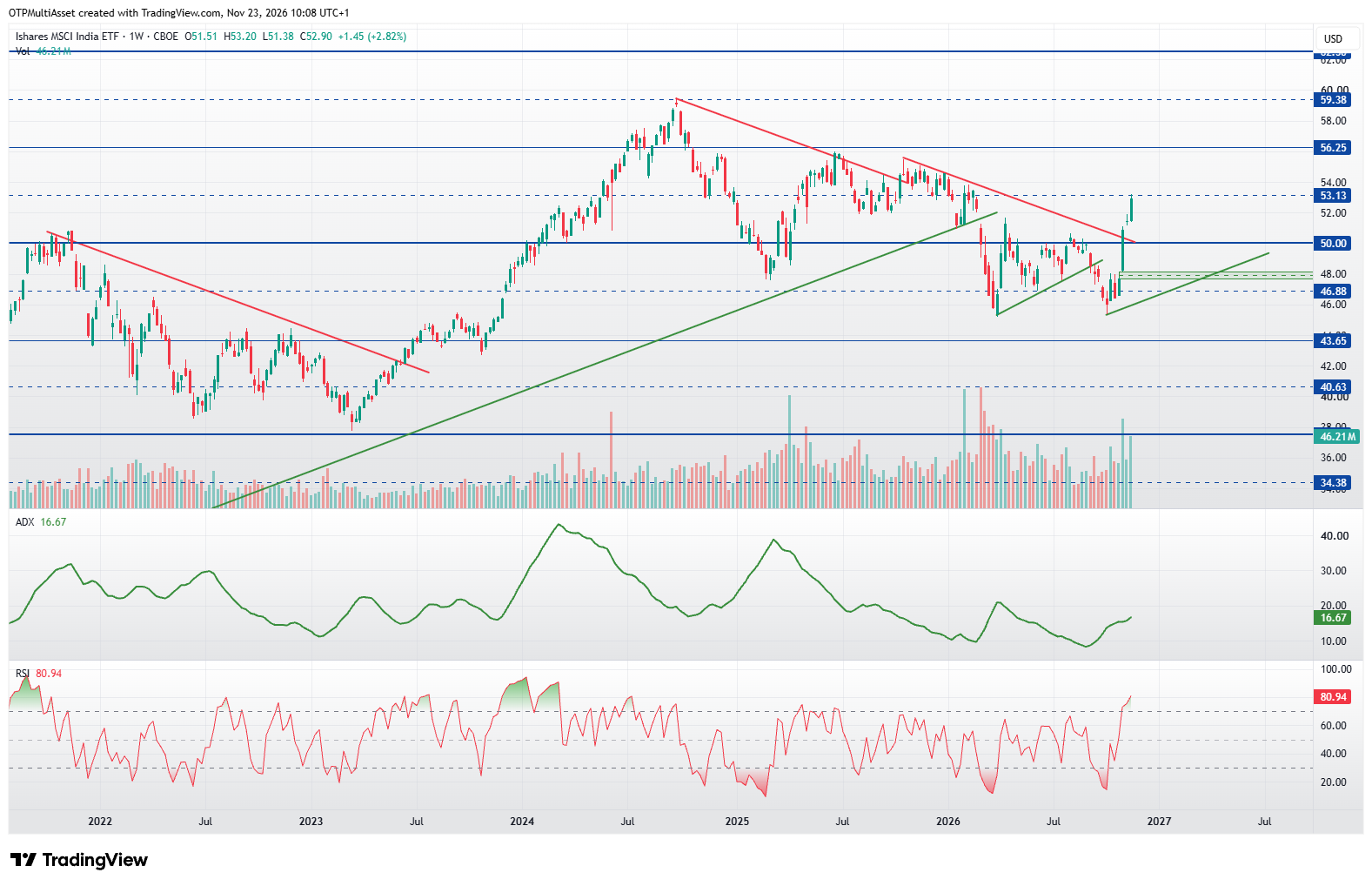
INDA - iShares MSCI India ETF technical picture
Two weeks ago, the price broke out of the correction phase, and closing above the 50 level signaled a buy. Since the long-term primary trend remains bullish, in this situation, the previous high—around the 60 level—can be set as a minimum target price. Stronger resistance is expected around 62.5, though the current pattern does not rule out the possibility of reaching higher target prices.
The price should no longer sustain a close below 50. In the event of a pullback, this level could present a favorable buying opportunity. The thick green trendline is currently quite far away, so a significant decline would only be expected if it were broken—which does not appear to be a likely scenario at this time.
Get more out of your investments!
Global Markets Services
OTP Global Markets offers a broad range of services in the field of local and international money and capital markets.
Read morePrivate Banking Services
Personal care and expertise with OTP Private Banking, along with the knowledge, security, and innovations of a multinational banking group.
Read more