
Broadcom: The long-term story is still intact, but the quarterly results failed to impress the market
Related content
US bank shares fell
The third-quarter earnings season in the US has picked up pace following the release of the latest figures from US banks. Based on preliminary expectations, the third quarter is likely to have closed with strong earnings growth for S&P 500 companies, led by the energy and technology sectors. The major US banks have still achieved solid growth on an annual basis, indicating that their operations remain strong, but the pace has clearly slowed in many cases, which has tended to result in negative share price reactions.
Commodities - Technical Analysis
Gold and silver continued their downward trend, bouncing off key levels. Until their downward trends are broken, they will not be able to produce a significant rise. The fall in oil prices reversed from the $87.5 level and began a slight upward movement. Natural gas remained in an uptrend; a significant rise could even occur if it breaks out upwards. The price of copper has become stuck in a wider range, so the oversold and overbought zones may offer more favourable trading opportunities. The falling prices of wheat and corn have reached key support levels; a buying reaction from these levels could present favourable long opportunities with limited risk.
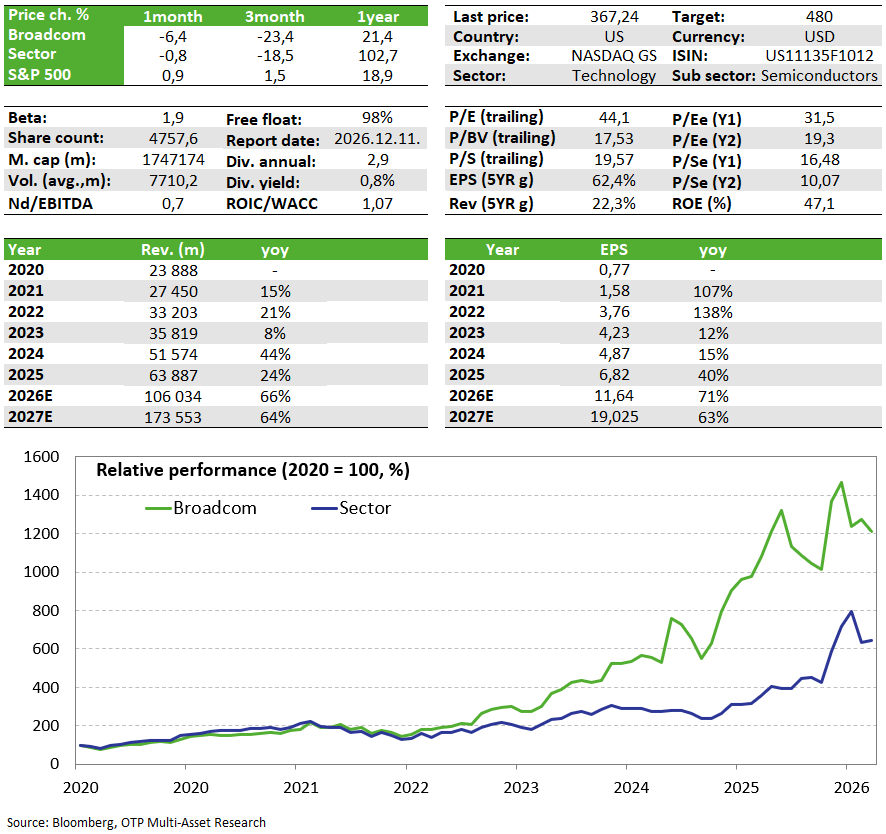
Broadcom, one of the leading players in the market for custom-designed AI chips, released its quarterly results on last Wednesday. The company’s figures were mostly in line with or slightly exceeded expectations, while its forecast for the current quarter proved to be rather conservative, reaching only the lower end of the consensus range. However, the lack of positive surprises was partially offset by the chipmaker’s longer-term outlook, which projects a further uptick in demand for AI and anticipates that revenue from the AI chip business will double by 2027 and 2028. The strong long-term growth outlook continues to support the company’s favorable fundamentals, so we are maintaining the stock on our Equity Top Pick List.
Quarterly Report
Expectations were high for Broadcom, which has underperformed its industry peers this year, after key players in the AI chip market — Nvidia and Marvell — outlined impressive growth prospects for the next year and a half last week. Although Broadcom has been able to keep pace with its rivals based on its longer-term AI outlook, its results and forecast for the current quarter — lacking any major positive surprises — may have disappointed investors overall. As a result, the stock is likely to receive a rather unfavorable market reaction initially.
The company reported revenue of $29.59 billion for the quarter just ended (+86% YoY), exceeding analysts’ expectations of $29.45 billion. The main driver of growth was AI semiconductor products, whose revenue rose 221%, significantly outperforming the consensus. In contrast, the infrastructure software segment underperformed expectations and continues to show subdued growth momentum. Earnings per share rose to $3.32 during the quarter (+96% YoY), exceeding the $3.23 EPS consensus estimate.
The chipmaker expects AI momentum to accelerate in the future. Based on guidance for the current quarter, revenue could grow by 93% year-over-year, though this may still fall just short of analysts’ expectations. AI chip sales are likely to remain the main driver of growth; the company has raised its revenue forecast for this year from $56 billion to $58 billion. In addition, it has raised its AI chip revenue forecast — previously projected for 2027 at over $100 billion — to $115 billion, while it now expects revenue of $230 billion from this segment by 2028. This significantly exceeds the analyst consensus of $180 billion.
The positive outlook is supported not only by strong demand for data center networking solutions but also by the acceleration of custom-designed AI chip programs. As a result, they will be able to deliver 5 gigawatts (GW) of computing capacity to Anthropic in 2027, up from the previous 3 GW, which could make the company their largest customer. Subsequently, capacity could rise to as much as 10 GW starting in 2028, while OpenAI’s capacity could reach 5 GW by then. Over the next year and a half, they could supply three generations of chips to Meta, while Google could continue to contribute tens of billions of dollars in revenue. These programs improve the visibility of revenue for the coming years and mitigate risks related to the sustainability of growth.
In addition, the company’s management indicated that demand for chips continues to exceed Broadcom’s shipping capacity, primarily due to supply constraints. To alleviate this, the company is stepping up its investments in expanding semiconductor manufacturing capacity. Overall, the lack of significant positive surprises in the quarterly report may put pressure on the stock price in the short term; however, the long-term growth outlook remains favorable given the current, more modest valuation.
Investment Thesis
The wave of AI infrastructure development could also provide Broadcom with a favorable structural tailwind. Within the AI megatrend, as the focus gradually shifts from training to deployment in the coming years, the inference phase will gain importance, and custom-designed AI chips (ASICs) could be the winners, as they can be optimized for specific tasks and are energy-efficient. Broadcom is the market leader in this segment.
The TPUs, co-designed with Google, are competitive with Nvidia GPUs during the inference phase, and as things stand, they outperform GPUs in terms of energy efficiency; thus, in a scenario where energy becomes the bottleneck in AI, the company’s solution could gain value. Furthermore, an Nvidia GPU costs nearly ~3x as much as a TPU, so if hyperscalers find themselves in a tight cash-flow situation, the TPU could be a favorable alternative, as it is not only cheaper to purchase but also cheaper to operate, given that it offers a performance-per-watt ratio that is ~2x as good as that of Nvidia’s previous-generation product.
In the short term, a further increase in the 2026 and 2027 capital expenditure plans of hyperscalers could serve as an additional catalyst — particularly in the case of Google and Meta, which are among the six major customers to whom Broadcom supplies custom-designed AI chips.
In early March, Broadcom announced that it had secured its supply chain for the 2026–2028 period, both in terms of memory and TSMC’s high-end manufacturing capacity. Furthermore, in recent weeks, it has entered into long-term agreements with Anthropic, Meta, and Google for ASIC shipments; it reported an agreement with the latter extending through 2031, which could help provide longer-term revenue visibility for the company and mitigate risks related to the sustainability of its growth rate.
Valuation
The company’s profit margin is over 50%, while its EBITDA margin is close to 70%; only Nvidia has comparable figures in the industry. Furthermore, it is one of the top semiconductor companies in terms of growth; analysts expect average annual revenue growth of around 60% and EPS growth of over 75% for the period from 2026 to 2028. Despite this, the stock is trading at a discount of around 20% compared to its competitors. Based on valuation metrics, even a share price of $480 appears fair. The company’s debt burden is not significant; it has a net debt-to-EBITDA ratio of just 1.1, which, combined with strong cash flow generation, can be considered a healthy level.
Risks
One of the key risks associated with Broadcom is potential margin compression, which stems from the rising proportion of AI-related semiconductor product sales in the revenue mix. This exerts downward pressure on the company’s overall gross margin, given that the IT infrastructure business operates with an exceptionally high gross margin of approximately 93%, compared to the roughly 60% level for AI-focused semiconductor products. Although the market has already priced this in, there may be more positive surprises here than in the early March flash report, which indicated no short-term pressure on margins.
In addition, the proportion of sales in China remains relatively high, at about 17% (although this proportion is declining year over year), which could pose a geopolitical risk. There is also significant customer concentration in the semiconductor business: the vast majority of revenue comes from six major customers. Intensifying competition, particularly from Marvell Technology, which could eventually take market share away from Broadcom, also poses a risk. Furthermore, increasing risks related to the financing of investments in AI infrastructure could negatively impact the company, as it could the entire semiconductor industry.
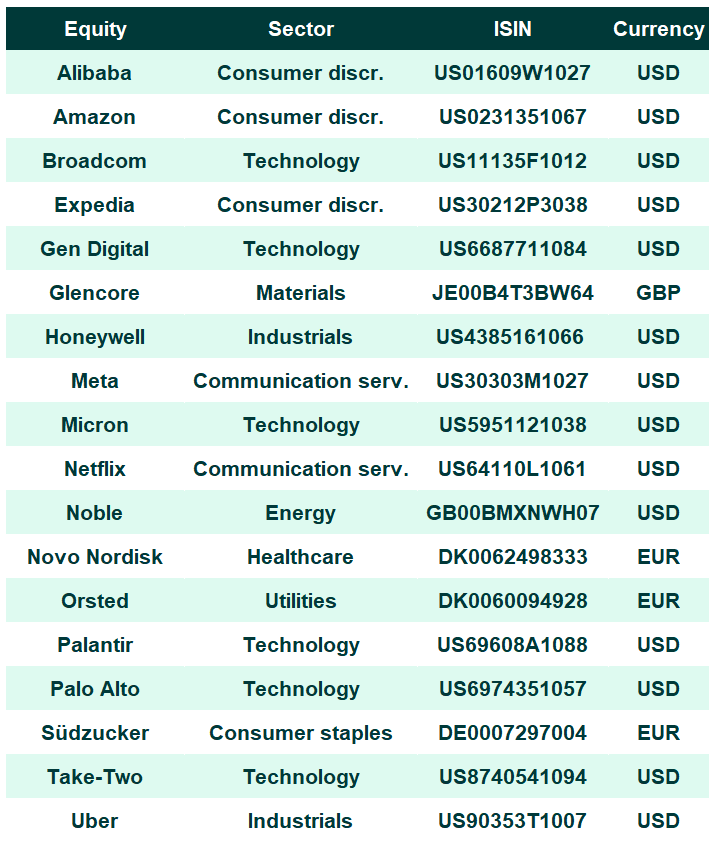
Equity Top Pick List (updated)
Get more out of your investments!
Global Markets Services
OTP Global Markets offers a broad range of services in the field of local and international money and capital markets.
Read morePrivate Banking Services
Personal care and expertise with OTP Private Banking, along with the knowledge, security, and innovations of a multinational banking group.
Read more