
Brazil: New US Tariffs Are Coming
Related content
US bank shares fell
The third-quarter earnings season in the US has picked up pace following the release of the latest figures from US banks. Based on preliminary expectations, the third quarter is likely to have closed with strong earnings growth for S&P 500 companies, led by the energy and technology sectors. The major US banks have still achieved solid growth on an annual basis, indicating that their operations remain strong, but the pace has clearly slowed in many cases, which has tended to result in negative share price reactions.
Commodities - Technical Analysis
Gold and silver continued their downward trend, bouncing off key levels. Until their downward trends are broken, they will not be able to produce a significant rise. The fall in oil prices reversed from the $87.5 level and began a slight upward movement. Natural gas remained in an uptrend; a significant rise could even occur if it breaks out upwards. The price of copper has become stuck in a wider range, so the oversold and overbought zones may offer more favourable trading opportunities. The falling prices of wheat and corn have reached key support levels; a buying reaction from these levels could present favourable long opportunities with limited risk.
The United States is imposing a new tariff on imports from Brazil, although several product categories have been exempted from the measure. It is quite possible that Brazil will face additional tariffs later on, but the initial market reaction following the announcement did not appear to be particularly negative. This may be attributed, on the one hand, to the exemptions from the tariffs and, on the other hand, to the fact that Brazil was able to partially offset the effects of previous US tariffs by redirecting its exports to other countries. However, the new tariffs are not only an economic issue but also a political one, and market participants are weighing whether the Brazilian president will be able to turn this to his advantage in the presidential election campaign.
New Tariffs Are Coming Against Brazil
The US Trade Representative announced that a 25 percent tariff will be imposed on certain Brazilian imports starting July 22, citing “unfair trade practices” as the reason. This follows the US Supreme Court’s decision earlier this year to overturn the US president’s 50 percent tariffs on Brazilian goods as well; under the relevant law, the 10 percent global tariff imposed by the administration may remain in effect for a maximum of 150 days. The legal basis for the tariffs now imposed by the US is more flexible, allowing for the application of country-specific tariff rates without time limits.
The 25% tariff, which takes effect in July, will apply to Brazilian imports such as sugar, steel, agricultural machinery, and clothing, among other items. However, beef, coffee, rare-earth metals, and aircraft and aircraft parts will be exempt from the tariff.
In addition to this country-specific tariff, Brazil may face an additional 12.5% tariff at a later date for allegedly failing to prevent imports linked to forced labor; a decision on this matter is also expected in July. Based on previous industry estimates, both tariffs could affect ~30 percent of US imports from Brazil, meaning that US tariffs on Brazilian imports could rise to 37.5% (if the two tariff rates are added together), although this would still be lower than the 50% tariff previously imposed by the US in the summer of 2025.
The impact of the new tariff on Brazilian exports and economic growth may be mitigated not only by the large number of exemptions but also by the fact that, following last year’s tariff dispute with the US, Brazil partially offset the decline in exports to the United States by increasing exports to other countries. According to data from the American-Brazilian Chamber of Commerce, the US’s share of Brazil’s total trade fell to 9.7% in the first half of this year (compared to 12.1% in the same period of the previous year), marking the lowest level since statistics began being compiled in the late 1990s.
What happens next?
Initial market reactions were moderately negative; the Brazilian real weakened slightly against the dollar, while the Brazilian stock market fell 1.2% (on June 16). It is worth noting that the last time the Brazilian stock index saw a significantly larger (positive) price reaction was on July 10, after Brazil’s June inflation came in lower than expected—a development that some investors viewed as an argument in favor of further monetary easing.
It is worth noting, however, that while annual inflation also slowed in June, it has now exceeded the central bank’s target range of 3% ± 1.5 percentage points for the second month in a row. The Brazilian central bank has cut its benchmark rate by 25 basis points three times this year, but due in part to gradually rising inflation expectations driven by the effects of the conflict in the Middle East, market participants see less room for further rate cuts this year.
Looking at the bigger picture, relations between the US and Brazil have been rather turbulent of late. Washington recently designated two Brazilian organized crime groups as terrorist organizations, and the latest US tariffs have further heightened uncertainty. In addition to the economic impacts of the tariff issue, its political implications may be at least as important—if not more so—given that Brazil will hold a presidential election in October, and the new tariffs could shape the domestic political narrative.
The current president, Lula, has previously been able to turn the escalating trade tensions between the US and Brazil to his advantage. And there is a chance that the presidential campaign strategy attempt to link the tariffs to Flávio Bolsonaro. According to the latest polls, the incumbent president is leading his challenger (the son of former President Jair Bolsonaro), after Flávio Bolsonaro’s popularity declined following the earlier release of an audio recording linking him to a key figure in a large banking scandal.
As expected, volatility is increasing as the Brazilian presidential election approaches; however, it appears for now that, despite the new tariffs, Brazil and the United States would prefer to avoid a broader trade conflict. For the MSCI Brazil Index, forward-looking earnings expectations have started to climb again over the past week, while valuations are not stretched. The MSCI Brazil Index’s 12-month forward P/E ratio of 8.39 is lower than that of the MSCI Emerging Markets Index (10.73). Overall, therefore, it will continue to be worth keeping an eye on the Brazilian stock market in the coming months.
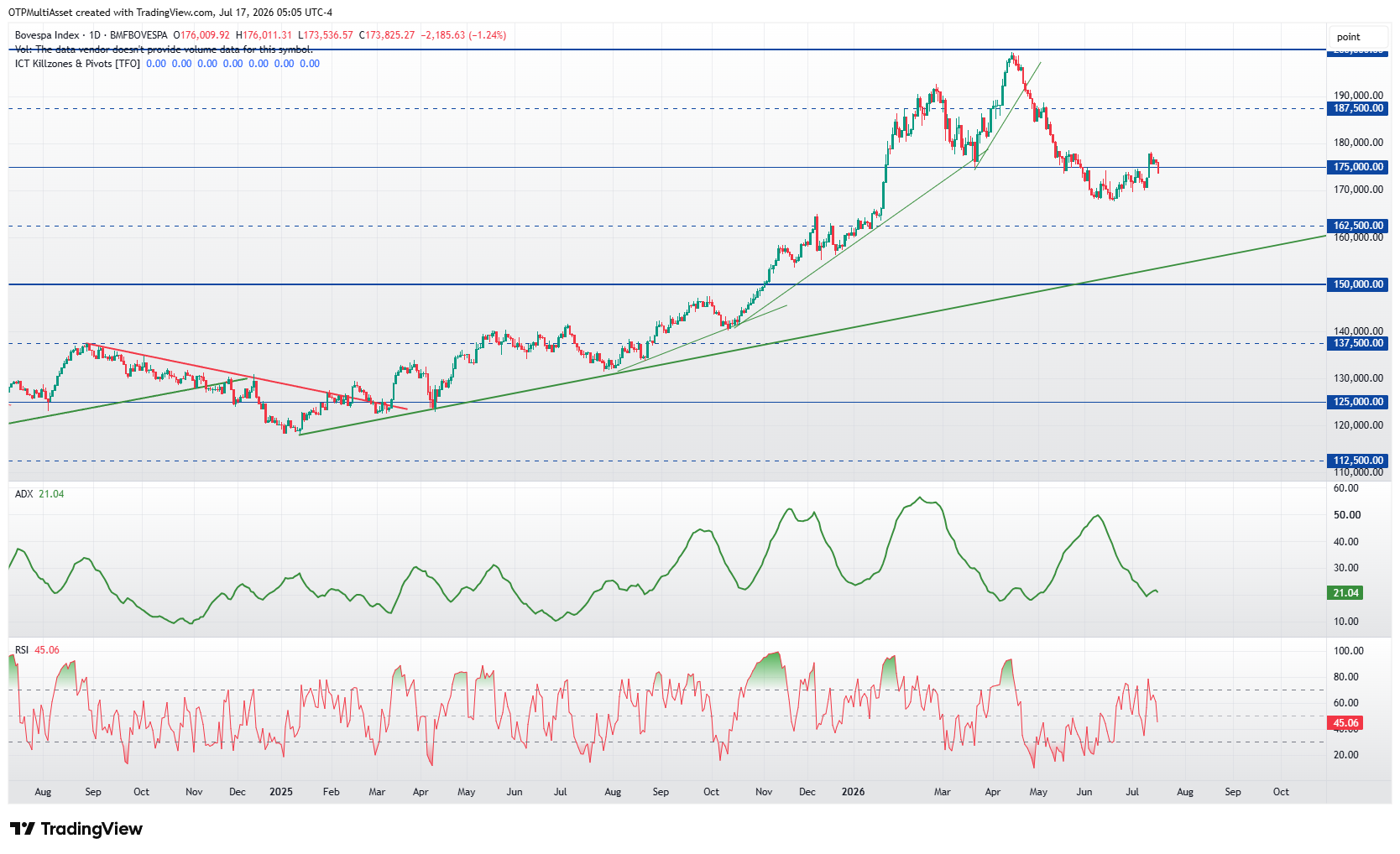
Bovespa technical picture
The uptrend that began in April 2025 followed a hyperbolic pattern and peaked this past April. A break in the steepest trend could trigger a correction phase and a return to the uptrend. There is very strong support around 150,000, but support could extend as far as 162,500. Currently, the formation of a lower high could reinforce the downtrend; taking a long position does not seem like a good idea at this time.
Get more out of your investments!
Global Markets Services
OTP Global Markets offers a broad range of services in the field of local and international money and capital markets.
Read morePrivate Banking Services
Personal care and expertise with OTP Private Banking, along with the knowledge, security, and innovations of a multinational banking group.
Read more