
Brazil: new highs, tariffs, elections
Related content
US bank shares fell
The third-quarter earnings season in the US has picked up pace following the release of the latest figures from US banks. Based on preliminary expectations, the third quarter is likely to have closed with strong earnings growth for S&P 500 companies, led by the energy and technology sectors. The major US banks have still achieved solid growth on an annual basis, indicating that their operations remain strong, but the pace has clearly slowed in many cases, which has tended to result in negative share price reactions.
Commodities - Technical Analysis
Gold and silver continued their downward trend, bouncing off key levels. Until their downward trends are broken, they will not be able to produce a significant rise. The fall in oil prices reversed from the $87.5 level and began a slight upward movement. Natural gas remained in an uptrend; a significant rise could even occur if it breaks out upwards. The price of copper has become stuck in a wider range, so the oversold and overbought zones may offer more favourable trading opportunities. The falling prices of wheat and corn have reached key support levels; a buying reaction from these levels could present favourable long opportunities with limited risk.
Brazil is once again in the crosshairs of market participants: renowned investor Stanley Druckenmiller also saw potential in Brazilian assets and recently expanded his portfolio with the EWZ ETF, which tracks the Brazilian stock market. There are several important events to watch out for in Brazil in the coming period: the central bank may soon cut interest rates, presidential elections are coming up in October, and Donald Trump's possible new tariff announcements may also cause surprises following the US Supreme Court's decision on US tariffs. The Brazilian stock market started the year strongly, with local stock market valuations approaching their long-term average, but all in all, there are still reasons to be optimistic about Brazil, so we will continue to closely monitor the Brazilian stock market.
Brazilian stock market starts the year strongly
Emerging markets started the year strongly, with Latin American equities benefiting from broad diversification as some market participants turned to emerging markets instead of the United States. This was also evident in the Brazilian stock market, with foreign investors investing more than R$33 billion (more than $6 billion) in Brazilian equities at the beginning of this year (up to February 11), exceeding the R$25.4 billion recorded for the whole of 2025. The Brazilian stock index rose sharply in January, repeatedly reaching new highs.
Stanley Druckenmiller (George Soros's former right-hand man) also saw potential in Brazil, and the well-known investor made several changes to his portfolio. Among the new positions taken was EWZ - iShares MSCI Brazil ETF, and Druckenmiller's fund also has call options on EWZ. The EWZ ETF has risen 22% so far this year.
However, market participants will soon turn their attention to the Brazilian central bank. Following minimal growth in the third quarter of last year, some expect that Brazilian growth may have been weak in the last three months of the year, despite the previous partial relief of US tariffs on Brazilian exports. Brazil's inflation rate remained within the central bank's target range (3%; plus or minus 1.5 percentage points) last year, reinforcing investor expectations of monetary easing. The Brazilian central bank's rate is at its highest level in about 20 years, which has eased inflationary pressures and reduced inflation expectations. The central bank kept interest rates at 15% in January, but indicated that due to the slowdown in growth and easing inflation, it would likely begin a cycle of easing in March, although it did not disclose details about the extent or duration of this.
Expectations are divided regarding the extent of the cuts that may occur in March (25 or even 50 basis points). The central bankers' caution is understandable, as the unemployment rate fell to a historic low at the end of the year, while market participants' current expectations (at the beginning of February) are for inflation to remain above 3% until the end of 2029. The approaching fall elections and the risk of increased public spending are also prompting investors to be cautious.
Investor attention turns to the presidential election
Alongside this year's nearly 7% increase in the minimum wage, Brazil is expanding the circle of employees who enjoy tax exemptions. In line with one of President Lula's key campaign promises, the new income tax exemption will apply to salaries below R$5,000 per month (more than three times the Brazilian minimum wage), which came into effect in January. This could boost the president's popularity beyond low-income voters, and some expect it to have a positive effect on economic growth. To compensate for the loss of revenue, the government has introduced a minimum income tax on incomes above 50,000 reais, in addition to a 10% withholding tax on corporate dividends transferred abroad. Amid the tax changes and ahead of the upcoming elections, market players are weighing whether the government will be able to meet its fiscal targets for this year. According to consensus expectations, the primary budget balance will not turn positive until after 2028. In addition, public debt calculated according to the Brazilian central bank's methodology is likely to continue to rise in the coming years.
As the elections approach, it increasingly appears that the current president's right-wing challenger could be Flavio Bolsonaro (the son of imprisoned former president Jair Bolsonaro), but President Lula still appears to be the frontrunner according to opinion polls. The Brazilian stock market fell sharply in early December after market participants reacted negatively to the former president's endorsement of his son's presidential candidacy, as some market participants had expected the former president to support the governor of Sao Paolo in this year's presidential election.
At an event in early February, Flavio Bolsonaro positioned himself as a market-friendly alternative to President Lula, promising tax cuts and the removal of bureaucratic obstacles, as well as adjustments to Brazilian fiscal policy. However, he did not provide any specific details about the nature of the spending cuts he has in mind. Whoever wins this year's presidential election will have work to do: according to Fitch, although Brazil made some fiscal progress last year, including improving structural revenues, the next government will have a lot of work to do after the election to achieve further and faster fiscal consolidation. Fitch believes that the increase in spending will offset the growth in revenues, and that the spending limit imposed by the fiscal rule will not prove to be a strong constraint.
Another twist in US tariffs
There has been a shift in US tariffs policy after the US Supreme Court invalidated the tariffs imposed under the International Emergency Economic Powers Act (IEEPA) on the grounds of economic emergency, although this decision does not affect the sector-specific tariffs imposed by Donald Trump through other legal mechanisms. The US president then announced a 10% global tariff on goods imported into the United States, although this would not apply to certain products (e.g., metals and energy products). Shortly thereafter, Donald Trump announced his intention to raise the new tariff to 15%.
Article 122 of the Trade Act of 1974 allows the president to impose tariffs of up to 15% on certain issues for a maximum of 150 days, with congressional approval required for any extension. The new 10% tariff has now come into effect, while according to the White House, the president remains committed to introducing a 15% global tariff, which is being worked on and is expected to be on the agenda later.
This is good news for Brazil in the short term, as the decision means that the 10% reciprocal tariff introduced last year and the additional 40% tariff previously imposed on Brazilian products are no longer in effect. The new 10% tariff announced by the US president (it is questionable whether this will actually rise to 15%) applies uniformly to Brazil, but includes product-specific exemptions (e.g., agricultural and energy products). The big question is what will happen next, as the new tariffs imposed by Donald Trump may be a temporary measure and the administration is likely to use the 150-day period at its disposal to finalize country-specific tariffs. This means that Brazilian exporters may face unexpected developments in the near future, but President Lula is optimistic and confident that they will be able to reach an agreement with the United States.
Brazilian stock market hits new highs
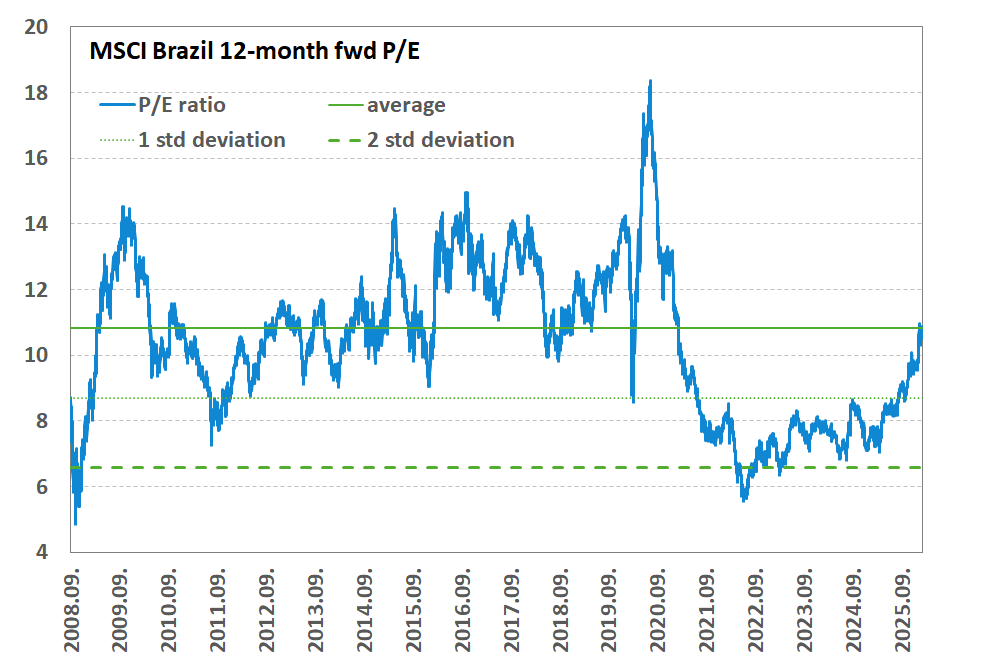
As mentioned above, the Brazilian stock market started the year strongly. After nearly a year and a half of sideways movement, Brazilian earnings expectations began to rise again in January. Following the recent rise in the stock market, the MSCI Brazil index's 12-month forward P/E ratio (10.8) has reached close to its longer-term average. However, the Brazilian stock market remains undervalued compared to the MSCI ACWI index (18.9). The market may have already begun to price in some of the monetary easing that is expected to begin soon, although the exact extent of the easing cycle remains uncertain
In addition to the upcoming interest rate cuts, the elections scheduled for the fall are another important catalyst for the Brazilian stock market, while the news flow regarding US tariffs may still hold some surprises. Thus, although the Brazilian stock market has seen a relatively large rise in a short period of time, all in all, there is still reason to be optimistic about Brazil.
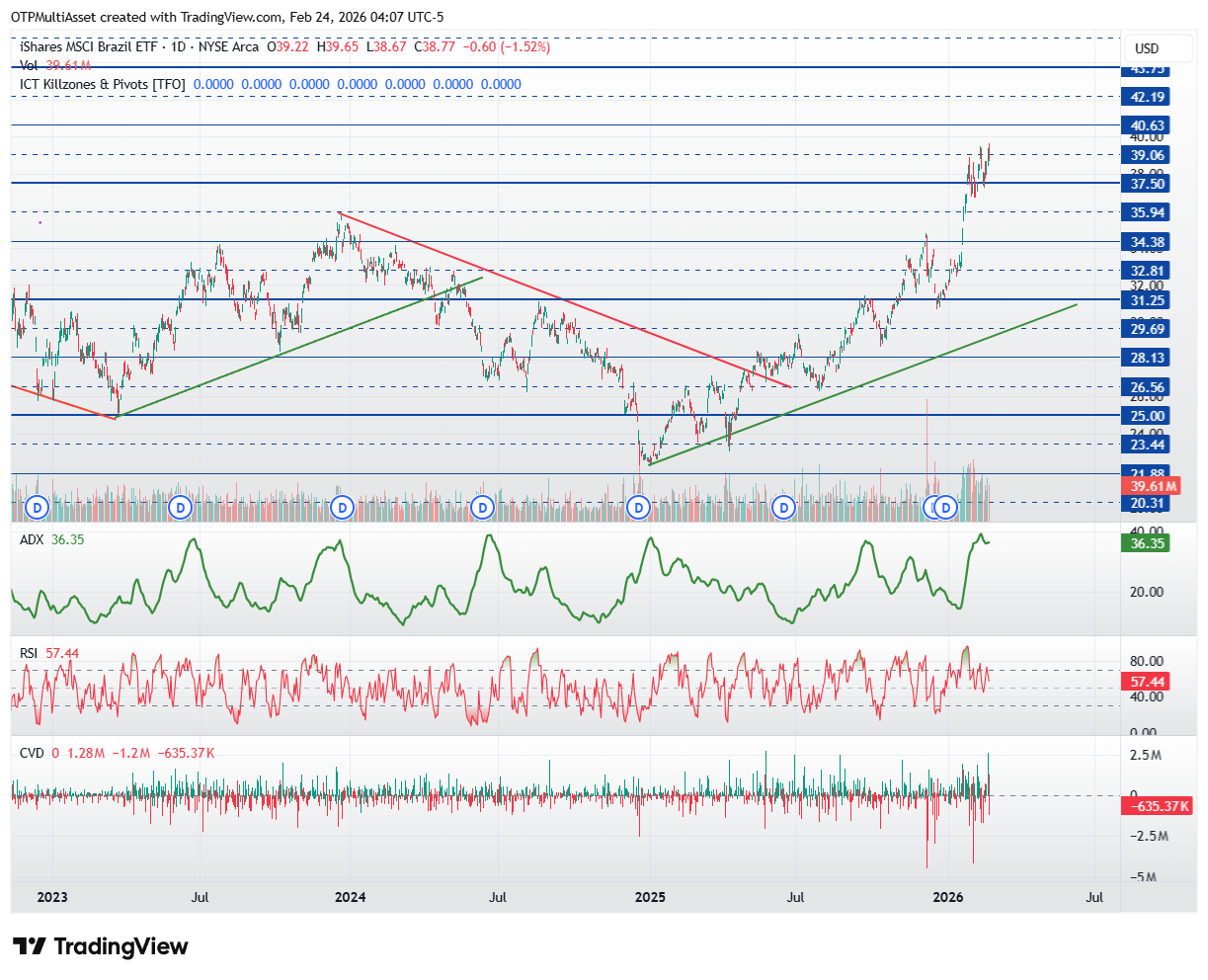
EWZ - iShares MSCI Brazil technical picture
After a significant rise, we are seeing signs of weakening momentum and a slight slowdown. The 37.5-40.63 range could essentially represent an overbought zone. The smaller the correction, the better it could be later on. A correction to around 34.38 could be realistic in the near future.
Get more out of your investments!
Global Markets Services
OTP Global Markets offers a broad range of services in the field of local and international money and capital markets.
Read morePrivate Banking Services
Personal care and expertise with OTP Private Banking, along with the knowledge, security, and innovations of a multinational banking group.
Read more