
An eventful year lies ahead for Mexico
Related content
US bank shares fell
The third-quarter earnings season in the US has picked up pace following the release of the latest figures from US banks. Based on preliminary expectations, the third quarter is likely to have closed with strong earnings growth for S&P 500 companies, led by the energy and technology sectors. The major US banks have still achieved solid growth on an annual basis, indicating that their operations remain strong, but the pace has clearly slowed in many cases, which has tended to result in negative share price reactions.
Commodities - Technical Analysis
Gold and silver continued their downward trend, bouncing off key levels. Until their downward trends are broken, they will not be able to produce a significant rise. The fall in oil prices reversed from the $87.5 level and began a slight upward movement. Natural gas remained in an uptrend; a significant rise could even occur if it breaks out upwards. The price of copper has become stuck in a wider range, so the oversold and overbought zones may offer more favourable trading opportunities. The falling prices of wheat and corn have reached key support levels; a buying reaction from these levels could present favourable long opportunities with limited risk.
The Mexican stock market could end this year on a high note, and next year promises to be very exciting. Mexico recently approved a proposal to impose higher tariffs on imported goods from China, among other countries, but it remains to be seen whether this move will pave the way for the US to ease tariffs on Mexican steel and aluminum. However, most Mexican exports to the US, which fall under the USMCA free trade agreement, are exempt from tariffs. The USMCA agreement is due for review in 2026, and market participants will be paying close attention to news flow on this issue.
In Mexico, a plan was presented in the fall that would impose high tariffs on imports from China and other Asian countries. However, due to opposition from the private sector and part of the ruling party, the lower house of parliament only approved the proposal in early December. Following amendments made in the meantime, Mexican tariffs will apply to a number of products, including steel, aluminum, auto parts, and clothing.
Following the House of Representatives, the Senate also approved the bill, which imposes tariffs ranging from five to fifty percent on products from Asian countries that have not signed trade agreements with Mexico. According to commentators, one of the aims of the move is to ease trade tensions between the US and Mexico, which could pave the way for the US to ease its tariffs on Mexican steel and aluminum. In the summer, Donald Trump issued an executive order raising tariffs on all Mexican steel and aluminum imports from 25% to 50%, but most Mexican exports to the United States, which fall under the USMCA free trade agreement, are exempt from tariffs.
The Mexican economy grew by 1.8% in the first half of this year, defying market expectations of weaker performance, although this may have been partly due to export front loading in response to uncertainty surrounding US tariffs. However, the third quarter brought a slowdown: GDP fell by 0.3% compared to the previous quarter, while the annual decline was 0.2% (and the consensus had expected an even greater contraction). Due to trade uncertainty, the aforementioned pull-forward demand had an impact in the form of lower exports, while commentators highlighted the weakening of domestic demand amid declining employment and slower wage growth. Some expectations were that moderate growth could follow in the fourth quarter, allowing the Mexican economy to avoid recession.
Following the release of third-quarter GDP data, the Mexican central bank revised its economic growth forecast for this year downward (from 0.6% to 0.3%). The central bank still expects GDP growth of 1.1% in 2026, followed by 2% growth in the following year. Central bankers have consistently expressed their concerns about the slowing economy, and in November, the central bank cut its base rate by another 25 basis points to 7.25%, a level not seen since 2022.
Mexico's inflation rate slightly exceeded preliminary expectations in November, while core inflation, excluding food and fuel prices, rose to 4.43% (from 4.28% in October). The central bank is targeting an inflation range of 3% (plus or minus one percentage point). The forward guidance accompanying the latest interest rate decision reflected a more cautious tone, while the minutes of the meeting suggest that there may be another interest rate cut in December, followed by a pause in easing at the beginning of the year. The deputy governor of the central bank warned of new inflation risks for the coming year, noting that, in addition to uncertainty surrounding tariffs, the renegotiation of the trade agreement between the United States, Mexico, and Canada (USMCA) will require greater caution from the central bank in the coming year.
An eventful year ahead for the Mexican stock market
The free trade agreement between the US, Canada, and Mexico is due for review in 2026: some market participants expect substantive renegotiation of the agreement to begin in the first half of the year, with the pace of finalization largely dependent on whether the US and Mexico can reach agreement on trade (and border security) issues. This is a key issue for Mexico, as the country is currently subject to an average US tariff of ~8.4%. At the same time, trade uncertainty is likely to remain a headwind in the short term, after the US president threatened Mexico with a further 5% tariff increase in early December in connection with a water issue. However, according to preliminary industry calculations, even if Donald Trump were to follow through on his latest tariff threat, the above-mentioned average Mexican tariff would only increase minimally (to just over ~8.7%).
Similar to the Brazilian stock market, the Mexican stock market may also close the year on a strong note, and it appears that there is still room for growth in the future. In terms of valuation, the MSCI Mexico index's 12-month forward P/E ratio of 13.35 has practically reached the valuation of the MSCI Emerging Markets index (forward P/E of 13.38). Looking at Mexico, forward earnings expectations have been rising nicely since the beginning of the summer, and analysts also appear optimistic. Twelve-month analyst expectations suggest a potential upside of around 9% for the Mexican stock market index from current levels. In the latter case, the trend is currently upward, but following the strengthening of recent months, the renegotiation of the USMCA and the associated news flow could easily lead to a more volatile period in the first half of next year. Nevertheless, it will be worth keeping an eye on the Mexican stock market next year and maintaining exposure to Mexico and Brazil in emerging markets.
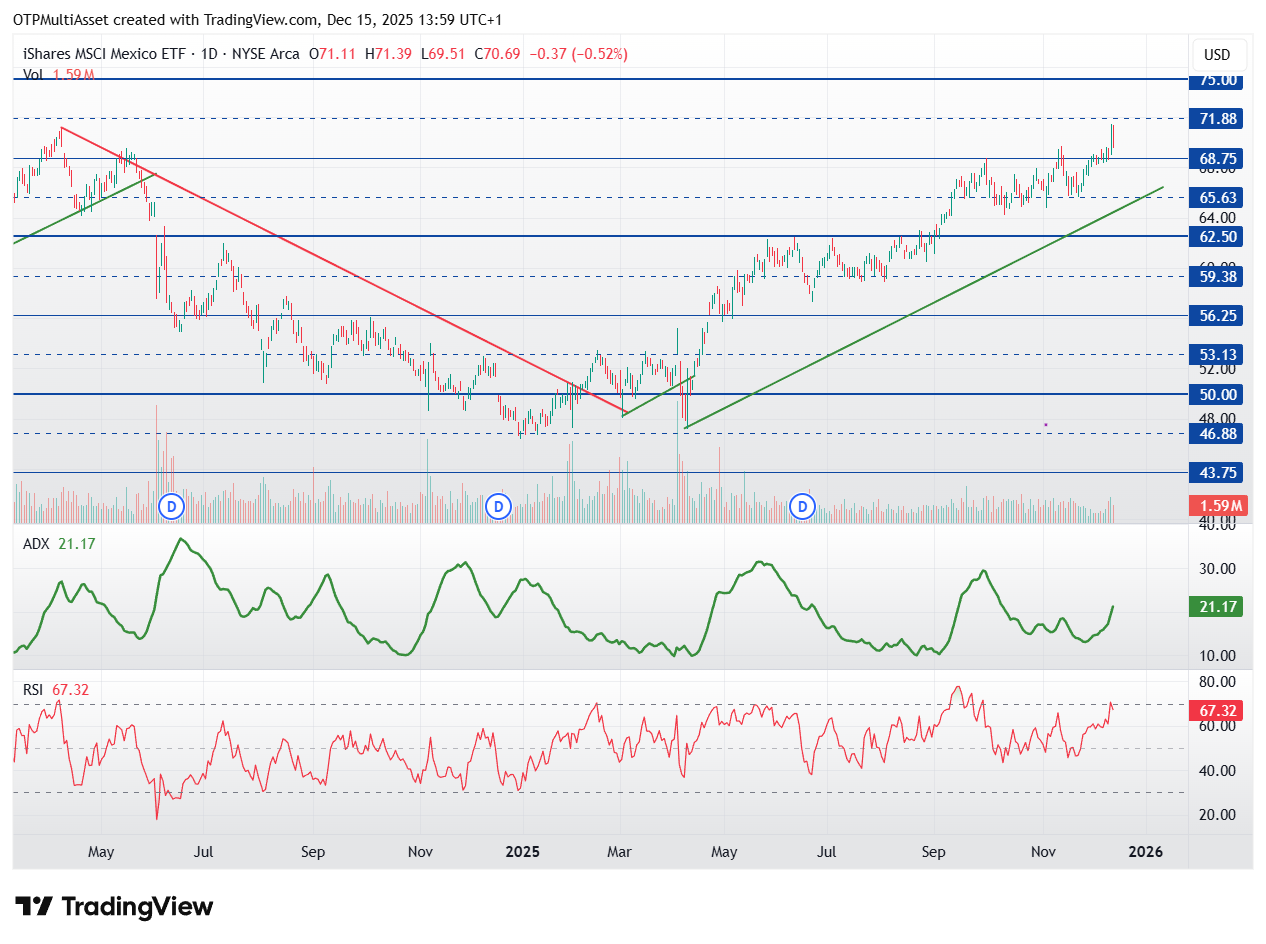
EWW - iShares MSCI Mexico ETF – technical picture
The uptrend has reached a zone where further long positions may not result in the best risk/reward ratio. The zone around 71.88-75 represents the 2024 highs, which usually act as strong resistance in such situations. The uptrend would be broken even further, at 65.63, but even so, it is far enough away that the correction alone would be significant. The momentum also shows weakness, and trading volume has decreased near the peaks, which is a warning sign. It may be worth exiting or reducing positions.
Get more out of your investments!
Global Markets Services
OTP Global Markets offers a broad range of services in the field of local and international money and capital markets.
Read morePrivate Banking Services
Personal care and expertise with OTP Private Banking, along with the knowledge, security, and innovations of a multinational banking group.
Read more