
Amazon Is Spending an Enormous Amount of Money
Related content
Spanish Utilities Defies The Market
European equities also joined last week's global sell-off. Given the exceptionally strong negative momentum accompanying the decline, it was expected that finding stocks on the verge of a bullish reversal would be challenging in these markets as well. Monday's rebound has done little to change that picture so far. Of course, there are always stocks that may offer attractive buying opportunities, but the number of technically compelling turnaround candidates remains rather limited at the moment. This week, we would highlight just one stock: Redeia, the utility company operating in Spain and Latin America. While the stock is already trading in an established uptrend, a pullback and successful retest could provide a favorable entry opportunity.
Could the Indian stock market rebound?
The Indian stock market did not perform well in the first half of this year, but a dramatic turnaround began in late October, and the ETF tracking the country’s stock market surged, so that with the gains of the past few weeks, it has now recouped most of this year’s losses. Recently, due to questions surrounding the artificial intelligence trade, India’s role as a potential AI hedge may have gained prominence. For the rally to continue, in addition to improving local earnings dynamics, an easing of headwinds related to high oil prices may also be necessary going forward.
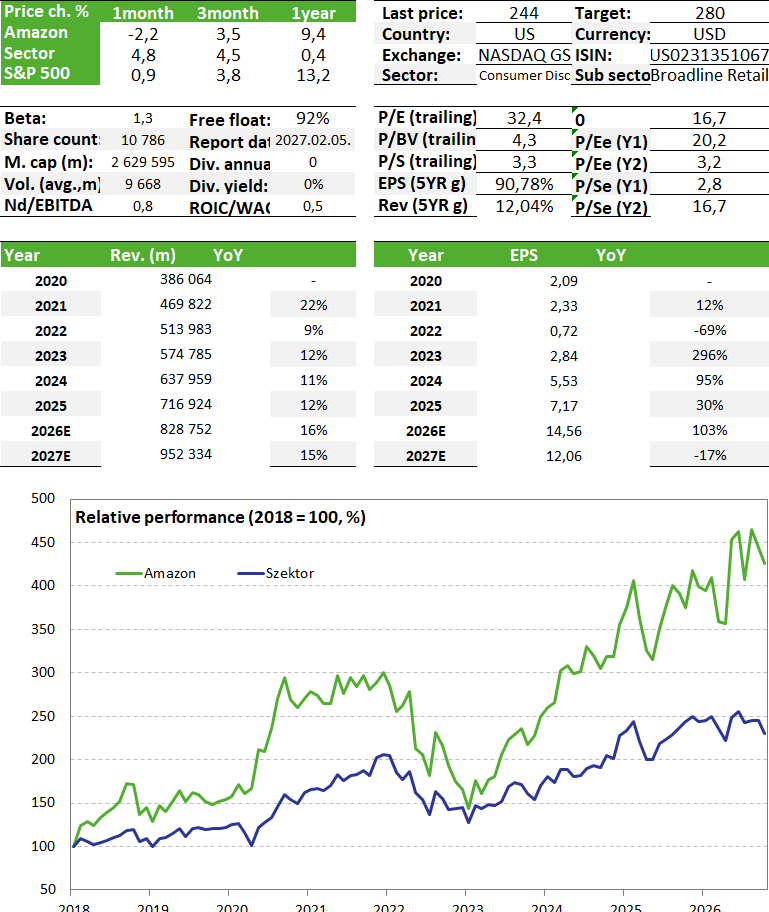
Amazon spent an enormous amount on capital expenditures in the third quarter, and shareholders are clearly not pleased. As a result, the stock fell by around 6% following the earnings release. Yet the company's core operations remain solid: AWS posted its strongest growth in five years, group-level operating income surged by 60%, and margins reached record highs. However, the massive negative free cash flow and the prospect of even higher investment spending next year are making investors uneasy.
Amazon shares remain on our Equity Top pick List.
Quarterly Report
Let's start with the most important point. AWS generated $46 billion in revenue in Q3, representing 39% year-over-year growth, marking its strongest growth rate in five years. This came in above consensus expectations, but some analysts had anticipated growth closer to 42%, a level the company ultimately failed to reach. This also helps explain the negative share price reaction, as expectations had simply been set too high. AWS operating margin improved to 28.7%.
However, management expects AWS to maintain growth above 40% over the next two years, while the company already has a $578 billion contract backlog. The capacity of newly deployed accelerator chips is being reserved by customers almost immediately, and the pace of growth is therefore determined in part by when additional data center infrastructure and computing capacity become available. At present, the key constraint appears to be the availability of infrastructure and supply rather than a lack of demand.
Amazon Bedrock (which enables companies to build generative AI applications using LLMs) is becoming an increasingly important AI platform. Enterprise customer spending on Bedrock increased nearly sevenfold, making it the fastest-growing multi-billion-dollar service in AWS history. In addition, tens of thousands of customers are already using AgentCore, and during the third quarter, twice as many agents were deployed on the platform as in the previous three quarters combined. Inference workloads already account for well over half of AWS's AI-related revenue. Since inference typically generates recurring, usage-based revenue, the widespread adoption of AI agents could provide a durable source of demand over the long term.
However, Amazon raised concerns among investors by spending $77 billion on capital expenditures in the third quarter alone. The company reaffirmed that total capex for this year will reach $220 billion, and indicated that spending is likely to increase even further next year. While trailing twelve-month operating cash flow rose 29% to $168.3 billion, highlighting the strong cash-generating capacity of the core business, free cash flow deteriorated from a positive $14.8 billion a year earlier to negative $42.4 billion. The market clearly dislikes this development, as investors are not yet convinced that these massive investments will generate adequate returns.
Retail and Advertising
North American retail revenue increased by 6% year over year, while the operating margin improved to 7.7%. Online store revenue rose by just 1.6% to approximately $68.5 billion, falling short of the $69.7 billion consensus estimate. Growth in this segment was held back by a shift in the timing of Prime Day, as last year the event took place entirely in the third quarter, whereas this year it was held in the second quarter across most major markets. .
Advertising revenue grew by approximately 11% year over year to $19.64 billion, falling short of the $20.82 billion consensus estimate. This segment was also negatively affected by the timing of Prime Day, which management estimates reduced the growth rate by 8.5 percentage points. However, the market remains skeptical that the slowdown was purely the result of this one-off factor. A deceleration in advertising revenue growth was also evident at Google, and a key question is how AI-powered shopping agents may reshape this segment in the coming years.
The company's fourth-quarter guidance also fell short of expectations, with the midpoints of management's ranges generally coming in below consensus forecasts. For now, however, we do not see any major issues at the company. While Amazon is spending an enormous amount on capital expenditures, we believe these investments are necessary to support its long-term growth and competitiveness. Admittedly, it is difficult to predict exactly how AI will reshape different industries, and those expectations can shift from quarter to quarter. Nevertheless, we continue to view Amazon as a strong player that is well positioned to benefit from the technology over the long run.
Investment thesis
- AWS is a leading player among the major cloud service providers, and this quarter once again demonstrated that the business still has significant growth potential. Management’s forecast for roughly 40% growth in 2027 and 2028 supports this view.
- The adoption of AI is still in its early stages, and even stronger growth could lie ahead in the coming years. Amazon is one of the companies best positioned to benefit from this expansion. AWS already offers a platform that customers can use to develop and run generative AI applications.
- The retail business is continuously seeking ways to improve efficiency, which could continue to support margins going forward. The company may also be among the early beneficiaries of increased automation, as greater use of robotics can further enhance efficiency. In addition, faster delivery times could help stimulate demand.
- Risks: Competition remains extremely intense in both cloud computing and artificial intelligence, and it is far from certain that Amazon will emerge as a winner. It is also unclear over what timeframe and with what returns the hundreds of billions of dollars being invested in AI-related capital expenditures will ultimately pay off.
Get more out of your investments!
Global Markets Services
OTP Global Markets offers a broad range of services in the field of local and international money and capital markets.
Read morePrivate Banking Services
Personal care and expertise with OTP Private Banking, along with the knowledge, security, and innovations of a multinational banking group.
Read more