
A new world may be dawning for Brazil
Related content
Promising technical setup in a german defense stock
Although European markets rebounded last week, they have started this week under renewed, significant selling pressure, which, for the time being, does not favour those looking to enter long positions. Based on momentum, the selling side currently still appears to be stronger. Nevertheless, amongst the shares, we would highlight Hensoldt, which presents a clear technical picture and offers a favourable entry opportunity. The company primarily develops radar systems and other electronic warfare solutions for military and security purposes.
Hungarian Equities - Technical Analysis
The BUX index has retested half of the downtrend; upside potential still appears limited, and a retest of another swing low is more likely. MOL’s share price has remained in a downtrend and could fall even lower than the most recent swing low of 4,844. Richter has also remained in a downtrend; more momentum is needed to break the trend. Only Magyar Telekom’s share price has broken out of its consolidation range and given a clear buy signal. Opus is still in a downtrend; a reversal is not yet in sight. Rába continued to trade within its consolidation range; another upward wave could follow later, provided the right conditions are met.
Elections are coming up in Brazil in October: of the two candidates who appear to be the frontrunners, current President Lula’s lead over his main challenger, Flávio Bolsonaro, appeared to be waning according to opinion polls. The race is not yet decided, and the stakes are high, as the next president will face, among other tasks, the challenge of allaying market participants’ concerns about Brazil’s growing national debt. Based on initial market reactions, investors are responding positively to Flávio Bolsonaro’s narrowing of the gap with Lula in the polls; or, to put it another way, market participants appear to be placing their trust in a stricter fiscal policy and spending cuts than before, as well as in the possibility of lower interest rates resulting from this and less government intervention. There is still roughly one month left until the Brazilian elections, and the next president will set the course for both Brazil and the local stock market in the coming period.
Brazil will elect a president in October
Elections will soon be held in Brazil: in early October, in addition to members of the lower house of Congress, voters will elect two-thirds of the Senate, twenty-seven governors, and the head of state. If no presidential candidate receives more than 50 percent of the vote in the first round on October 4, a second round will be held on October 25.
The current (left-wing) president, Luiz Inácio Lula da Silva, is now running for his fourth presidential term, while his main challenger is (right-wing) Senator Flávio Bolsonaro (the son of former President Jair Bolsonaro, who is currently serving a prison sentence). According to the latest opinion polls, the presidential race appears to be getting tighter, and Bolsonaro has been gradually closing the gap on Lula in recent weeks.
It is also worth noting that nearly half of voters reject the two frontrunners in equal measure, while other candidates face lower rejection rates, but in the meantime, they are also less well known. Some commentators note that Lula began the campaign with a smaller lead than he had in the 2022 election. The most likely scenario appears to be a runoff between Lula and Bolsonaro, though a first-round victory for either candidate cannot be ruled out.
The momentum seen at the beginning of the year has slowed
The Brazilian economy performed well in the first quarter of this year, though several pre-election fiscal support measures may have played a role in this. In addition to the previous minimum wage increase, middle-income earners benefited from a higher income tax exemption threshold, and debt relief and fuel subsidies may also have had a positive effect.
In the second quarter, however, the Brazilian economy expanded at a slower pace; between April and June, GDP grew by 0.5% compared to the previous quarter, as persistently high interest rates likely weighed on economic activity, and household consumption also declined for the first time in three quarters. The consensus forecast currently calls for 2% GDP growth this year.
Partly as a result of the government’s support measures for the population, inflation crept back up after March; however, it has now returned to the central bank’s target range (3 percent, plus or minus 1.5 percentage points). The Brazilian central bank cut interest rates for the fourth time in August; however, despite a total easing of 100 basis points since March, monetary policy remains tight. The central bank did not provide forward guidance regarding future policy, but market expectations currently point to one more 25-basis-point rate cut this year (which could bring the interest rate down to 13.75 percent).
What can we expect from the frontrunners?
In his presidential campaign, Lula can point to economic growth as well as low unemployment rates but rising living costs and a growing national debt could cast a shadow over his administration. Lula’s program would create the conditions for persistently lower interest rates, alongside responsible fiscal policy and keeping inflation under control. However, the new program contained few concrete details on this matter. It is also worth noting, however, that Brazil’s public debt-to-GDP ratio rose to approximately 82% by mid-2026, representing an increase of about 10 percentage points since Lula’s return in 2023; furthermore, interest payments on the public debt account for more than 8% of GDP.
Among the priorities for his potential fourth term, the president highlighted, among other things, strengthening the defense industry and protecting rare earth metals and critical minerals as strategic national resources, in addition to education. Lula also recently stated that he is not concerned about the trend in Brazil’s debt, and according to commentators, this may have reinforced expectations that another Lula presidency would not bring about significant changes in fiscal policy.
According to observers of his presidential campaign, Lula is running one of the most cautious presidential campaigns in recent years, in an effort to maintain his slim lead over Flávio Bolsonaro. Based on polls conducted in late August, Lula leads (37%–41%, depending on the pollster) over Bolsonaro (30%–37%), while projections for a potential runoff appeared even closer, falling within the margin of error.
If elected, Bolsonaro would introduce new fiscal rules: this would entail a ceiling on public debt, which, if a predetermined threshold were exceeded, would trigger spending restrictions, steering the budgetary trajectory toward sustainability. According to Bolsonaro, stabilizing and reducing public debt would allow Brazilian interest rates to align with the international average, and inflation could return to the middle of the central bank’s target range. In addition, the proposed spending cuts include the elimination of several ministries and restrictions on subsidized loans. The review of several government programs, as well as tax system reform and potential privatization, have also been raised.
The Brazilian stock market rebounded in August
As for market reactions, whenever a poll showed Flávio Bolsonaro closing the gap with Lula or, in some cases, taking the lead in a potential runoff, this was generally followed by a rise in the Brazilian stock market; as investors appear to be placing their trust in a stricter fiscal policy and spending cuts than before, as well as in the possibility of lower interest rates resulting from this and less state intervention.
There is still a great deal of uncertainty surrounding the details of the campaign promises, and market participants obviously want more clarity regarding Flávio Bolsonaro’s fiscal plans and the proposed spending cuts. At the same time, the race between the two candidates is getting tighter, and a poll released in early September even showed Bolsonaro with a lead over Lula in a potential runoff.
There’s still roughly a month left until the election, so we may see even more intense market volatility in the coming weeks. As the fog surrounding the election clears, uncertainty may finally subside, and the next president may chart a new course for Brazil (and the local stock market). That said, some commentators are urging caution regarding the rally in the Brazilian stock market seen since mid-August, because even if Bolsonaro were to win the presidential election, a more important question is how much of his platform he would be able to implement (and how much of that has already been priced in by market participants).
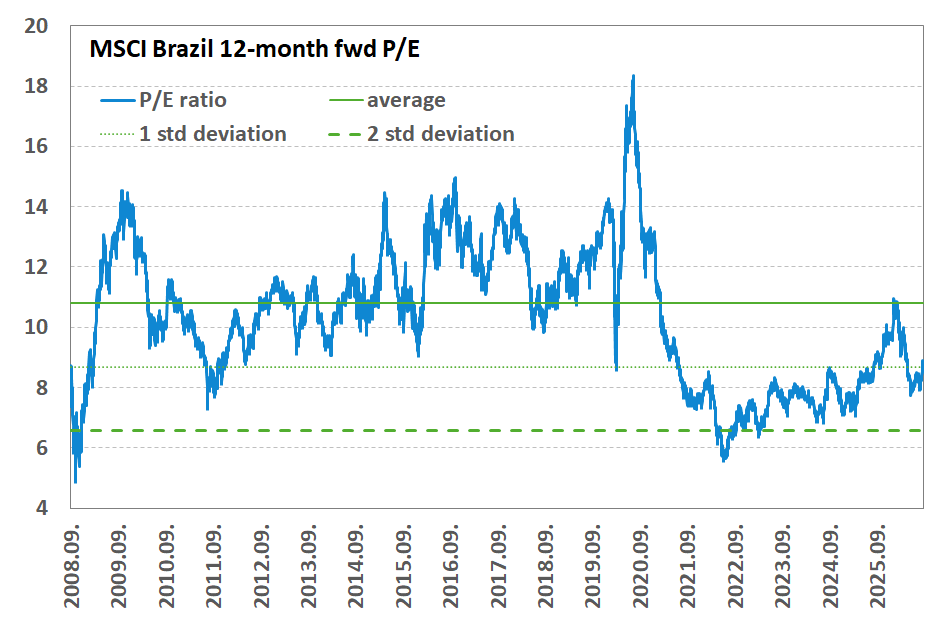
In any case, valuations are not stretched: in terms of Brazilian stock market valuations, the MSCI Brazil Index’s forward P/E ratio of 8.9 is lower than that of the MSCI Emerging Markets Index (9.96) and the MSCI Brazil Index’s long-term average (10.8).
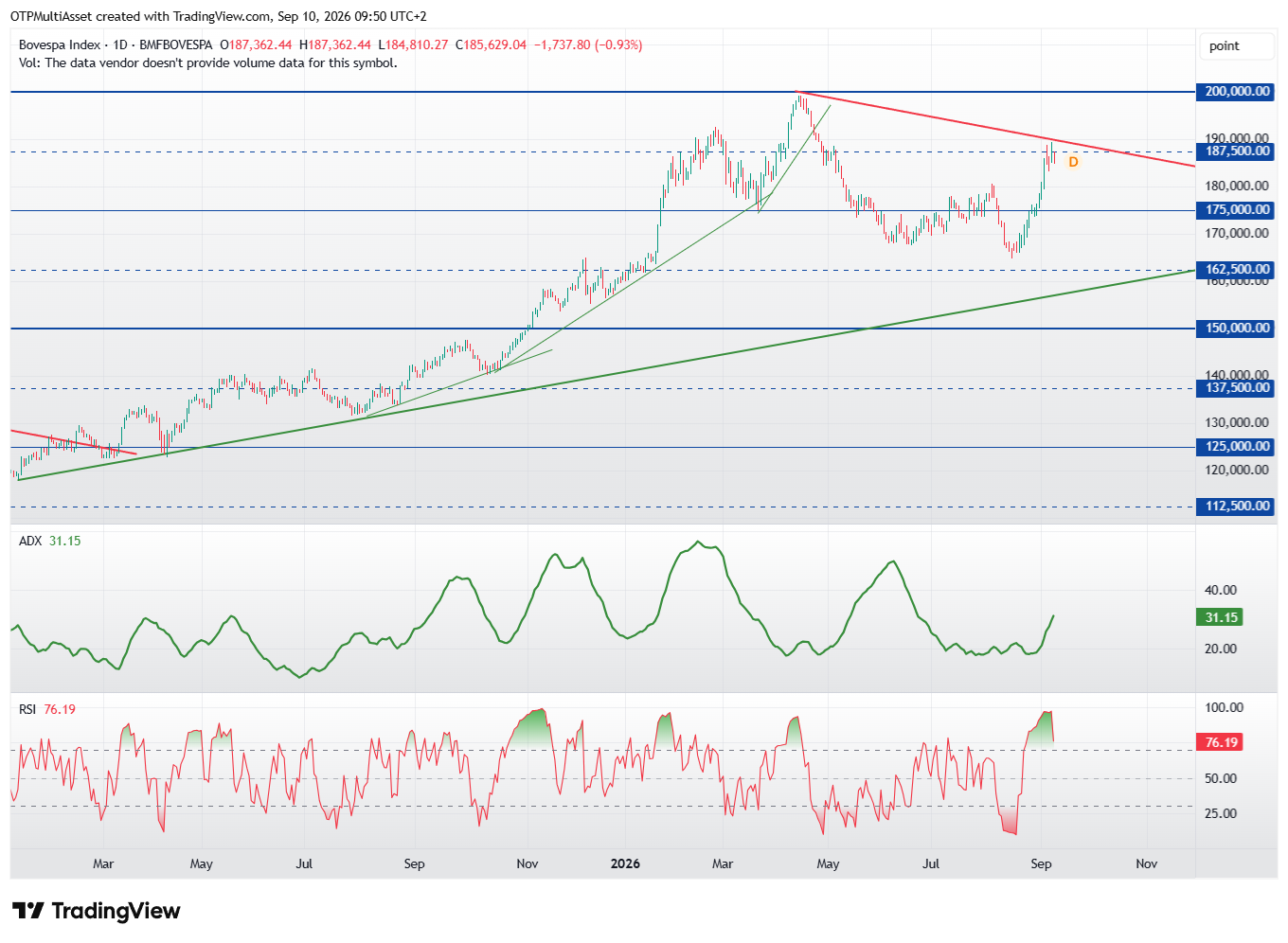
Bovespa technical picture
The correction that began this May likely ended about two weeks ago, followed by a brief upward move toward the main downtrend line. The chart currently shows an overbought condition again, so a correction or sideways consolidation may follow from here. The 175,000-point level now serves as an important support level, so it could also be a potential entry zone for long positions. In contrast, the 187,500-point level is a key resistance level; if it is broken, retesting previous highs could become a realistic scenario.
Get more out of your investments!
Global Markets Services
OTP Global Markets offers a broad range of services in the field of local and international money and capital markets.
Read morePrivate Banking Services
Personal care and expertise with OTP Private Banking, along with the knowledge, security, and innovations of a multinational banking group.
Read more