
A market-friendly finance minister is set to take office in Brazil
Related content
Commodities - Technical Analysis
Gold and silver prices reached their previously identified target zones amid a sharp decline. Trading volume has already increased significantly at these levels, suggesting that a major bottom may be forming for both precious metals. For now, however, we should expect a corrective rally rather than a new, trend-driven upward move. The decline in oil prices has also lost some of its momentum, but clear signs of a reversal have yet to materialize. Natural gas continues to move within a strong uptrend, so there may still be room for further gains. Copper has broken through its uptrend line and has reached the previously identified target price. Wheat and corn prices have fallen to key support levels, where buyers have already emerged; however, buying activity has remained subdued for now.
FX - Technical Analysis
The dollar remained strong against major currencies. The EUR/USD exchange rate broke through another support level, opening up further room for a decline for the time being. Against the pound, the curve also broke out of an important channel, which could favor a further decline in the exchange rate. The EURHUF exchange rate broke out of its contracting pattern to the upside and may now test the 375 level. The forint also continued to weaken against the dollar, so it may now test the previously identified 343 level. The USDJPY continues to move within an uptrend, though the breakout has not yet been accompanied by particularly strong momentum. Following a minor correction, the EURCHF once again turned downward near the downtrend line, continuing its downward movement.
The first fiscal package has been approved by the Brazilian Congress, although it is unlikely to be sufficient on its own to stabilize the country’s rising public debt and restore investor confidence. The administration may take further measures, and, more importantly, Brazil appears to have found its next finance minister: the chairman of Bradesco has accepted the offer to head the Finance Ministry. In Luiz Carlos Trabuco, Brazil may have a market-friendly finance minister. Investors also viewed the development as another step in the right direction, and the Brazilian stock market rebounded sharply following the massive declines of recent weeks.
Brazil may consider additional fiscal measures
Following its approval by the Brazilian Senate, the fiscal adjustment package has also passed the lower house of Congress. The measures could improve Brazil’s fiscal position by up to $10 billion next year. Among other provisions, the package enables further spending freezes, caps expenditure growth at 2%, scales back tax incentives and limits the use of tax credits.
Although these measures may have represented the president’s first attempt to ease mounting investor concerns following his re-election, markets had expected more. As the end of November approached, there were no signs of a decisive turnaround in Brazilian assets: the Bovespa index was trading close to its year-to-date low, while the Brazilian real had weakened by approximately 20% against the US dollar in the roughly one month since the second round of the presidential election.
Market participants were clearly sceptical that the measures approved so far would be sufficient on their own to stabilise public debt. Brazil’s public debt ratio has increased by more than 10 percentage points since Lula took office in 2023, pushing it above 80% of GDP, while interest payments relative to GDP also remain elevated. Investors fear a persistently deteriorating debt trajectory unless the government succeeds in implementing meaningful changes to mandatory spending. Consequently, the administration has indicated that further fiscal measures may be introduced.
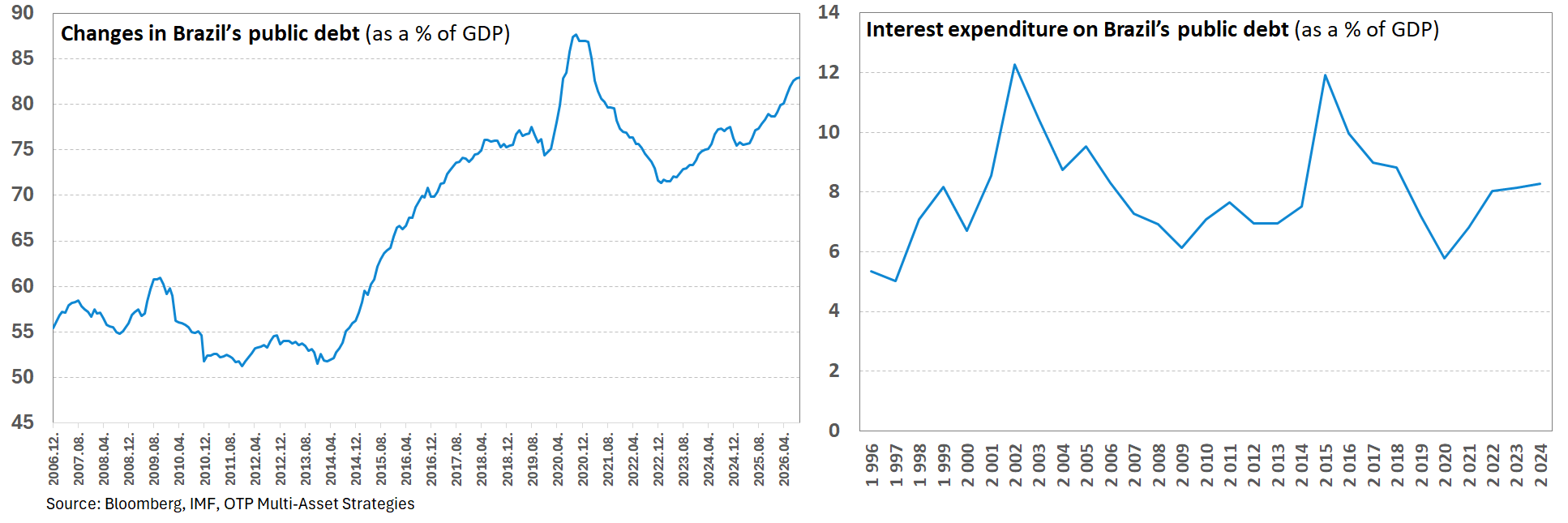
Lula may have already taken steps towards submitting a second package to Congress aimed at curbing mandatory government spending. The administration’s objective is to increase the primary budget surplus to 1.5–2% of GDP by the end of the president’s next term. The government had previously projected a primary surplus of 1.5% of GDP for 2030 in its annual budget proposal for the coming year. Another key objective is to enable Brazil to regain its investment-grade credit rating from rating agencies.
Lula reassures investors with a market-friendly finance minister
The Finance Ministry also cut its 2027 GDP growth forecast from 2.3% to 1.8%, while raising its inflation projection for next year from 3.8% to 4.5%. The revisions were attributed, among other factors, to persistently high interest rates and borrowing costs. However, the central bank’s latest survey showed that market participants were even more pessimistic, expecting GDP growth of just 1% next year alongside an inflation rate of 5.12%.
After pausing its rate-cutting cycle in November following the presidential election, Brazil’s central bank is now expected to keep its benchmark interest rate at the current level of 13.75% for longer than previously anticipated. Inflationary pressures remain a concern, partly because of the Brazilian real’s depreciation in recent weeks.
It is also worth noting that the governor of the Central Bank of Brazil has commented on the relationship between fiscal policy and inflation. In his view, government spending growth in an economy which is operating close to full employment can fuel inflation. According to the governor, Brazil does not simply face a choice between fiscal adjustment and social policy. Social programs can be preserved, but the spending rules need to be recalibrated, as the combination of expenditure growth outpacing GDP, rising real incomes and an economy operating close to full employment increases demand-driven inflationary risks.
Overall, the Brazilian administration appears willing to take further fiscal adjustment measures. Such steps will also be necessary to restore investor confidence and curb the further increase in public debt. The first fiscal package may prove insufficient to achieve these objectives, but market participants could nevertheless view it as an initial step in the right direction, particularly if it is followed by additional measures.
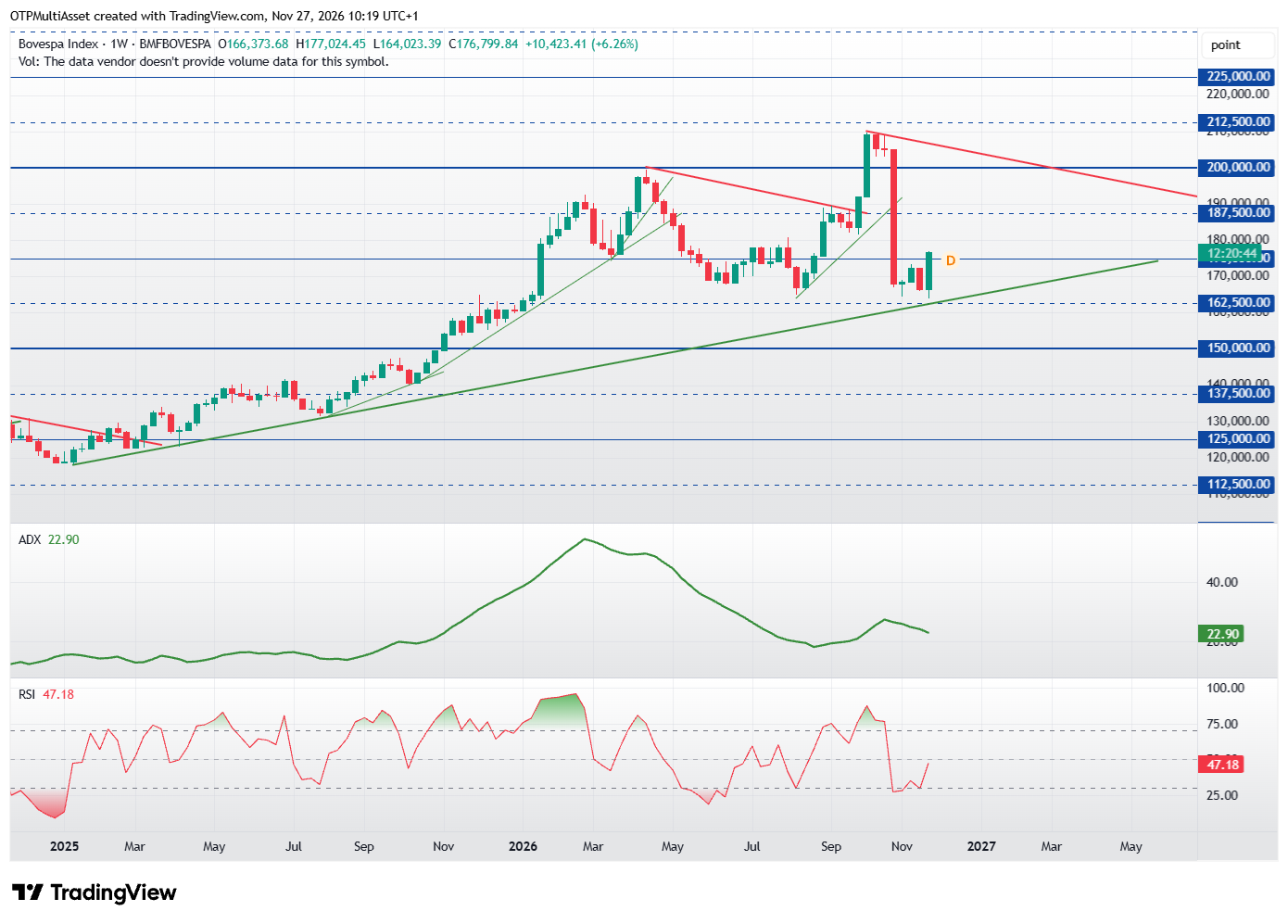
The Brazilian stock market rebounded sharply from its year-to-date low on Thursday. Although the scale of the recovery partly reflected the preceding sell-off, several positive developments may also have fueled the rally. In addition to a softer-than-expected inflation reading, reports emerged that the chairman and former chief executive officer of Bradesco could become Brazil’s next finance minister. Market participants welcomed the possibility, with commentators arguing that Luiz Carlos Trabuco Cappi could lend greater credibility to the fiscal adjustment process.
Trabuco is one of Brazil’s best-known bankers. Although he was invited to lead the Finance Ministry following Dilma Rousseff’s re-election in 2014, he declined the position at the time. This time, however, he accepted the offer, and the government confirmed his appointment as finance minister. Trabuco will hopefully be able to strike a balance between the president’s campaign promises and investors’ concerns over the country’s rising public debt. Alongside the prospect of further fiscal measures, the appointment of a finance minister with sufficient credibility and a proven commitment to macroeconomic stability is positive in its own right. The Bovespa’s gain of more than 6% on Thursday therefore appears justified.
Bovespa index technical picture
The longer-term ideal uptrend, which began in 2025, has been hovering around the 162,500 level in recent weeks. The rebound occurred above this important natural level, which could be a positive sign for long positions. Due to the post-election sell-off, the 175,000–200,000 zone is waiting to be retested. The index should ideally recoup at least half of the fall suffered at that time, but the 200,000 level may also appear within reach. As long as the thick green trendline remains intact, the long trend may persist despite the significant volatility.
Get more out of your investments!
Global Markets Services
OTP Global Markets offers a broad range of services in the field of local and international money and capital markets.
Read morePrivate Banking Services
Personal care and expertise with OTP Private Banking, along with the knowledge, security, and innovations of a multinational banking group.
Read more