
A constitutional crisis in Poland?
Related content
Investors Shifted Toward Defensive Positions
The sharp correction weighing on technology stocks has so far had a much more limited impact on European markets. In fact, certain sectors are benefiting from the ongoing market rotation, which has been increasingly favoring defensive areas. Pharmaceutical and healthcare companies, in particular, continue to stand out. This week, we take a closer look at Koninklijke Philips, the healthcare technology and medical devices company. Alongside it, BASF, the German chemicals giant, has also moved near the top of our screen. In both cases, the current constructive technical setup has been preceded by an extended period of consolidation, potentially creating attractive opportunities for long positions as the emerging trends begin to take shape.
Hungarian Equities - Technical Analysis
The BUX index’s correction has reached a zone that may once again present a selling opportunity; however, for this to materialize, further weakness must be confirmed by a strong day of selling. MOL’s share price continues to trend downward, and further downside potential may open up if it breaks below the low of the past few weeks. Richter has approached its previous key resistance level, from which it has rebounded for now; nevertheless, an upward pattern may continue to form as long as its uptrend remains intact. Magyar Telekom has been in an uptrend for three weeks now, reaching a new high, with no signs of a top yet. Opus remains in a downtrend, and there are no signs of a reversal yet. Rába continued its narrowing movement, which, under the right conditions, could later form the basis for another rising wave.
As Poland approaches the 2027 parliamentary elections, political tensions are mounting over disagreements concerning the composition of the Constitutional Tribunal. Moreover, the possibility cannot be ruled out that the governor of the central bank could soon be suspended from office in connection with a separate case, potentially deepening the political divide further. Against this backdrop, following an almost uninterrupted rally in recent months, the Polish stock market appears to be losing momentum, while the zloty has weakened to a three-year low against the euro. The domestic political situation may well have further surprises in store, while the Polish equity market, despite its strong performance so far this year, can no longer be considered particularly cheap.
What is happening in Poland?
Political tensions are escalating in Poland after Anna Korwin-Piotrowska, a judge on the Constitutional Tribunal, suspended the president and vice-president of the institution from their duties in late October and assumed control of the Tribunal. Her stated objective was to enable the constitutional judges elected by the current Polish parliament to take up their positions. However, the Tribunal’s existing leadership rejected the move, arguing that it had no legal basis. Protests began outside the building, while the Polish president cut short a foreign trip and returned to Warsaw on Friday. He was only able to enter the Constitutional Tribunal building by making his way through a cordon of riot police.
The government regards these developments as part of the restoration of constitutional rule of law. By contrast, the opposition Law and Justice party, known as PiS, and the removed leadership of the Tribunal have described the situation as a coup. To understand what is currently happening in Poland, it is worth going back a little further in time. The roots of the conflict date to 2015, when the centrist government led by Donald Tusk’s Civic Platform, or PO, handed over power to PiS following the latter’s victory in the parliamentary election.
Before leaving office, the outgoing parliament elected five judges to the Constitutional Tribunal. However, according to the Tribunal, only three of those appointments had a valid legal basis. The president of the republic at the time refused to swear in the three judges who had been validly elected, while the incoming PiS majority elected new judges to all five positions. The outgoing governing coalition may have exceeded its authority by filling two judicial vacancies prematurely, but PiS also challenged three appointments that the Constitutional Tribunal had deemed valid. During its subsequent eight years in government, PiS introduced wide-ranging judicial reforms that, according to critics, placed the courts under greater political influence.
As a consequence, Donald Tusk’s government disregarded the rulings of the Polish Constitutional Tribunal and, until this year, refrained from nominating new judges to vacant positions. This spring, however, the Polish government began filling the vacancies. So far this year, eight constitutional judges have been elected, meaning that the judges chosen by the current parliamentary majority would, in theory, hold a majority on the Tribunal.
Although constitutional judges are elected by parliament, they are required to take their oath of office before the president of the republic. However, the Polish president refused to administer the oath to five of the judges, who consequently took their oaths before parliament instead. The president of the Constitutional Tribunal, a former minister in a PiS government, nevertheless denied the new judges access to the court. In doing so, the Tribunal’s president also disregarded a directive from the European Court of Human Rights stating that the constitutional judges must be allowed to take up their positions.
What Could Happen Next?
Anna Korwin-Piotrowska has convened a general assembly of the Constitutional Tribunal’s judges for 3 November in an attempt to find a solution to the situation. However, it remains uncertain how quickly the current crisis can be resolved. The Polish president recently described the situation as a violation of the constitutional order, while Prime Minister Donald Tusk argued that the president should recognise the constitutional judges lawfully elected by parliament and ensure that they are able to take up their duties.
Amid the dispute surrounding the Constitutional Tribunal, the Polish stock market underperformed regional equity indices on Monday. The WIG20 index continued to decline on Tuesday morning, while the zloty weakened against the euro to levels not seen for around three years.
Poland’s next parliamentary election is still a year away, but the election campaign appears to have already begun. In addition to the confrontation over the Constitutional Tribunal, another key issue to watch will be the fate of the governor of the National Bank of Poland. A parliamentary investigation found that the central bank governor may have favoured the previous right-wing administration ahead of the most recent parliamentary election.
According to the findings of the earlier investigation, the central bank governor may have misled the Ministry of Finance regarding the National Bank of Poland’s 2023 profit. The central bank may also have indirectly financed the budget deficit through bond purchases during the Covid-19 pandemic. The Polish parliament is expected to vote later this month on whether to suspend the governor from office. He has not only denied the allegations but has also indicated that he would not recognise parliament’s forthcoming decision.
An escalation in the confrontation between the central bank governor and the government, together with the dispute surrounding the Constitutional Tribunal, could intensify investors’ concerns about Poland’s institutional stability. Although the Polish economy is expected to continue expanding at a healthy pace this year, with the current consensus forecast pointing to GDP growth of 3.5% in 2026, the country’s budget deficit is among the highest in the European Union. Moody’s downgraded Poland’s sovereign credit rating to A3 at the end of September, the fourth-lowest investment-grade rating, and warned that the country was struggling to contain its deficit. S&P is expected to announce its decision on Poland’s sovereign rating later this week.
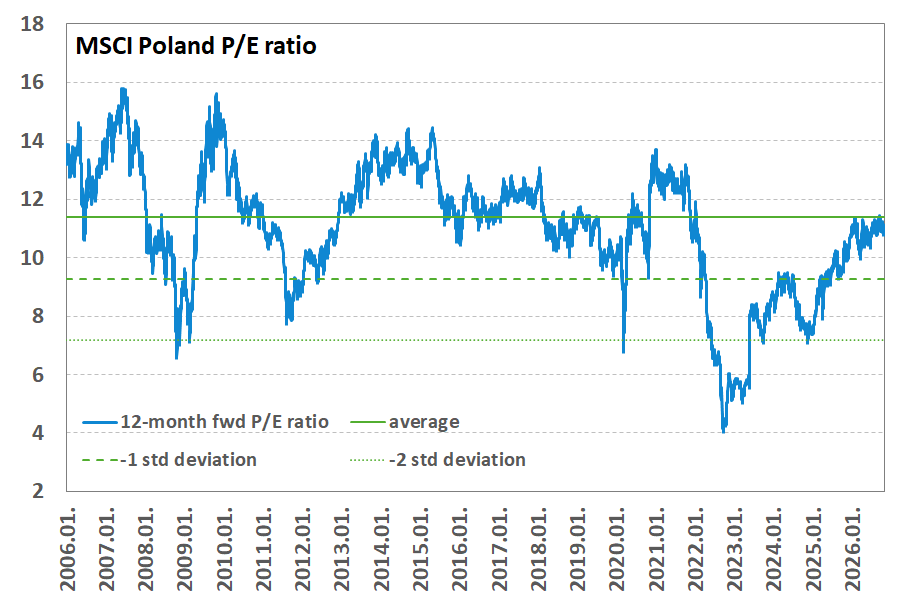
As of 2 November, the Polish stock market had gained 30% since the beginning of the year. Following the rally and repeated record highs of recent months, the market had already become vulnerable to a negative correction. In the short term, the political uncertainty described above could bring the rally to a halt. From a valuation perspective, Polish equities can no longer be regarded as particularly cheap compared with the past few years. The MSCI Poland Index is trading at a 12-month forward P/E ratio of 10.85, above the MSCI Emerging Markets Index’s multiple of 8.44. Nevertheless, the Polish market’s valuation remains slightly below its long-term average of 11.4.
WIG20 technical picture
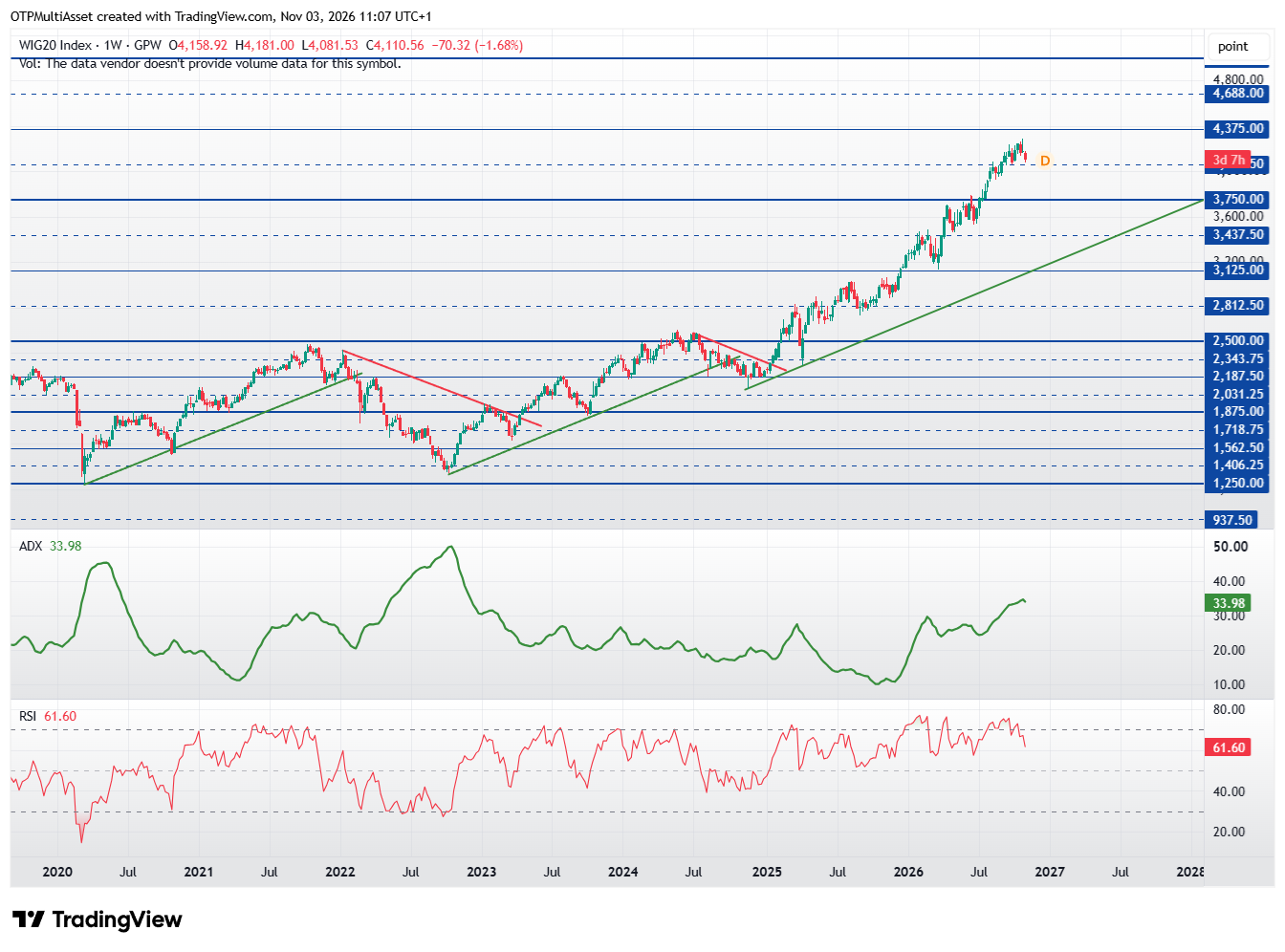
The last significant correction occurred in late 2024, followed by an uptrend that has lasted for nearly two years. The price may now have reached a zone that could once again lead to a pause or even a deeper correction. The thick green trendline represents the key support level, making a retest of this line technically justified.
On the upside, above 4,375 points, the market no longer offers sufficient short-term upside potential to justify further buying without an intervening correction. In the event of a decline, important support levels can be found around 3,438 and 3,125 points, and a retest of these zones appears to be a realistic scenario. At a later stage, these levels could also offer attractive buying opportunities with a favorable risk-reward profile.
Get more out of your investments!
Global Markets Services
OTP Global Markets offers a broad range of services in the field of local and international money and capital markets.
Read morePrivate Banking Services
Personal care and expertise with OTP Private Banking, along with the knowledge, security, and innovations of a multinational banking group.
Read more