
OTP Morning Brief: News about the Middle East conflict and the earnings season drove market movements
Related content
OTP Morning Brief: US producer price index came in above expectations, yet the US 10-year Treasury yield still declined
Western European equities continued to advance despite ongoing pressure on the technology sector. Wall Street indices also rebounded, recovering some ground after Wednesday’s sell-off. Healthcare was the standout performer on both sides of the Atlantic. Eurozone industrial production declined by 0.5% month-on-month in August. In the US, the producer price index accelerated to 6.3%, delivering another upside surprise in inflation developments. US retail sales increased by 0.8% compared to August. The US 10-year Treasury yield declined by more than 10 basis points. The long end of the Hungarian government bond yield curve also declined by 7-9 basis points. In Hungary, August wage data will be released today, while in the US, September industrial production figures are due.
OTP Morning Brief: US CPI data came in above expectations
European equity markets advanced, supported by strong results from ASML and the outstanding performance of the healthcare sector. US equity markets came under pressure following higher-than-expected September CPI data. The annual CPI rate accelerated to 3.7%, driven primarily by a surge in gasoline prices, while core CPI rose by 0.3% month-on-month, supported by higher housing costs and rising transportation service prices. Oil prices rose amid escalating tensions in the Middle East and the impact of the IEA's oil market report. US Treasury yields retreated after an initial increase, driven by Fed commentary, while European bond yields generally moved higher. The US macro calendar will be busy today, with investors focusing on September retail sales and producer price index data, as well as the New York Fed Manufacturing Index, weekly jobless claims, and business inventories. August industrial production data from the euro area will be released today.
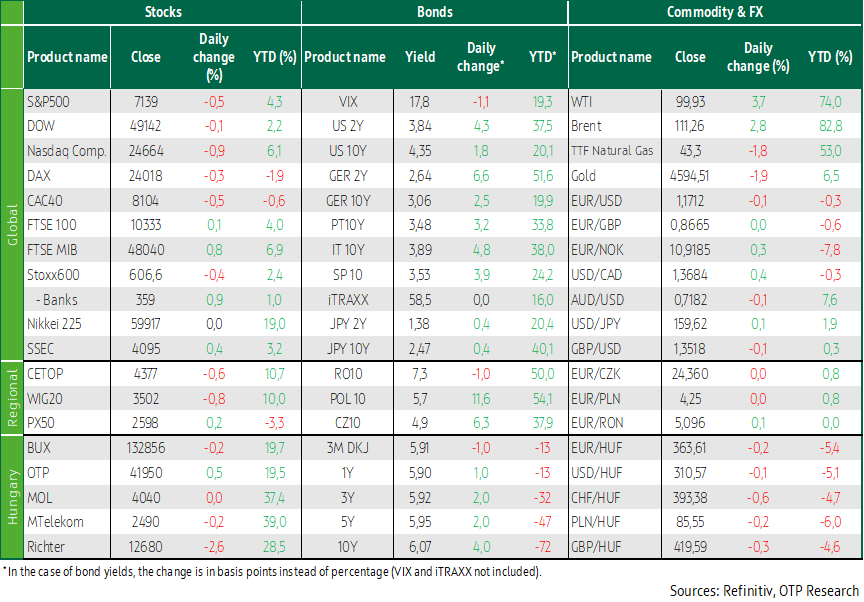
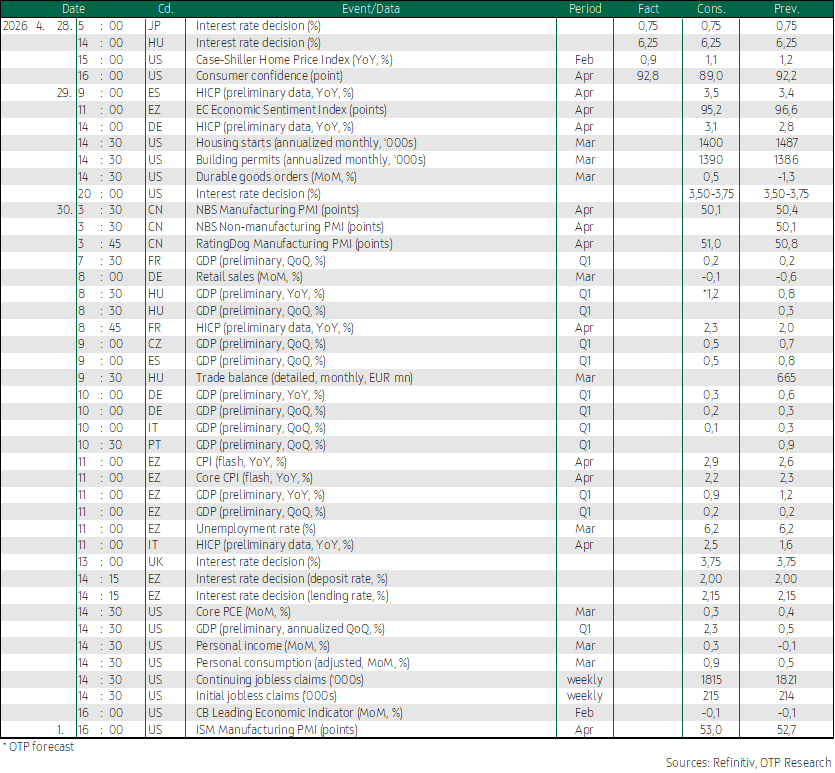
There is still no agreement between the United States and Iran on peace in the Middle East. Crude oil prices continued to rise. The United Arab Emirates announced that it will withdraw from OPEC and OPEC+. Most stock markets in the developed world closed in the red. The BUX slipped by 0.2%, with OTP the only domestic blue chip to record gains. Developed market bond yields rose, while the dollar strengthened against the euro. Domestic yields edged slightly higher, while the forint strengthened against the euro. In line with expectations, the MNB’s Monetary Council left the policy rate unchanged at its April meeting. April inflation data are due from several major euro area member states. The FOMC’s two-day meeting ends today. The earnings season continues with results from the technology sector’s heavyweights.
Major European indices closed mixed amid negative investor sentiment; the BUX fell
Sentiment was gloomy across European stock markets on Tuesday, as mixed corporate earnings, the failure of negotiations to resolve the Middle East conflict, and caution ahead of interest rate decisions scheduled for the rest of the week all weighed on investor sentiment. . The pan-European Stoxx 600 slipped 0.4%, although among the major indices the UK’s FTSE 100 and Italy’s FTSE MIB managed to edge higher. Most Stoxx 600 sector indices turned negative, with technology posting the biggest decline of 1.8% amid fading optimism surrounding artificial intelligence, while banks delivered the strongest performance. Barclays shares closed down 0.2% after the British bank flagged a USD 308 million hit linked to collapsed lender MFS. The energy sector rose 0.6%, riding a rally in BP, whose shares gained 1.1% after beating expectations for first-quarter earnings.
Equity markets in the CEE region closed mixed, with the BUX down 0.2%, placing it in the middle of the pack. Among Hungarian blue chips, only OTP managed to advance.
Wall Street indices turned lower; the technology sector underperformed; crude oil prices rose
The United States rejected Iran’s latest proposal on Middle East peace, as it would have postponed negotiations on the nuclear issue. The decision heightened concerns about persistently elevated inflation and deteriorating growth prospects; however, media reports suggest that Pakistani intermediaries expect a new proposal from Iran in the coming days.
Wall Street indices closed in the red on Tuesday, driven partly by the breakdown of peace talks and partly by growing concerns surrounding the artificial intelligence boom. Semiconductor manufacturers such as Nvidia, AMD and Broadcom performed particularly poorly, but the entire technology sector came under pressure. The Wall Street Journal reported that growth in OpenAI’s new user numbers and revenues has fallen short of the company’s own targets, raising questions over whether the AI giant can cover the massive spending associated with its data center investments.
The earnings season continued: General Motors shares rose on the back of better-than-expected first-quarter earnings and an upwardly revised full-year revenue outlook; meanwhile, UPS shares fell after the parcel delivery company reaffirmed its full-year revenue targets, while Coca-Cola shares advanced thanks to stronger-than-expected quarterly results and a raised full-year profit forecast.
Crude oil prices continued to rise yesterday, with Brent reaching USD 111 per barrel and WTI USD 100, levels that are roughly 50% higher than those seen immediately before the outbreak of the Middle East conflict. So far this year, WTI prices have climbed by 74%, while Brent has gained 83%. In addition to the Strait of Hormuz remaining closed, yesterday’s announcement by the United Arab Emirates that it would withdraw from OPEC and OPEC+ on May 1 also caused turmoil in the oil market. The country, which accounts for 3-4% of global oil production and has long advocated for raising production quotas, justified its decision by stating that it aligns with the United Arab Emirates’ long-term strategic and economic vision; furthermore, due to the closure of the Strait of Hormuz, the announcement’s impact on the oil market may now be smaller.
Developed market yields rose; the MNB left the policy rate unchanged yesterday; the forint strengthened
Developed market bond yields rose and the dollar strengthened following further adverse developments in the oil market. US Treasury yields edged higher, with the 10-year yield up 1 basis point to 4.35%. European yields rose more markedly, as the 10-year German Bund yield climbed 4 basis points to 3.07%. The dollar also firmed slightly against the euro, with EUR/USD trading around 1.17.
In Hungary, markets focused on the MNB, which, in line with expectations, left the policy rate unchanged at 6.25% at its April rate-setting meeting. In a hawkish message, MNB Governor Mihály Varga warned of geopolitical risks, the inflationary impact of rising oil prices, and noted that the sustainability of the election-related strengthening of the forint and the decline in yields remains uncertain. He also said that should the government decide to adopt the euro, the central bank would support the process.
In parallel with the press conference, the forint strengthened against the euro, with the exchange rate falling below 364. Government Debt Management Agency (ÁKK) reference yields recorded in early afternoon moved a few basis points higher, with the 10-year yield rising to 6.07%. Demand was strong at ÁKK’s auction yesterday, where HUF 40 billion worth of three-month Treasury bills were sold at an average yield of 5.98%.
Today's highlights
Morning trading in the key Asia-Pacific markets showed mixed movements amid concerns surrounding the oil market and the technology sector. Japanese markets were closed today due to a public holiday.
Today, attention will be on inflation data from euro area member states and the Fed’s rate-setting meeting. In the latter case, particular focus may fall on Jerome Powell’s post-meeting press conference, as this will be the last meeting in the series chaired by him.
The earnings season continues today with major names, including results from Alphabet, Amazon, Meta, and Microsoft.
Get more out of your investments!
Global Markets Services
OTP Global Markets offers a broad range of services in the field of local and international money and capital markets.
Read morePrivate Banking Services
Personal care and expertise with OTP Private Banking, along with the knowledge, security, and innovations of a multinational banking group.
Read more