
OTP Morning Brief: Unexpectedly weak PMI data came in from the euro area
Related content
OTP Morning Brief: US producer price index came in above expectations, yet the US 10-year Treasury yield still declined
Western European equities continued to advance despite ongoing pressure on the technology sector. Wall Street indices also rebounded, recovering some ground after Wednesday’s sell-off. Healthcare was the standout performer on both sides of the Atlantic. Eurozone industrial production declined by 0.5% month-on-month in August. In the US, the producer price index accelerated to 6.3%, delivering another upside surprise in inflation developments. US retail sales increased by 0.8% compared to August. The US 10-year Treasury yield declined by more than 10 basis points. The long end of the Hungarian government bond yield curve also declined by 7-9 basis points. In Hungary, August wage data will be released today, while in the US, September industrial production figures are due.
OTP Morning Brief: US CPI data came in above expectations
European equity markets advanced, supported by strong results from ASML and the outstanding performance of the healthcare sector. US equity markets came under pressure following higher-than-expected September CPI data. The annual CPI rate accelerated to 3.7%, driven primarily by a surge in gasoline prices, while core CPI rose by 0.3% month-on-month, supported by higher housing costs and rising transportation service prices. Oil prices rose amid escalating tensions in the Middle East and the impact of the IEA's oil market report. US Treasury yields retreated after an initial increase, driven by Fed commentary, while European bond yields generally moved higher. The US macro calendar will be busy today, with investors focusing on September retail sales and producer price index data, as well as the New York Fed Manufacturing Index, weekly jobless claims, and business inventories. August industrial production data from the euro area will be released today.
Oil prices rose amid heightened uncertainty in the Middle East. Mixed news flow left the pan-European STOXX 600 close to flat. PMI data in the euro area came in unexpectedly weak. Corporate earnings reports from Europe were mostly positive. Oil shipments esumed via the Druzhba crude oil pipeline on Thursday. U.S. equity indices moved lower, with the software sector underperforming. Intel is rallying in after-hours trading. Ten-year benchmark government bond yields edged higher across developed markets. The domestic ten-year yield rose by nearly 20 basis points. Attention today will focus on the MNB’s fourth-quarter house price index and the unemployment rate for March published by the KSH. Germany’s IFO business climate index is due for release.
Oil prices rose amid heightened uncertainty in the Middle East
There has still been no meaningful progress in resolving the conflict in the Middle East. On Tuesday, President Trump appeared to unilaterally extend the ceasefire indefinitely, while at the same time refraining from lifting Iran’s maritime blockade. Iran described the latter as unacceptable and ruled out the continuation of talks in Islamabad. On Wednesday, Iranian units seized two container ships in the strait. The United States reported on Thursday that an Iranian cargo vessel had been boarded in the Indian Ocean. According to reports, air defense systems were activated in parts of Tehran on Thursday in response to signs of hostile aerial activity. Amid the persistent uncertainty and stalled negotiations, oil prices moved higher.
Overnight, President Trump announced that the Israeli–Lebanese ceasefire had been extended by three weeks.
The pan-European STOXX 600 hovered close to flat amid mixed news flow
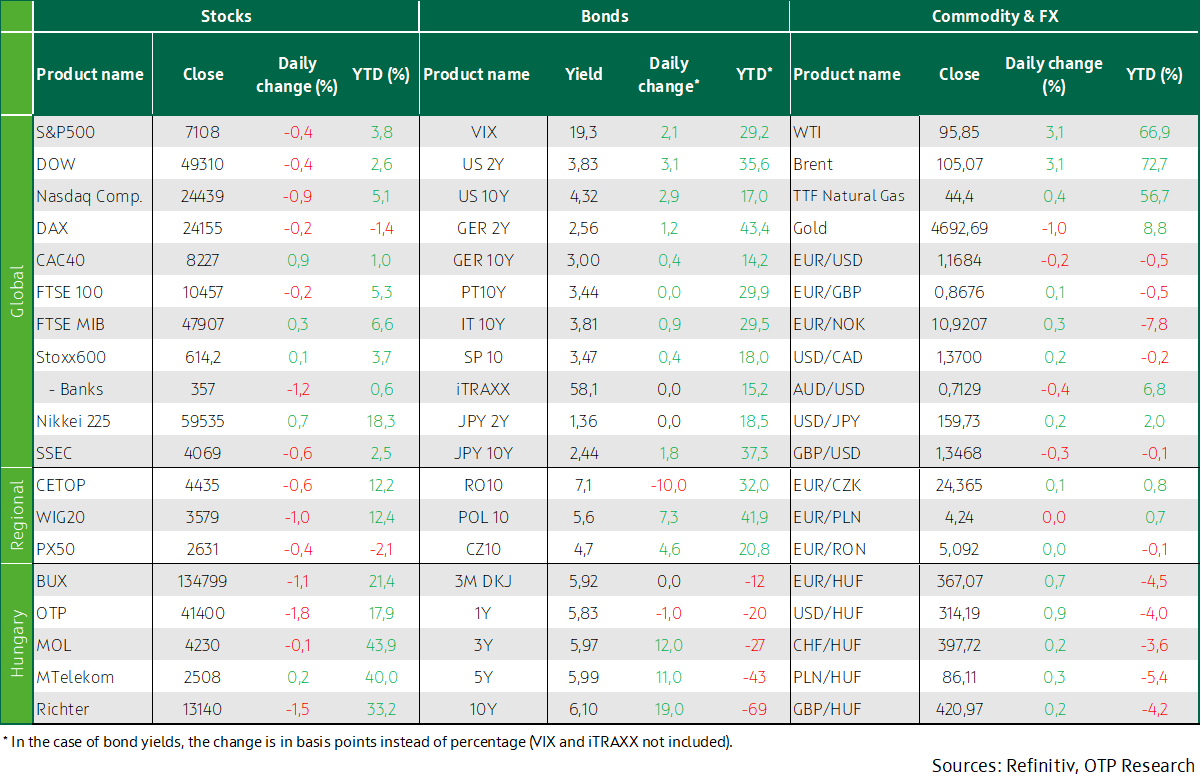
The STOXX 600 was virtually flat amid weak PMI data, the breakdown of U.S.–Iran talks, and corporate earnings that were generally better than expected. The DAX and the FTSE 100 both declined by 0.2%, while the CAC 40 advanced by 0.9%.
Nestlé shares jumped 5.9% on Thursday after the food company maintained its full-year organic growth guidance of 3–4%. Nestlé also reported that the war involving Iran has so far had only a limited impact on its operations. Nokia shares rose 6.4% after the network equipment maker raised its growth targets in its AI-related business and exceeded first-quarter profit expectations. L’Oréal shares climbed 9% after the French cosmetics group reported first-quarter revenue that surpassed analysts’ forecasts. French pharmaceutical company Sanofi gained 1.2% as both its first-quarter profit and revenue beat market consensus. Swiss drugmaker Roche said on Thursday that its first-quarter revenue fell by 5%, largely due to the appreciation of the Swiss franc against the U.S. dollar. The giredestrant tablet for the treatment of breast cancer is expected to receive approval from the U.S. FDA by the end of the year. Roche also indicated its intention to enter the weight-loss drug market, although data released in March related to its obesity drug candidate petrelintide fell short of investor expectations. Roche shares nevertheless advanced 3.8% on Thursday. Siemens Energy raised its outlook for 2026 on Thursday after a sharp increase in both its order backlog and profits. The company is benefiting from rising demand for power equipment driven by the expansion of data centers.
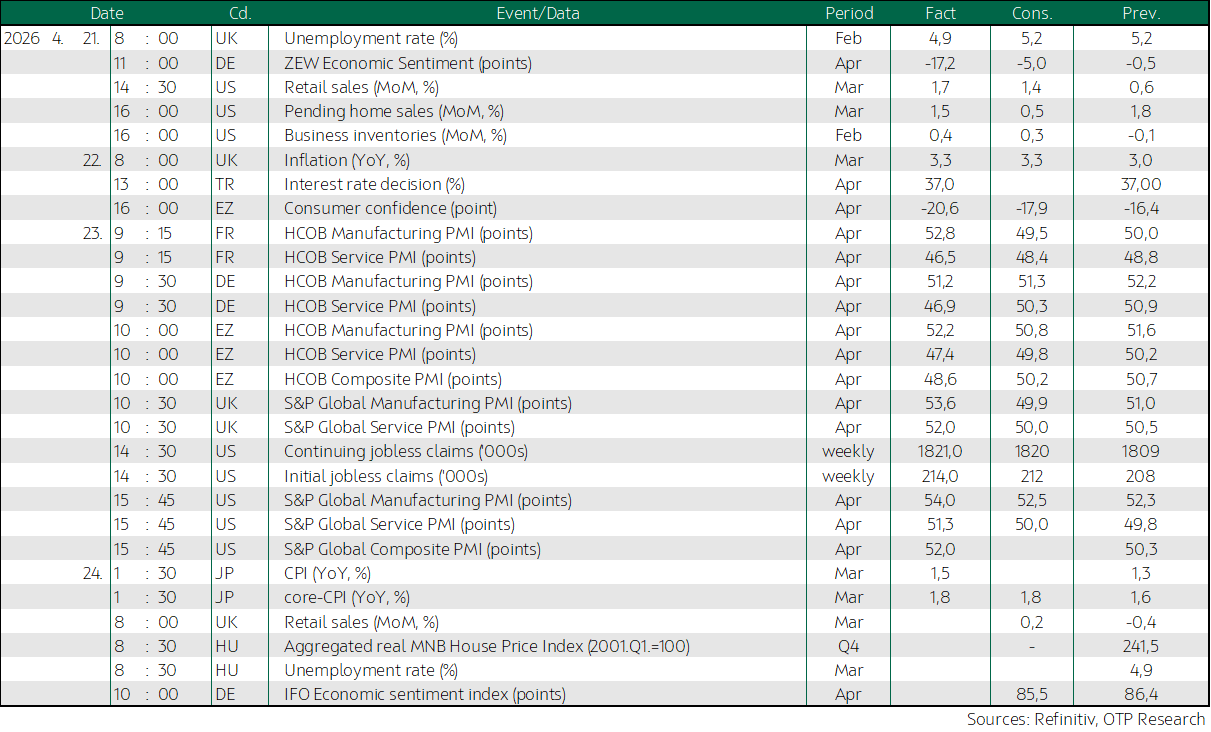
Following the consumer confidence reading that delivered a negative surprise on Wednesday, the preliminary April purchasing managers’ indices in the euro area also came in weaker than expected. Although analysts had anticipated a decline in the composite index, the reading fell below the 50 threshold separating expansion from contraction, at 48.6, undershooting consensus expectations as well. Both in the euro area as a whole and in its larger member states, the trend continued whereby manufacturing PMI data remained relatively strong, while the decline in the composite index was driven by a sharp deterioration in the services sector. The resilience in manufacturing activity is likely due to temporary factors, as the Middle East conflict has heightened uncertainty around supply chains, prompting companies to respond by building inventories and bringing forward procurement and production.
MOL reported that oil deliveries via the Druzhba crude oil pipeline have resumed toward Hungary and Slovakia following an outage that had been in place since January. Amid the ongoing Middle East conflict, this represents a positive development for Hungary’s fuel supply. However, this does not yet mean that the Danube Refinery in Százhalombatta can operate at full capacity, as repairs to the AV3 processing unit damaged in the October fire are not expected to be completed until the third quarter.
In the region, the BUX fell by 1.1%. Poland’s WIG20 declined by 1.0%, while the Czech PX50 dropped by 0.4%.
U.S. equity indices moved lower
Wall Street indices gave back part of Wednesday’s gains. The S&P 500 and the Dow Jones both fell by 0.4%, while the Nasdaq Composite declined by 0.9%. Overall, the earnings season has been solid so far: around 80% of companies reporting through Thursday morning have beaten analysts’ expectations.
On Thursday, the S&P 500 technology index was the worst performer. IBM shares fell by 8.3% as revenue growth slowed in the first quarter due to weakness in its software business. ServiceNow shares dropped by nearly 18% following the release of its quarterly results, as delays in the completion of government contracts in the Middle East weighed on revenue growth. On Wednesday, Tesla raised its capital expenditure plan for 2026 to more than USD 25 billion, nearly three times last year’s USD 8.5 billion and above the USD 20 billion forecast issued earlier this year. The investments will primarily be directed toward artificial intelligence, robotaxis, and robotics. Tesla’s shares fell by 3.6% on Thursday. Lockheed Martin reported first-quarter profit below expectations, as cost overruns on fixed-price contracts and production slowdowns in certain programs reduced the defense company’s ability to benefit from surging demand driven by geopolitical conflicts. The company maintained its 2026 revenue guidance of USD 77.5–80 billion. Shares of the defense giant declined by 4.6% on Thursday. Intel forecast second-quarter revenue above expectations on Thursday, highlighting booming demand for data center server processors used in artificial intelligence applications. Intel shares jumped by nearly 20% in after-hours trading.
Both the services sector and manufacturing contributed to an upside surprise in the S&P Global composite PMI. Meanwhile, the usual weekly unemployment claims data in the United States showed a slight increase but did not deliver any meaningful surprise.
Government bond yields rose slightly in developed economies, while the increase was more pronounced across the region
Brent and WTI futures jumped by a further 4% on Thursday, marking the fourth consecutive session of sizeable gains and exacerbating inflation concerns. In developed bond markets, ten-year benchmark yields edged higher, with the U.S. ten-year yield moving slightly above 4.3%, while the German ten-year yield closed Thursday’s session at 3.03%. Two-year benchmark yields also rose by a few basis points on Thursday, although monetary tightening is still not seen as imminent. According to the CME FedWatch Tool, the earliest decision on a change in the policy rate in the United States—specifically a rate cut—could come in September 2027. In contrast, markets are pricing in two rate hikes by the ECB this year, though there is currently no indication that such a move would occur at the next meeting scheduled for two weeks from now. The dollar strengthened, with EUR/USD slipping below 1.17, its lowest level in two weeks. In addition to developments in the Middle East, investors were also focused on the latest manufacturing and services PMI releases, which reflected limited positive momentum for the euro area.
Domestically, long-term yields rose significantly, broadly in line with the increase seen across the region. The Hungarian ten-year yield climbed by 18 basis points to 6.1%, although it remains well below pre-election levels. The Czech ten-year yield rose by 4 basis points, while the Polish yield increased by 7 basis points on Thursday. The forint weakened by more than the zloty and the Czech koruna, also reflecting uncertainty surrounding the change of government. EUR/HUF closed near 367. At the same time, government bond auctions were successful, with the 12-month Treasury bills and long-term bonds sold at more than three times oversubscription.
Today's highlights
As markets moved toward the close, Asian equities showed a mixed performance. Japan’s Nikkei was up 0.6%. South Korea’s KOSPI fell by 0.2% and China’s SSEC declined by 0.6%, while Hong Kong’s Hang Seng was close to flat. Japan’s headline inflation and core inflation for March accelerated to 1.5% and 1.8%, respectively, in line with expectations, approaching the central bank’s 2% target from below. Markets do not expect a rate hike from the Bank of Japan next week; however, based on current pricing, a 25 basis point increase could take place in June or July.
Today, attention will turn to the March retail sales figures from the United Kingdom. Domestically, focus will be on the MNB’s fourth-quarter house price index and the unemployment rate for March published by the KSH. Germany’s April IFO business climate index is also due for release. Among others, P&G will publish its earnings report today.
Get more out of your investments!
Global Markets Services
OTP Global Markets offers a broad range of services in the field of local and international money and capital markets.
Read morePrivate Banking Services
Personal care and expertise with OTP Private Banking, along with the knowledge, security, and innovations of a multinational banking group.
Read more