
OTP Morning Brief: U.S. indexes rose despite tensions with Iran
Related content
OTP Morning Brief: US producer price index came in above expectations, yet the US 10-year Treasury yield still declined
Western European equities continued to advance despite ongoing pressure on the technology sector. Wall Street indices also rebounded, recovering some ground after Wednesday’s sell-off. Healthcare was the standout performer on both sides of the Atlantic. Eurozone industrial production declined by 0.5% month-on-month in August. In the US, the producer price index accelerated to 6.3%, delivering another upside surprise in inflation developments. US retail sales increased by 0.8% compared to August. The US 10-year Treasury yield declined by more than 10 basis points. The long end of the Hungarian government bond yield curve also declined by 7-9 basis points. In Hungary, August wage data will be released today, while in the US, September industrial production figures are due.
OTP Morning Brief: US CPI data came in above expectations
European equity markets advanced, supported by strong results from ASML and the outstanding performance of the healthcare sector. US equity markets came under pressure following higher-than-expected September CPI data. The annual CPI rate accelerated to 3.7%, driven primarily by a surge in gasoline prices, while core CPI rose by 0.3% month-on-month, supported by higher housing costs and rising transportation service prices. Oil prices rose amid escalating tensions in the Middle East and the impact of the IEA's oil market report. US Treasury yields retreated after an initial increase, driven by Fed commentary, while European bond yields generally moved higher. The US macro calendar will be busy today, with investors focusing on September retail sales and producer price index data, as well as the New York Fed Manufacturing Index, weekly jobless claims, and business inventories. August industrial production data from the euro area will be released today.
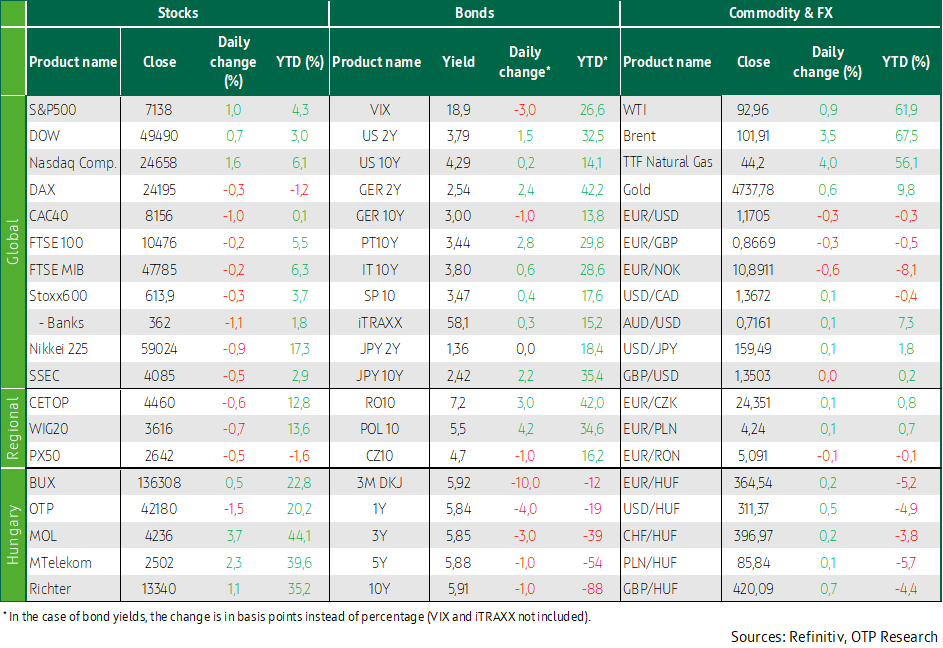
European indexes fell yesterday; inflation in the UK accelerated in March in line with expectations; the Turkish central bank left its policy rate unchanged. U.S. stock markets rose on Wednesday as Donald Trump extended the ceasefire; Brent crude traded above $100; Boeing and GE Vernova shares advanced following positive earnings reports. Developed market bond yields were little changed on Wednesday; the dollar strengthened against the euro, while regional currencies weakened. Today, European and U.S. purchasing managers’ indices are due, along with the release of the usual weekly initial jobless claims data in the United States.
European indexes fell yesterday; inflation in the UK accelerated in March in line with expectations; the Turkish central bank left its policy rate unchanged
European equity markets weakened yesterday as investors weighed developments related to the extension of the Iranian ceasefire. Sentiment was further dented by the German government halving its 2026 growth forecast, now expecting GDP growth of just 0.5% for this year, while cutting its 2027 growth projection to 0.9% from 1.3%. The Ministry for Economic Affairs attributed the deteriorating outlook to the Middle East conflict and the de facto closure of the Strait of Hormuz, noting rising costs for households and businesses. At the same time, inflation is forecast at 2.7% this year and 2.8% next year, both remaining above the ECB’s target. Geopolitical uncertainty was reinforced by U.S. President Donald Trump’s decision to extend the two-week ceasefire with Iran while maintaining the U.S. blockade on Iranian ports, prompting Tehran to reject further negotiations. On the corporate front, there were nevertheless some positive surprises: Dutch chipmaker ASML reported quarterly revenues above analysts’ expectations and achieved a record operating margin.
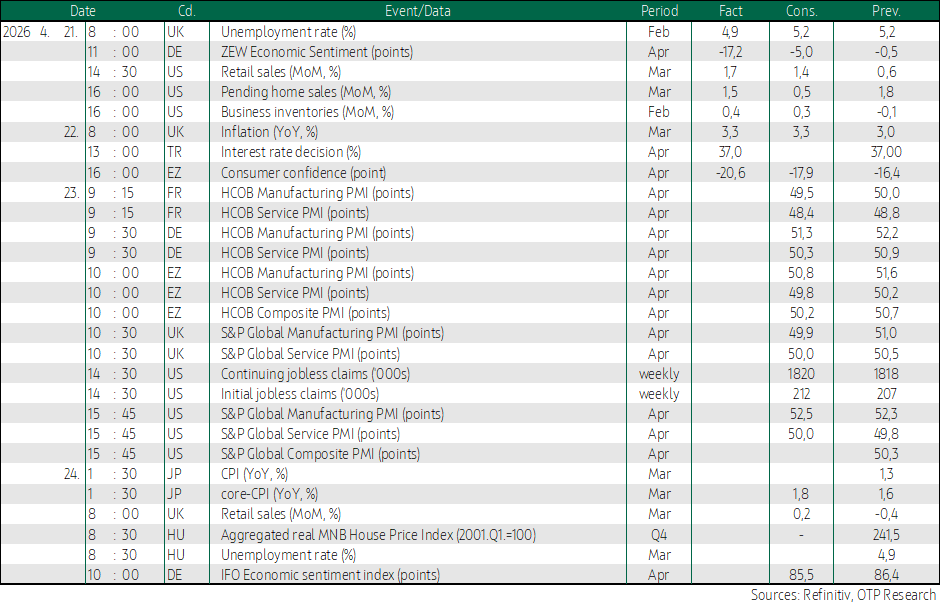
In the euro area, consumer confidence deteriorated by 4.3 points to -20.6 in April compared with March, according to preliminary estimates, marking the lowest level since December 2022 and a larger-than-expected decline relative to market expectations. The deterioration was driven by rising economic uncertainty, exacerbated by the prolonged Middle East conflict and inflationary pressures stemming from persistent supply disruptions. Across the European Union as a whole, consumer sentiment also weakened sharply, falling by 4.2 points to -19.4, likewise coming in worse than expected. In both the euro area and the EU, consumer confidence remains well below its long-term averages, which could weigh on a recovery in domestic demand in the near term.
In the United Kingdom, annual inflation rose to 3.3% in March from 3% recorded in the previous two months, in line with market expectations. The acceleration was driven mainly by higher transport costs (4.7%, the fastest pace since December 2022), with fuel prices in particular jumping by 4.9%, partly due to the impact of the conflict involving Iran. As a result of a 95.3% surge in household heating oil prices, housing-related inflation accelerated to 4.3% from 4.2% in the previous month. Meanwhile, the price index for food and non-alcoholic beverages increased to 3.7% from 3.3%, while services inflation rose to 4.5% from 4.3%. By contrast, clothing prices fell by 0.8%, marking the largest decline since March 2021. On a monthly basis, the consumer price index increased by 0.7% compared with February.
The Turkish central bank kept its policy rate unchanged at 37%, in line with market expectations. According to the central bank’s statement, underlying inflation dynamics eased in March, while preliminary indicators point to a renewed mild acceleration in April. High and volatile energy prices continue to add to inflationary risks. The statement reaffirmed that the central bank will maintain tight monetary conditions until price stability is restored, that is, until the 5% inflation target becomes attainable.
Regional indexes closed mixed yesterday: the BUX was the only index to post gains, while the Prague and Warsaw indexes declined. Domestic blue chips closed in positive territory with the exception of OTP.
U.S. stock markets rose on Wednesday as Donald Trump extended the ceasefire; Brent crude traded above $100; Boeing and GE Vernova shares advanced following positive earnings reports
U.S. equity markets closed higher on Wednesday after U.S. President Donald Trump extended the ceasefire with Iran, while stronger-than-expected corporate earnings also supported investor sentiment. President Trump cited divisions within the Iranian government when announcing the extension of the ceasefire but noted that the U.S. military blockade would remain in place, leaving the situation uncertain. As a result, uncertainty persisted: Iran’s navy seized two container ships in the Strait of Hormuz on Wednesday, contributing to Brent crude prices rising above $100 per barrel. However, equity markets have increasingly looked past Middle Eastern tensions, particularly in the technology sector, where several stocks posted strong gains. This was reinforced by a favorable start to the earnings season: Boeing shares climbed 5.5% after the company reported a smaller-than-expected first-quarter loss, while GE Vernova surged 13.8% after revenues beat analysts’ expectations. According to FactSet data, more than 80% of S&P 500 companies reporting so far have exceeded consensus forecasts, further strengthening the market narrative that investors’ focus is gradually shifting back to corporate fundamentals.
Developed market bond yields were little changed on Wednesday; the dollar strengthened against the euro, while regional currencies weakened
Crude oil prices continued to rise on Wednesday, with both WTI and Brent gaining around 3%, pushing Brent above $100 per barrel. Tensions in the Middle East have not eased: although the ceasefire was extended for an indefinite period, positions have not converged, with Iran’s Revolutionary Guard seizing two vessels in the Strait of Hormuz while the United States has not eased its blockade. Middle Eastern developments therefore remain in the spotlight, even as investors stay cautious following the extension of the ceasefire. In developed bond markets, there were no significant moves on Wednesday: the U.S. 10-year yield stayed near 4.3%, while the German 10-year remained stuck at 3%. At shorter maturities, however, yields rose more noticeably, with the German two-year yield edging up by 3 basis points and the U.S. two-year by 4 basis points. Interest rate expectations also shifted slightly, with futures markets now pricing in two rate hikes by the ECB with high confidence for this year, while the first Fed rate cut is priced in for autumn 2027. Analysts’ expectations differ somewhat: amid inflation risks, the expected timing of the first rate cut in the U.S. has been pushed back, with a Reuters survey suggesting that it may take another six months before the Fed delivers its first cut. On news of the ceasefire extension, the dollar strengthened, with EUR/USD slipping 0.3% to around 1.17.
In line with regional currencies, the forint weakened slightly on Wednesday, with the EUR/HUF exchange rate closing the day at around 364. In the domestic secondary bond market, yields declined, with the more pronounced moves this time concentrated at the short end of the yield curve. The Wednesday Treasury bill auction was deemed successful: demand for the six-month T-bill was nearly three times the offered amount, the issued volume was doubled, and the average yield came in at 5.94%.
Today, the Government Debt Management Agency (ÁKK) will issue 12-month Treasury bills as well as bonds maturing in 2036 and 2038, in amounts of HUF 30 billion, HUF 10 billion, and HUF 15 billion, respectively.
Today's highlights
After early gains, Asian indexes turned sharply lower this morning following reports that U.S. forces had intercepted at least three Iranian oil tankers in Asian waters, increasing the risk of a continuation of the conflict.
Today, European and U.S. purchasing managers’ indices are due, along with the release of the customary weekly initial jobless claims data in the United States.
Get more out of your investments!
Global Markets Services
OTP Global Markets offers a broad range of services in the field of local and international money and capital markets.
Read morePrivate Banking Services
Personal care and expertise with OTP Private Banking, along with the knowledge, security, and innovations of a multinational banking group.
Read more