
OTP Morning Brief: News of the ceasefire extension came after the market close
Related content
OTP Morning Brief: US producer price index came in above expectations, yet the US 10-year Treasury yield still declined
Western European equities continued to advance despite ongoing pressure on the technology sector. Wall Street indices also rebounded, recovering some ground after Wednesday’s sell-off. Healthcare was the standout performer on both sides of the Atlantic. Eurozone industrial production declined by 0.5% month-on-month in August. In the US, the producer price index accelerated to 6.3%, delivering another upside surprise in inflation developments. US retail sales increased by 0.8% compared to August. The US 10-year Treasury yield declined by more than 10 basis points. The long end of the Hungarian government bond yield curve also declined by 7-9 basis points. In Hungary, August wage data will be released today, while in the US, September industrial production figures are due.
OTP Morning Brief: US CPI data came in above expectations
European equity markets advanced, supported by strong results from ASML and the outstanding performance of the healthcare sector. US equity markets came under pressure following higher-than-expected September CPI data. The annual CPI rate accelerated to 3.7%, driven primarily by a surge in gasoline prices, while core CPI rose by 0.3% month-on-month, supported by higher housing costs and rising transportation service prices. Oil prices rose amid escalating tensions in the Middle East and the impact of the IEA's oil market report. US Treasury yields retreated after an initial increase, driven by Fed commentary, while European bond yields generally moved higher. The US macro calendar will be busy today, with investors focusing on September retail sales and producer price index data, as well as the New York Fed Manufacturing Index, weekly jobless claims, and business inventories. August industrial production data from the euro area will be released today.
Amid geopolitical uncertainties, European equities declined, economic sentiment deteriorated sharply in Germany due to the war, while unemployment fell in the United Kingdom. The BUX also fell, led by OTP. Trump unilaterally extended the ceasefire with Iran, but the announcement came only after the market close, sending U.S. indices lower. Several favorable macroeconomic data releases were published for the United States. At his hearing, Warsh emphasized central bank independence, while the decline in domestic yields continued. Asian markets also declined. Today the earnings season continues, while developments in the Middle East will be worth monitoring.
Amid geopolitical uncertainties, European equities declined, while economic sentiment deteriorated sharply in Germany due to the war
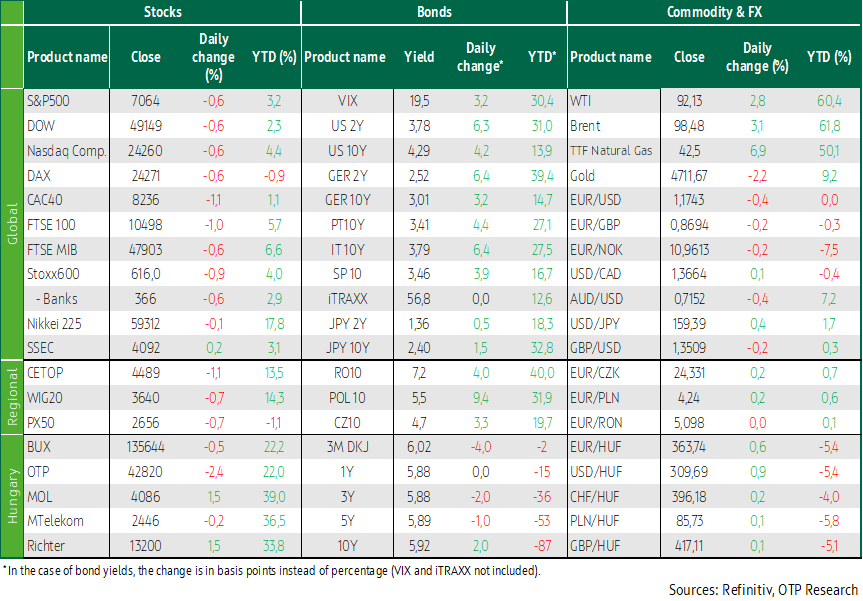
European stocks fell on Tuesday as uncertainty surrounding peace talks between the United States and Iran prompted investor caution, just hours before the planned expiration of the ceasefire. The pan-European STOXX 600 index closed down 0.9%, while major regional markets also weakened: France’s CAC 40 and London’s FTSE 100 each fell 1.1%, while Germany’s DAX declined by 0.6%. The aerospace and defense sector led losses, plunging 4.8% to post its biggest one-day drop since April 2025. Europe’s largest defense technology company, Thales, fell 6% after first-quarter sales missed expectations. Aircraft engine manufacturers Safran and Rolls-Royce both dropped more than 6.5%. Healthcare stocks also weighed on the index, with the sector down 2% overall. Novo Nordisk, the maker of Wegovy, slid 4.2%, while AstraZeneca and GSK each suffered losses of more than 2.5%.
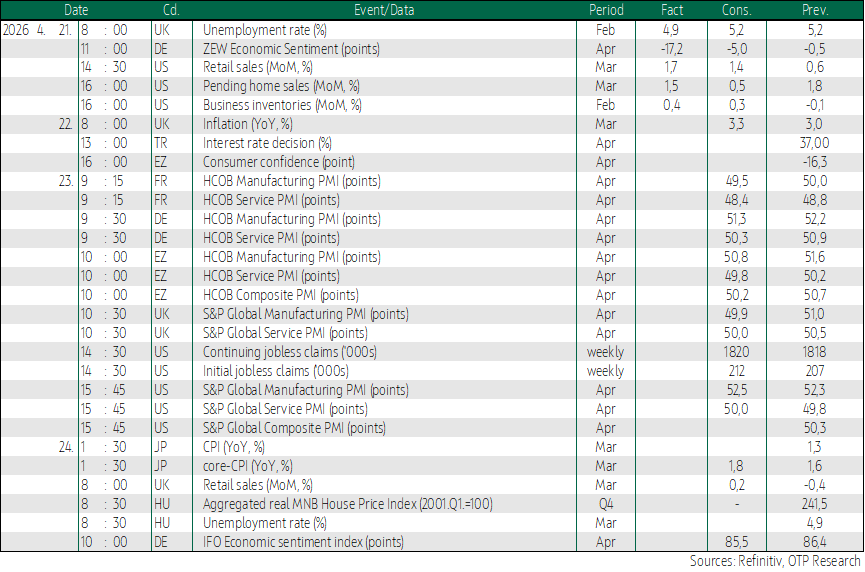
Germany’s ZEW economic sentiment index plunged by 16.7 points to -17.2 in April 2026, marking its lowest level since December 2022 and coming in well below the market expectation of -5. The sharp decline, which represented the third-largest monthly drop in the history of the index following the fall in March, reflects rising pessimism as the escalating conflict in the Middle East weighs on Germany’s economic outlook. Meanwhile, the UK unemployment rate fell to 4.9% in the three months to February 2026, defying expectations of stagnation at 5.2%. The decline in unemployment coincided with an increase in economic inactivity, suggesting that some Britons are opting to leave the labor force rather than continue searching for work.
The decline was mirrored across the CEE markets, with both the PX50 and the WIG 20 down 0.7%, while the BUX fell by around half a percent. The drop was led by OTP, which lost 2.4%, while MOL and Richter both managed to post gains of around one and a half percent.
Trump extended the ceasefire with Iran for an indefinite period, U.S. stock markets fell, and macroeconomic data came in stronger than expected
Developments in the Middle East remain in focus. The two-week ceasefire was set to remain in effect until Wednesday evening, while the outcome of the talks in Pakistan remained uncertain after Trump once again threatened Iran with intensified bombardment, and the Iranian side did not even confirm its participation in the negotiations. The turning point came on Tuesday evening after the U.S. market close, when Trump extended the ceasefire with Iran for an indefinite period, just hours before its planned expiration, to allow the two countries to continue peace talks. Trump said he had extended the ceasefire that came into force two weeks ago until Iran submits its proposal and the negotiations are concluded, one way or another.
As the positive news failed to arrive in time, overseas investors were marked by heightened uncertainty and pessimism, leading major indices to close lower: the Dow Jones, Nasdaq and S&P 500 each fell by 0.6%. The S&P 500 energy sector index rose by 1.3%, the only gainer among the major S&P sectors, as oil prices jumped again amid heightened tensions in the Middle East. UnitedHealth shares surged 7% after the healthcare conglomerate raised its full-year profit forecast and beat Wall Street expectations in the first quarter, providing the largest support to the Dow during the session. Apple shares also came into focus, falling 2.5% after the company announced that CEO Tim Cook would hand over leadership to long-time hardware chief John Ternus.
Several U.S.-related macroeconomic data releases were published yesterday. U.S. retail sales jumped by 1.7% in March 2026, beating market expectations of 1.4% and the upwardly revised 0.7% increase recorded in February. This marked the strongest expansion since March 2025, driven largely by a record 15.5% surge in gasoline station revenues. At the same time, the data excluding fuel and motor vehicle sales also showed no sign of slowing compared with the previous month. Pending home sales likewise exceeded analyst expectations, rising 1.5% month on month. The February business inventories report also delivered a positive surprise, increasing by 0.4% compared with January after three months of stagnation.
Oil prices rose ahead of the ceasefire extension, with Brent climbing 3.8% to move back above USD 99 per barrel, while WTI gained 2.8%.
At his hearing, Warsh emphasized central bank independence, while the decline in domestic yields continued
Long-term yields rose across developed bond markets, with the German 10-year yield climbing above 3% (+4bp), while the U.S. 10-year yield increased by nearly 5bp to close the day at around 4.3%. The two-year yield jumped by 7bp on Monday, pushing expectations for interest rate cuts further out; according to the CME FedWatch Tool, markets are now pricing in the first 25bp Fed rate cut for October 2027. Fed chair nominee Kevin Warsh emphasized during his congressional hearing that he would make monetary policy decisions independently of advice or pressure from President Trump, adding that success in maintaining low inflation could serve as a “shield” protecting the central bank from criticism. As expectations for a potential rate cut were pushed further back, the dollar strengthened, with EUR/USD falling 0.4% to 1.174.
In the domestic bond market, yields continued to decline at maturities below 10 years, while the long end of the curve edged slightly higher, according to secondary market data from the Government Debt Management Agency (ÁKK). Today’s ÁKK auction was successful, with bids exceeding HUF 150 billion submitted for the announced HUF 30 billion quota, of which the issuer accepted HUF 88 billion. The average yield came in at 6%. Meanwhile, the forint traded close to the 361 level against the euro for most of the day, but strengthened sharply in the evening, with EUR/HUF jumping to around 365 (+1.0%).
Today's highlights
The MSCI index tracking Asia-Pacific equities excluding Japan fell by 0.5% after reaching a seven-year high on Tuesday. Meanwhile, Japan’s Nikkei index declined by 0.1%.
Today, the UK will release its March inflation data, while April consumer confidence figures for the euro area are due, and a monetary policy decision is expected in Turkey. In addition, earnings reports are anticipated from companies including Tesla, Philip Morris, IBM, and Boeing.
Today, a six-month Treasury bill auction will be held with a HUF 30 billion issuance limit, while the ÁKK will also conduct two bond auctions worth HUF 15 billion each.
Get more out of your investments!
Global Markets Services
OTP Global Markets offers a broad range of services in the field of local and international money and capital markets.
Read morePrivate Banking Services
Personal care and expertise with OTP Private Banking, along with the knowledge, security, and innovations of a multinational banking group.
Read more