
OTP Morning Brief: The short-lived reopening of the Strait of Hormuz shaped market sentiment on Friday
Related content
OTP Morning Brief: US producer price index came in above expectations, yet the US 10-year Treasury yield still declined
Western European equities continued to advance despite ongoing pressure on the technology sector. Wall Street indices also rebounded, recovering some ground after Wednesday’s sell-off. Healthcare was the standout performer on both sides of the Atlantic. Eurozone industrial production declined by 0.5% month-on-month in August. In the US, the producer price index accelerated to 6.3%, delivering another upside surprise in inflation developments. US retail sales increased by 0.8% compared to August. The US 10-year Treasury yield declined by more than 10 basis points. The long end of the Hungarian government bond yield curve also declined by 7-9 basis points. In Hungary, August wage data will be released today, while in the US, September industrial production figures are due.
OTP Morning Brief: US CPI data came in above expectations
European equity markets advanced, supported by strong results from ASML and the outstanding performance of the healthcare sector. US equity markets came under pressure following higher-than-expected September CPI data. The annual CPI rate accelerated to 3.7%, driven primarily by a surge in gasoline prices, while core CPI rose by 0.3% month-on-month, supported by higher housing costs and rising transportation service prices. Oil prices rose amid escalating tensions in the Middle East and the impact of the IEA's oil market report. US Treasury yields retreated after an initial increase, driven by Fed commentary, while European bond yields generally moved higher. The US macro calendar will be busy today, with investors focusing on September retail sales and producer price index data, as well as the New York Fed Manufacturing Index, weekly jobless claims, and business inventories. August industrial production data from the euro area will be released today.
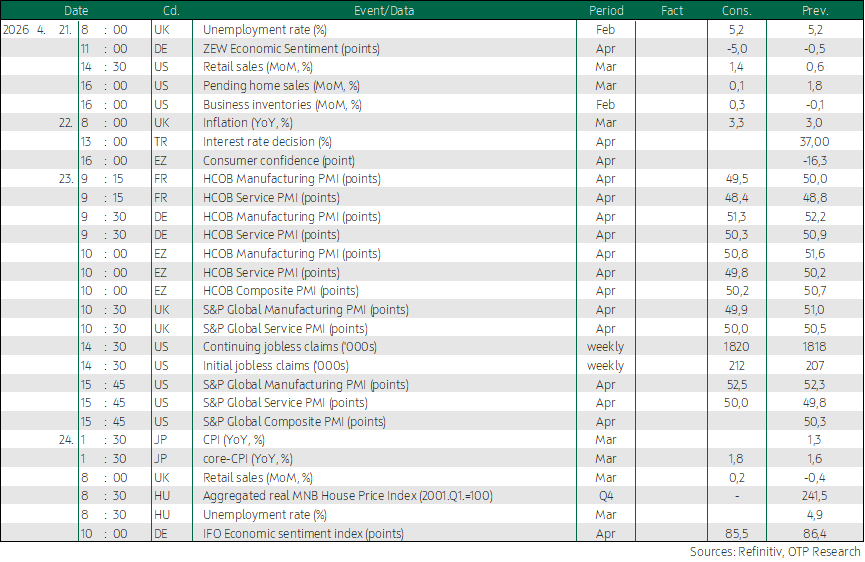
On Friday, Tehran indicated that it would open the Strait of Hormuz, which led to gains in developed equity markets, declines in bond yields, and a sharp fall in crude oil prices. However, the tables turned on Saturday, and Iran fired on ships passing through the strait, claiming that the US was violating their previous agreement; yet this does not appear to have halted negotiations, as the two sides are set to return to the negotiating table today in Pakistan. In the domestic bond and foreign exchange markets, the election was the main driver over the past week. On a weekly basis, we saw significant declines in bond yields, while the forint strengthened to levels not seen for a long time against the euro, with the EURHUF falling to 361.525. From Germany, the April ZEW economic sentiment index will be released today, while from the US, March retail sales data are due. Over the rest of the week, April purchasing managers’ indices will be published in Europe and overseas, and the earnings season continues to roll on.
Iran announced the reopening of the Strait of Hormuz on Friday, but market optimism proved short-lived
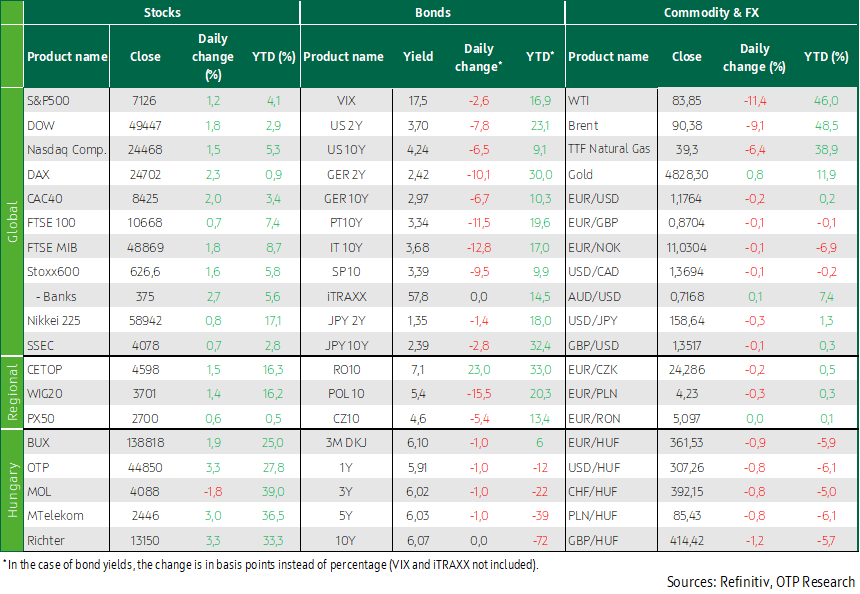
Although the earnings season picked up pace last week, markets continued to keep one eye on the Middle Eastern conflict. On Thursday, the first truly positive news arrived from the region, as a ceasefire agreement was reached between Israel and Lebanon, which could advance negotiations aimed at resolving the conflict. This was reinforced by an optimistic statement from Donald Trump, who said that peace talks could continue over the weekend and that the ceasefire agreement previously concluded between Iran and the United States, set to expire on April 22, could be extended, although in his view this would no longer be necessary. However, the news of the week was clearly Iranian Foreign Minister Abbas Araghchi’s announcement on Friday that, in the wake of Thursday’s ceasefire agreement in Lebanon, the Strait of Hormuz is now fully open to all commercial vessels. As a result, European and overseas stock markets surged, bond yields fell, and crude oil prices plummeted. The price of a barrel of WTI fell by 11.5% to below $90, while the per-barrel price of Brent dropped by 9% to $90. The European TTF natural gas price fell 6.4% to below €40/MWh.
However, the optimism could not last long, as Iranian gunboats opened fire on two tankers transiting the strait on Saturday, citing violations of the agreement by the U.S. through the blockade of Iranian ports. Later, reports emerged from Tehran that new U.S. proposals were being reviewed after Pakistani military chief Asim Munir acted as a mediator between the two countries. In response to the attacks on the vessels, Donald Trump threatened Iran with destroying all of the country’s power plants and every single bridge. Later, President Trump reported that one missile destroyer under the command of the U.S. Navy had opened fire on a cargo ship sailing under the Iranian flag in the Gulf of Oman. Nevertheless, the U.S. delegation departed for Pakistan on Sunday for today’s peace talks. In light of these developments, the closely watched strait will remain in the spotlight this week too.
On Friday and over the week as a whole, the leading European indices and stock markets in the CEE region moved higher
European equity markets rose sharply on Friday following news of the reopening of the Strait of Hormuz. The pan-European Stoxx 600 climbed by 1.6%, while Germany’s DAX, France’s CAC 40, Italy’s FTSE MIB and Spain’s IBEX all advanced by around 2%. At the sector level, all sectors rose except for energy and utilities, which fell in line with oil prices, as well as telecommunications; shares of Shell and BP dropped by 5.5% and 7.2%, respectively. Travel and leisure emerged as the top performer, after airline stocks rallied strongly, with Ryanair, Lufthansa and easyJet rising by more than 6%. Luxury stocks also performed well, after earlier in the week concerns about war-related demand weakness had dominated sentiment. The aerospace and defense sector, as well as banks, posted gains of around 3%.
Among individual stocks, Alstom is worth highlighting, as it fell by 27.2% after the company withdrew its three-year cash flow forecast, marking the second major financial warning since the end of 2023. The online food delivery company Delivery Hero rose by 5.2% after Uber increased its stake in the firm.
Christine Lagarde said on Friday that the ECB needs to remain vigilant, as the war could weigh on growth in the euro area while pushing inflation above already raised forecasts.
On a weekly comparison, the Stoxx 600 has now closed in positive territory for the fourth consecutive week. All of the major European indices moved higher, with the DAX performing the best last week (+3.8%).
Optimism fueled by signs pointing toward a resolution of the Middle Eastern conflict also swept across stock markets in the CEE region, with the BUX delivering the best performance (+1.9%). Among the domestic blue chips, only MOL, which moved lower in line with falling energy prices, slipped into the red, while the other blue chips rose by just over 3%. Looking at the full week, regional stock markets also advanced, with the BUX emerging as the clear winner with a gain of more than 8%, while the WIG20 and the PX50 posted increases of around 4%. All of the major Hungarian blue chips ended the week higher.
Wall Street also celebrated the reopening of the Strait of Hormuz on Friday, delivering strong gains over the week
U.S. indices also turned higher on Wall Street following the reopening of the Strait of Hormuz: the S&P 500 and the Nasdaq closed at record highs for the third consecutive day, while the Dow finished trading at its highest level since late February. The Russell 2000 rose by 2.1% and also hit a record, as lower energy prices are particularly beneficial for smaller companies operating with thinner margins. At the sector level, consumer cyclicals and industrial companies led the gains, with shipping and airline stocks performing especially well. As in Europe, the energy sector posted the largest losses due to falling oil prices, with Exxon (-3.6%) and Chevron (-2.2%) both moving lower.
Among individual stocks, Netflix is certainly worth highlighting, as it fell by 9.7% after forecasting current-quarter earnings below ?expectations
and announced the exit of Reed Hastings. Alcoa declined by 6.8% amid high costs and weakening demand.
On a weekly basis, Wall Street indices performed well, with the Nasdaq rising by 6.8%, the S&P 500 gaining 4.5%, and the Dow climbing by 3.2%.
Developed market bond yields declined, while the election was the key driver in the domestic bond and foreign exchange markets
Bond and foreign exchange markets in developed economies were also driven by the Middle Eastern conflict. Beyond news surrounding the Strait of Hormuz, last week’s macroeconomic data failed to move markets meaningfully: neither the better-than-expected European nor the weaker U.S. industrial production figures, nor the stronger-than-expected Chinese GDP data had any significant effect. Following Friday’s drop in oil prices, yields declined across developed markets, with the U.S. 10-year yield falling by 7 basis points to 4.25%, while the German 10-year yield also fell by 7 basis points, slipping back below 3%. Markets in the U.S. continue to price in an unchanged policy rate of 3.5–3.75% by year-end, while at least two 25-basis-point rate hikes are expected from the ECB. The euro’s strengthening against the dollar continued last week as well, with EURUSD briefly trading above 1.18 before ending the week around 1.177, up roughly 1%.
Meanwhile, on domestic markets, the national election was the key driver. The TISZA party, which promised a Western-oriented foreign policy, the repatriation of EU funds, and the adoption of the euro, secured a solid two-thirds majority in parliament, triggering a significant strengthening of domestic financial assets. The forint appreciated by 3% on Monday and 1% on Friday, gaining nearly 6% against the euro over the week and strengthening to around the 360 level, not seen since the start of the war in Ukraine. Bond yields continued to decline as well. Earlier expectations of rate hikes—at their peak the market priced in 125 basis points, and two weeks ago still 25 basis points—were replaced by expectations of rate cuts, with the yield curve on Friday indicating that the current 6.25% base rate could fall to 6% by year-end and to 5.75% by the end of next year. Over the past week, long-term government bond yields declined by around 50–60 basis points: early-afternoon reference yields were still in the 6–6.2% range, but following news of the reopening of the strait, the yield curve dropped below the 6% level. Both the forint and the domestic bond market significantly outperformed regional peers. Last week, the Czech koruna and the Polish zloty also strengthened, but by less than 0.5%. Markets currently expect one 25-basis-point rate hike from the Polish central bank this year and two from the Czech central bank, neither of which changed significantly over the week. Polish and Czech 10-year yields declined as well, but by a much smaller margin of 10–15 basis points compared with the Hungarian 10-year yield.
Today's highlights
Equity markets in the Asia-Pacific region were in positive territory in the hour before the close, despite the turbulent weekend following developments in the Middle Eastern conflict. Crude oil prices rose by more than 5% during morning trading. Equity index futures mostly point to a lower open in both Europe and overseas markets.
Today, Germany will release the April ZEW economic sentiment index, which is expected to show a sharp decline in line with the uncertainty caused by the Middle Eastern conflict.
Data from the United States on March retail sales will be released today, which will almost certainly show a sharp increase compared with the previous month, though not necessarily due to strengthening consumption but rather to rising fuel prices, as for the first time in a long while the nationwide average price of gasoline has exceeded 4 dollars per gallon, and the data to be released are not adjusted for inflation.
Over the remainder of the week, April purchasing managers’ indices will be published in Europe and overseas.
The earnings season continues today with, among others, figures from Rio Tinto, while more major names such as UnitedHealth, Tesla, IBM, Boeing, Intel, and P&G are set to report later in the week.
Get more out of your investments!
Global Markets Services
OTP Global Markets offers a broad range of services in the field of local and international money and capital markets.
Read morePrivate Banking Services
Personal care and expertise with OTP Private Banking, along with the knowledge, security, and innovations of a multinational banking group.
Read more