
OTP Morning Brief: Indexes rose on hopes of peace talks
Related content
OTP Morning Brief: US producer price index came in above expectations, yet the US 10-year Treasury yield still declined
Western European equities continued to advance despite ongoing pressure on the technology sector. Wall Street indices also rebounded, recovering some ground after Wednesday’s sell-off. Healthcare was the standout performer on both sides of the Atlantic. Eurozone industrial production declined by 0.5% month-on-month in August. In the US, the producer price index accelerated to 6.3%, delivering another upside surprise in inflation developments. US retail sales increased by 0.8% compared to August. The US 10-year Treasury yield declined by more than 10 basis points. The long end of the Hungarian government bond yield curve also declined by 7-9 basis points. In Hungary, August wage data will be released today, while in the US, September industrial production figures are due.
OTP Morning Brief: US CPI data came in above expectations
European equity markets advanced, supported by strong results from ASML and the outstanding performance of the healthcare sector. US equity markets came under pressure following higher-than-expected September CPI data. The annual CPI rate accelerated to 3.7%, driven primarily by a surge in gasoline prices, while core CPI rose by 0.3% month-on-month, supported by higher housing costs and rising transportation service prices. Oil prices rose amid escalating tensions in the Middle East and the impact of the IEA's oil market report. US Treasury yields retreated after an initial increase, driven by Fed commentary, while European bond yields generally moved higher. The US macro calendar will be busy today, with investors focusing on September retail sales and producer price index data, as well as the New York Fed Manufacturing Index, weekly jobless claims, and business inventories. August industrial production data from the euro area will be released today.
European stock markets rose on hopes that negotiations could resume, while the BUX corrected after yesterday’s gains. The United States has begun a trade blockade against Iran. Stocks advanced on Wall Street as inflation fears eased. On hopes of peace, yields fell and the dollar weakened, while the forint corrected. Asian equities were in positive territory in morning trading. Today, attention will turn to euro zone industrial production.
European stock markets rose on hopes that negotiations could resume, while the BUX corrected after yesterday’s rally
Investors worldwide were reassured by signs of de-escalation in the Middle East. According to reports on Tuesday, the United States and Iran may resume negotiations after Washington took steps to impose a maritime blockade of the Strait of Hormuz. Consultations are currently under way on holding another round of talks before the expiry of the two-week ceasefire, with reports suggesting that the discussions could take place in Pakistan. Meanwhile, several tanker ships linked to Iran have passed through the strait, which is now also blocked by the U.S.; however, these vessels did not dock in Iran and therefore were likely not subject to the blockade targeting Iran’s foreign trade.
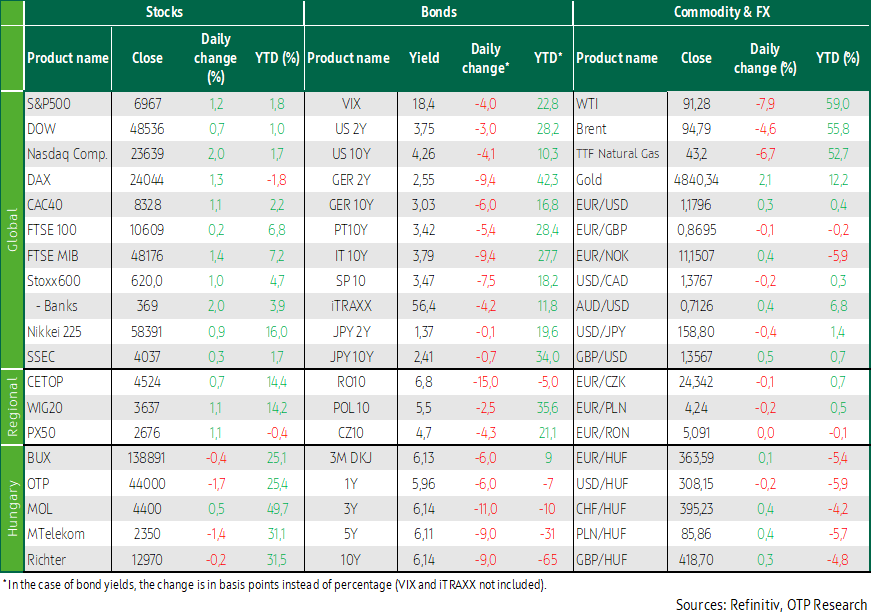
On the back of the positive news, major European indexes closed higher, with the DAX up 1.3%, the CAC 40 gaining 1.1% and the FTSE rising 0.2%, lifting the pan-European STOXX 600 by 1.0% by the end of the session. Gains were led by the media (+2.4%), travel (+2.1%) and banking (+2.0%) sectors, while the energy sector slipped 1.5% on the back of lower oil prices. Meanwhile, the personal and household goods sector edged down 0.1%, with shares of LVMH easing slightly after the luxury group said the Iran war had reduced group-wide sales by at least 1% in the past quarter due to weaker spending in the Gulf region. Shares of Imperial Brands plunged around 4.8% after the Davidoff cigarette maker warned that the impact of the Middle East conflict could disrupt its performance in the second half.
Sentiment was also positive across the CEE region, with both the PX and the WIG 20 rising 1.1%. The BUX, however, underwent a mild correction after Monday’s rally, slipping 0.4%. The decline was driven in part by losses in OTP (-1.7%), Magyar Telekom (-1.4%) and Richter (-0.2%), while MOL gained 0.5% to reach a new high. Beyond the oil company, a stronger positive correction was seen in stocks that had fallen sharply on election-related news, with Opus jumping 21.3% and 4iG climbing 10.0% on Tuesday.
Stocks rose on Wall Street, inflation fears eased
Wall Street indexes extended their gains on Tuesday, with the Nasdaq rising 2.0%, the S&P 500 adding 1.2% and the Dow climbing 0.7%. Of the S&P 500’s 11 major sectors, only three closed in negative territory, led lower by the energy sector, which fell 2.2%. Within technology, software stocks advanced for a second consecutive session, ending the day up 1.6%, while the Philadelphia Semiconductor Index gained 2%, marking its fifth straight record close. On the earnings front, shares of BlackRock rose 3% after the asset manager reported an increase in first-quarter profit, supported by strong inflows into ETFs and a sharp rise in performance fees. Citigroup shares closed up 2.6% after its first-quarter results topped analysts’ expectations. By contrast, JPMorgan’s first-quarter earnings received a more muted market reaction, while Wells Fargo shares declined after net interest income fell short of expectations. In the airline sector, United Airlines gained 2%, while American Airlines shares surged 8% following unconfirmed internal sources about a potential merger between the two companies.
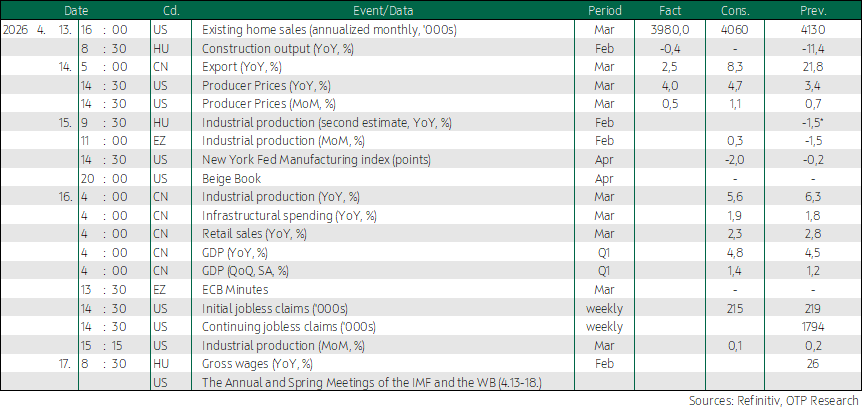
The positive sentiment was further supported by data from the U.S. Bureau of Labor Statistics showing that the producer price index (PPI) rose by 0.5% month on month and 4.0% year on year in March, well below the market consensus of 1.1% and 4.6%, respectively. Core PPI increased by 0.1% on a monthly basis and by 3.8% year on year. Similar to the March CPI figures published last Friday, the PPI release indicated that the surge in oil prices linked to the Iran war had a significant impact on headline inflation measures, while its effect on core inflation was more limited. On Tuesday, the International Monetary Fund (IMF) downgraded its growth outlook due to the energy price shock and supply disruptions triggered by the Iran war, warning that the global economy could be pushed to the brink of recession if the conflict were to escalate and oil prices were to remain sustainably above $100 per barrel through 2027. The IMF’s most optimistic, so-called baseline scenario in its World Economic Outlook assumes a short-lived Iran war and projects global real GDP growth of 3.1% in 2026, which is 0.2 percentage points lower than its January forecast.
On the back of positive war-related news, oil prices declined again, with Brent futures falling 4.6% and slipping back below the $100-per-barrel mark, while WTI dropped 7.9%. Meanwhile, the International Energy Agency (IEA) said the conflict could wipe out global oil demand growth this year, which would mark the first annual decline since the pandemic, adding that prices do not necessarily yet reflect the full extent of lost capacity. The war has significantly damaged energy infrastructure and severely disrupted traffic through the Strait of Hormuz, with an OPEC+ report estimating that production fell by 7.9 million barrels per day in March.
Yields fell on hopes of peace, while the dollar weakened
Confidence in the resumption of peace talks pushed energy prices down by 5–7% yesterday. In line with this, bond yields declined across developed markets, with the U.S. 10-year falling by 4 basis points to around 4.25%, while the German 10-year dropped 6 basis points, moving closer to 3%. The dollar continued to weaken, slipping 0.3% against the euro, with EUR/USD approaching the 1.18 level.
The forint slightly corrected after Monday’s strong post-election rally, easing from levels last seen before the war in Ukraine to above 363.5. Bond yields continued to fall, by around 10 basis points. The reference yield curve flattened significantly, with most benchmark tenors – including the 10-year – clustered around the 6.15% level. At the Government Debt Management Agency’s auction of three-month treasury bills, HUF 40 billion worth of securities were sold amid solid demand, at an average yield of 6.15%.
Today's highlights
Trading in Asia was also positive, with the Nikkei up 0.9%, the SSEC gaining 0.3% and the Kospi rising 2.2%.
Today, attention will focus on euro zone industrial production data for February and the New York Fed’s manufacturing index, as well as the Fed’s Beige Book based on reports from its regional banks. In addition, companies such as ASML, Bank of America and Morgan Stanley are set to report earnings.
Get more out of your investments!
Global Markets Services
OTP Global Markets offers a broad range of services in the field of local and international money and capital markets.
Read morePrivate Banking Services
Personal care and expertise with OTP Private Banking, along with the knowledge, security, and innovations of a multinational banking group.
Read more