
OTP Morning Brief: Winds blowing from the Strait of Hormuz are driving the markets
Related content
OTP Morning Brief: US producer price index came in above expectations, yet the US 10-year Treasury yield still declined
Western European equities continued to advance despite ongoing pressure on the technology sector. Wall Street indices also rebounded, recovering some ground after Wednesday’s sell-off. Healthcare was the standout performer on both sides of the Atlantic. Eurozone industrial production declined by 0.5% month-on-month in August. In the US, the producer price index accelerated to 6.3%, delivering another upside surprise in inflation developments. US retail sales increased by 0.8% compared to August. The US 10-year Treasury yield declined by more than 10 basis points. The long end of the Hungarian government bond yield curve also declined by 7-9 basis points. In Hungary, August wage data will be released today, while in the US, September industrial production figures are due.
OTP Morning Brief: US CPI data came in above expectations
European equity markets advanced, supported by strong results from ASML and the outstanding performance of the healthcare sector. US equity markets came under pressure following higher-than-expected September CPI data. The annual CPI rate accelerated to 3.7%, driven primarily by a surge in gasoline prices, while core CPI rose by 0.3% month-on-month, supported by higher housing costs and rising transportation service prices. Oil prices rose amid escalating tensions in the Middle East and the impact of the IEA's oil market report. US Treasury yields retreated after an initial increase, driven by Fed commentary, while European bond yields generally moved higher. The US macro calendar will be busy today, with investors focusing on September retail sales and producer price index data, as well as the New York Fed Manufacturing Index, weekly jobless claims, and business inventories. August industrial production data from the euro area will be released today.
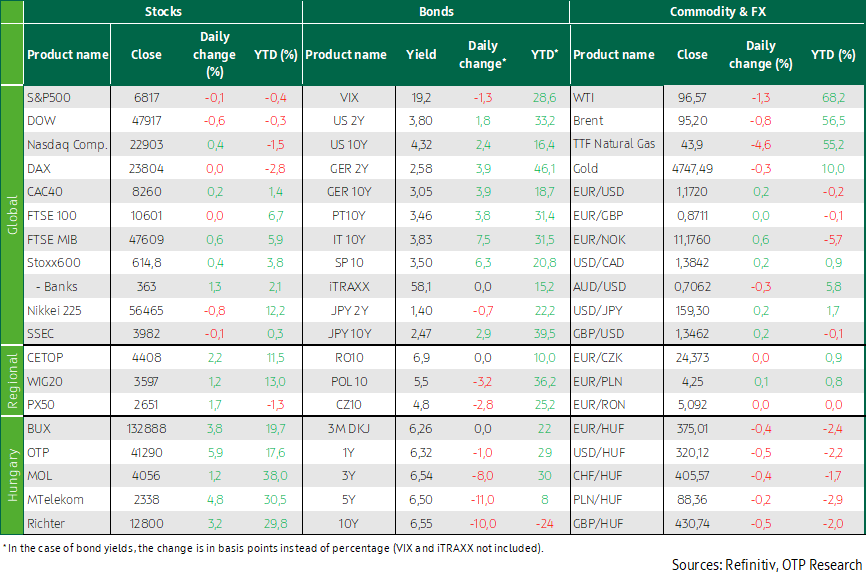
Optimism fueled by the ceasefire agreement faded steadily over the past week as the conflict appears to be escalating again. On Friday, the world’s leading stock exchanges delivered mixed performances, but managed to rise on a weekly basis. Stock markets in the CEE region closed in positive territory on Friday and also posted gains for the week as a whole. Due mainly to rising fuel prices, inflation in the United States accelerated in March, in line with expectations. The Middle Eastern ceasefire helped push crude oil prices lower last week, but prices rebounded following news of developments over the weekend. Eurozone yields remained stuck near previous highs, while long-term U.S. yields declined. The euro strengthened against the dollar. Domestic long-term yields fell, and the forint performed well on the foreign exchange market. In Sunday’s parliamentary election, with more than 98% of votes counted, the Tisza Party secured a two-thirds majority in the Hungarian Parliament. This week will bring several domestic, European, and U.S. business cycle indicators, and the earnings season is set to begin.
Optimism fueled by the ceasefire agreement gradually faded over the course of last week
Last week, global attention remained focused on the Middle Eastern conflict and the Strait of Hormuz. In the first half of the week, news about the start of negotiations significantly eased fears related to oil supply, inflation, and interest rate hikes. Risk appetite strengthened, while energy prices, the dollar, and bond yields declined. In the second half of the week, however, a correction began, and over the weekend peace talks collapsed, to which markets will only be able to react today. On Sunday, Donald Trump announced that the U.S. Navy will impose a blockade on the Strait of Hormuz today, and he also threatened China with a 50% tariff should if it sends arms to Iran. As a result, oil prices are rising again.
On Friday, optimism in European markets was still fueled by confidence in the success of the weekend peace talks
Cautious optimism characterized trading on Friday across the leading Western European stock exchanges, with only Germany’s DAX and the UK’s FTSE 100 slipping into slight negative territory. At the sector level, media, basic materials, financials, and technology performed best, while aerospace and defense stocks declined on news of a possible Russian–Ukrainian agreement. Germany’s Rheinmetall and Hensoldt, as well as Italy’s Leonardo, fell by more than 5%, while CSG dropped by 8%. Shares of Sodexo plunged more than 10% to a six-year low after the French company significantly revised down its full-year revenue and profitability targets. Repsol’s share price declined by 5.8% after the Spanish energy company reported weaker-than-expected first-quarter results.
Looking at the week as a whole, all major European stock markets managed to move higher—for the third consecutive week—as investors awaited the next round of U.S.–Iran peace talks over the weekend with optimism, that we now know did not succeed. The pan-European Stoxx 600 rose by 0.4% on Friday, bringing its weekly gain to 3%.
Stock markets in the CEE region also moved higher on Friday, with the BUX clearly delivering the strongest performance, rising by nearly 4%. All domestic blue-chip stocks closed in positive territory, with OTP—up more than 5%—emerging as the day’s winner on the final trading day of the week. Looking at the week as a whole, the BUX also outperformed the region, posting gains of over 7%.
With more than 98% of votes counted in Sunday’s parliamentary election, the Tisza Party secured a two-thirds majority in the Hungarian Parliament. The result was received positively by the market, with the forint strengthening against the euro, falling below the 370 level.
Most major U.S. indices declined on Friday, but posted gains for the week as a whole
Leading Wall Street indices slipped slightly on Friday, with the exception of the NASDAQ, which was able to benefit from the strong performance of the technology sector, as investors remained cautious ahead of the weekend peace talks. Among the S&P sector indices, consumer staples led the declines, while technology stocks topped the gainers. Chipmakers recorded strong gains, with Broadcom and Nvidia rising by 4.7% and 2.6%, respectively. The financial sector underperformed on Friday, as markets prepared for the release of earnings reports from major U.S. banks due later this week. On a weekly basis, all three major Wall Street indices posted solid gains.
The March inflation data published on Friday showed an acceleration in line with expectations. The 0.9% month-on-month increase was driven three-quarters by rising fuel prices, while the increase in housing costs—long a persistent concern—also accelerated compared with February. Core inflation rose by 0.2% month-on-month, as in February, below than expected (+0.3%).
Following Thursday’s rebound after the sharp sell-off on Wednesday, Brent and WTI prices edged slightly lower again on Friday. Prices are hovering around USD 95 per barrel. However, worries began to mount again on unfavorable news related to the peace talks.
Eurozone yields remained stuck around previous highs; long-term U.S. yields declined; the euro strengthened against the dollar; domestic long-term yields fell; and the forint performed well on the foreign exchange market
Although markets are currently paying less attention to macroeconomic data, incoming U.S. and European activity indicators—largely still referring to the period before the outbreak of the war—pointed to a slowdown in growth, while U.S. core inflation for March also came in lower than expected. Markets continue to expect the Federal Reserve to keep its policy rate unchanged at the current 3.5–3.75% level through year-end, though the implied probability of rate cuts increased last week. Long-term bond yields fell by around 10 basis points from recent local peaks by mid-week, but only about half of this move remained after the subsequent correction, leaving the 10-year yield above 4.3%, in the lower third of the post-COVID trading range. The number of 25-basis-point rate hikes expected from the ECB declined from three to four to two to three, while eurozone government bond yields, despite significant volatility, ultimately hovered around previous highs. The 10-year German Bund yield returned above the important 3% level, the upper bound of the post-pandemic trading range. The euro continued to strengthen against the dollar on Friday as well for the whole week—rising by 0.2% on the final trading day and by 2% over the week as a whole—pushing the EUR/USD exchange rate above 1.17.
In Hungary, February’s industrial production and retail sales data show no sign of a meaningful acceleration in growth in the first quarter, although the March inflation figure came in more favorably than expected. This likely contributed to the very positive sentiment on the domestic FX and bond markets in the week leading up to the parliamentary elections. The forint strengthened by 0.5% against the euro on Friday and by 2% over the week as a whole, pushing the EUR/HUF exchange rate below 375—a two-and-a-half-year high for the forint. This represented a significant outperformance compared with the zloty and the koruna, which appreciated by less than 1% over the week. Expectations for rate hikes also declined: instead of the 125 basis points priced in two weeks ago and the 75 basis points expected a week ago, the yield curve now implies a single 25-basis-point rate increase. As a result, government bond yields fell sharply, with maturities beyond one year declining by 10 basis points on Friday and by 30–50 basis points over the week as a whole. The 10-year yield now stands only slightly above 6.5%.
Today's highlights
News over the weekend related to the Middle Eastern conflict was received negatively by the major Asia-Pacific stock markets this morning. The failure of the peace talks and the potential U.S. blockade of the Strait of Hormuz have renewed concerns about a prolonged conflict and pushed oil prices higher. As a result, Brent crude, which was trading around USD 95 per barrel on Friday, climbed back above USD 100 per barrel this morning. Equity index futures point to a lower open in both Europe and the United States.
Today it will be important to monitor how markets react to the domestic election results.
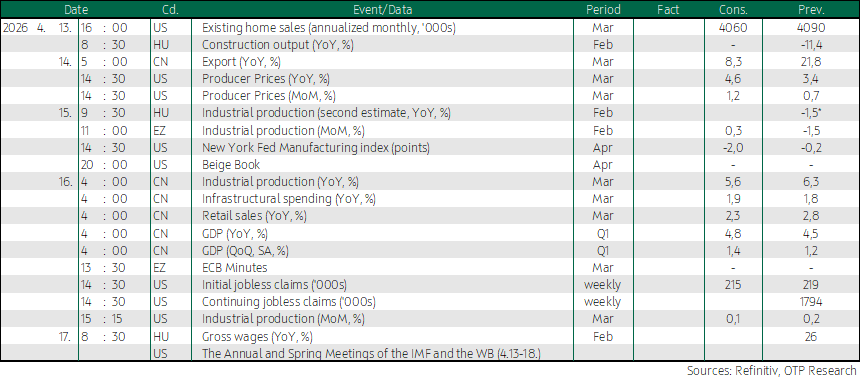
From a data perspective, we are heading into a busy week both domestically and internationally. Hungary’s Central Statistical Office (KSH) will publish February business confidence indicators. Industrial production data will be released from the euro area and the United States, while first-quarter GDP figures will be in focus in China.
News related to the Middle Eastern conflict is unlikely to fade into the background, and markets are currently awaiting reactions to the unfavorable developments over the weekend.
In addition, the earnings season kicks off this week, with major names such as Goldman Sachs, JPMorgan, Citigroup, BlackRock, Bank of America, Morgan Stanley, and Netflix among those set to report.
Get more out of your investments!
Global Markets Services
OTP Global Markets offers a broad range of services in the field of local and international money and capital markets.
Read morePrivate Banking Services
Personal care and expertise with OTP Private Banking, along with the knowledge, security, and innovations of a multinational banking group.
Read more