
OTP Morning Brief: Investors were closely monitoring the extremely fragile ceasefire
Related content
OTP Morning Brief: US producer price index came in above expectations, yet the US 10-year Treasury yield still declined
Western European equities continued to advance despite ongoing pressure on the technology sector. Wall Street indices also rebounded, recovering some ground after Wednesday’s sell-off. Healthcare was the standout performer on both sides of the Atlantic. Eurozone industrial production declined by 0.5% month-on-month in August. In the US, the producer price index accelerated to 6.3%, delivering another upside surprise in inflation developments. US retail sales increased by 0.8% compared to August. The US 10-year Treasury yield declined by more than 10 basis points. The long end of the Hungarian government bond yield curve also declined by 7-9 basis points. In Hungary, August wage data will be released today, while in the US, September industrial production figures are due.
OTP Morning Brief: US CPI data came in above expectations
European equity markets advanced, supported by strong results from ASML and the outstanding performance of the healthcare sector. US equity markets came under pressure following higher-than-expected September CPI data. The annual CPI rate accelerated to 3.7%, driven primarily by a surge in gasoline prices, while core CPI rose by 0.3% month-on-month, supported by higher housing costs and rising transportation service prices. Oil prices rose amid escalating tensions in the Middle East and the impact of the IEA's oil market report. US Treasury yields retreated after an initial increase, driven by Fed commentary, while European bond yields generally moved higher. The US macro calendar will be busy today, with investors focusing on September retail sales and producer price index data, as well as the New York Fed Manufacturing Index, weekly jobless claims, and business inventories. August industrial production data from the euro area will be released today.
European markets declined under the pressure of the ceasefire. German industrial production fell more than expected ahead of the war, while export performance came as a positive surprise. The Polish central bank left its policy rate unchanged. Markets rose later in the evening on signs of de-escalation. Core PCE came in in line with expectations. Oil futures rose again. U.S. yields declined, and a weakening dollar supported gains in regional currencies. Asian stock markets advanced. Today, attention will be on U.S. inflation data.
Investors were watching the extremely fragile ceasefire; European markets declined, and industrial production in Germany came in lower than expected
Investors worldwide were monitoring developments surrounding the shaky U.S.–Iran ceasefire, which came under threat within a day after Israel stated that the agreement did not extend to Lebanon and carried out the most intense airstrike of the war on Beirut, resulting in more than three hundred fatalities, just days ahead of the planned talks in Pakistan. In response, Iran’s Supreme Leader vowed retaliation for the attacks and signaled a move into a “new phase” of control over the Strait of Hormuz, which effectively remained closed despite Wednesday’s agreement, with not even 10% of normal shipping traffic able to pass through. Accordingly, both the Iranian and U.S. sides accused each other of violating the ceasefire. However, by the end of yesterday’s session, Israeli Prime Minister Benjamin Netanyahu stated that he intended to pursue direct talks with Beirut.
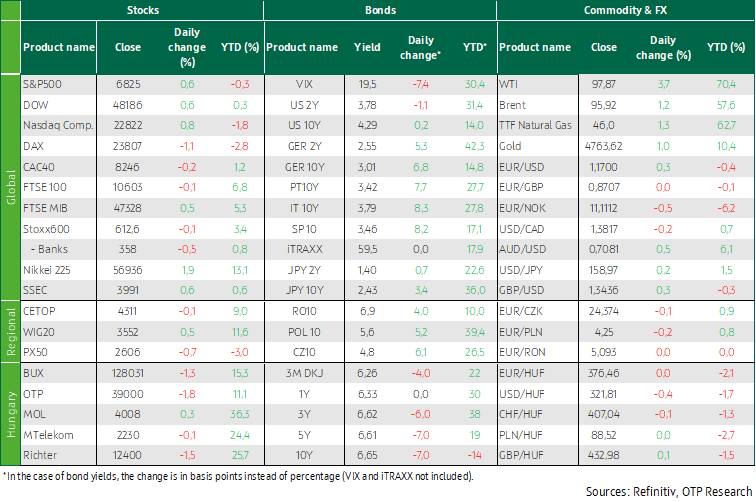
Volatile news dampened investors’ risk appetite, and following the strong gains seen on Wednesday, European stock markets turned lower again. The DAX recorded the largest decline, falling 1.1%, while the CAC 40 slipped more modestly by 0.2% and the UK’s FTSE 100 edged down 0.1%, leaving the Stoxx 600 to close just 0.1% lower overall. The industrial sector weighed most heavily on the market, declining 0.5%, with Germany’s Siemens falling 2.1% and Airbus dropping 2.5%. Travel, banking, and technology stocks also traded in negative territory following the previous day’s rally, while the energy sector rose 1.9% amid renewed gains in oil prices. The sector was supported by a 3.1% rise in BP shares, which also provided support to the UK market.
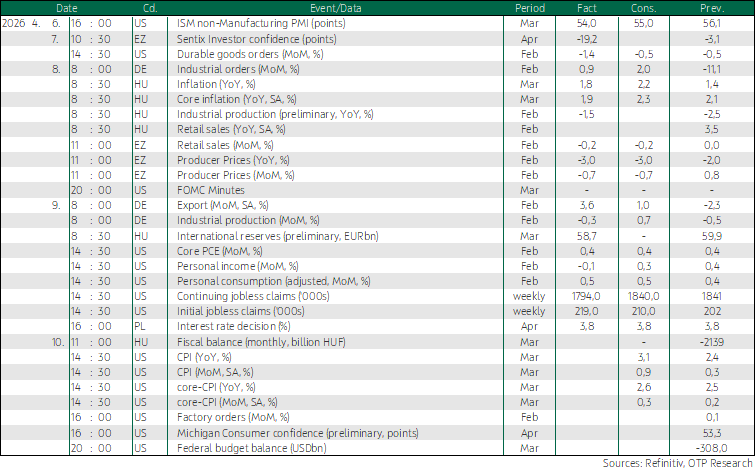
Germany’s weaker market performance was partly driven by a contraction in industrial production, which fell by 0.3% month on month in February, compared with expectations for a 0.7% increase, although the January figure was revised upward. The outlook for the industrial sector is being weighed down by energy prices that remain significantly above pre-Iran conflict levels. That said, analysts argue that the risk of a downturn comparable to the 2022 energy crisis is lower, as the rise in energy prices has been more moderate, interest rates are unlikely to increase further, portion of the energy-intensive production capacity has been already underperforming, and the manufacturing PMI showed a slight improvement in March. The weaker-than-expected data point was partly offset by a strong export performance, as German exports rose by 3.6% month on month in February 2026, reaching a three-year high of EUR 135.2 billion, following a downward-revised 1.5% decline in January and exceeding the market’s expectation of a 1% increase.
Sentiment across Central and Eastern Europe was also mostly negative, with the BUX falling 1.7% and the PX50 down 0.7%, while the WIG20 posted a gain of around 0.5%. The latter may have been supported by the Polish central bank’s decision at its April meeting to keep the policy rate unchanged at 3.75%, in line with market expectations. Optimism expressed at the previous meeting regarding the Middle East conflict has since faded, with inflation forecasts now surrounded by heightened uncertainty. Within the BUX index, losses were led mainly by OTP, which fell 1.8%, and Richter, down 1.5%.
U.S. markets moved higher on positive news, with core PCE meeting expectations
The deterioration in morning sentiment had partly eased by the time of the U.S. market open, and following conciliatory remarks from Israeli officials, U.S. equities moved higher: the S&P 500 and the Dow Jones ended the session up 0.6%, while the Nasdaq gained 0.8%. The consumer discretionary sector strengthened after Amazon CEO Andy Jassy said that annualized revenue from AI-based services within the company’s cloud division has exceeded USD 15 billion so Amazon shares closed sharply higher, up 5.8%. CoreWeave shares rose 3.4% after the cloud infrastructure company announced an expansion of its USD 21 billion cloud agreement with Meta Platforms, although gains were limited by the announcement of a USD 3 billion convertible bond issuance.
PCE inflation rose by 0.4% month on month in February, while the year-on-year rate remained at 2.8%, indicating price pressures similar to those seen in the previous month. At the same time, core inflation—excluding volatile food and energy prices—also increased by 0.4% on a monthly basis, while easing to 3.0% year on year from 3.1% in January. Consumption expanded by 0.5% in February, suggesting that elevated price levels continue to provide meaningful support to the growth of nominal spending. Inflation had already been running above the 0.2% monthly pace consistent with the Fed’s 2% target even prior to the war, a trend that was further reinforced by Trump’s import tariffs. According to weekly labor market data, initial jobless claims rose by 16,000 to 219,000 in the week ending April 4 compared with the previous week, exceeding the market expectation of 212,000 and reaching the highest level in roughly one month.
Brent crude oil futures rose again on Thursday, gaining 1.7% to above USD 96 per barrel, partially correcting the nearly 13% plunge seen in the previous trading session, as investors grew increasingly concerned about the fragility of the ceasefire. Meanwhile, WTI surged by 3.7%, approaching USD 98 per barrel.
U.S. Treasury yields declined, while a weakening dollar supported gains in regional currencies
Optimism about a swift end to the conflict with Iran proved short-lived, as the parties failed to adhere to the ceasefire. As a result, the sharp sell-off seen in energy prices on Wednesday was followed by a correction yesterday. Meanwhile, the U.S. 10-year Treasury yield edged slightly lower, briefly dipping below the 4.3% level, after February PCE inflation rose in line with expectations, while fourth-quarter GDP growth was revised down to an annualized 0.5%. Weaker data have also been emerging for the first quarter, and initial jobless claims increased as well. In contrast, European bond yields corrected higher after Wednesday’s drop, with the 10-year German yield rising by nearly 5 basis points to around 3.0%. On the back of weak U.S. data, the euro strengthened further, with EUR/USD reaching the 1.17 level.
Regional currencies were supported by a weakening dollar, with the Czech koruna appreciating by 0.1%, the Hungarian forint by 0.2%, and the Polish zloty by 0.3% against the euro. The domestic currency strengthened back to the 376 level per euro. The Government Debt Management Agency’s (ÁKK) early-afternoon published government bond reference yields showed declines of 5–6 basis points at maturities beyond one year; however, this largely reflected the drop following Wednesday’s fixing, as there was no material movement during yesterday’s trading session, with the 10-year yield closing below 6.7%. Demand was weak at auctions, however: the announced HUF 20 billion of one-year Treasury bills was only just sold, at an average yield of 6.35%. Sales of the 15-year bond amounted to HUF 26 billion at an average yield of 6.71%, while only around HUF 7 billion of the 20-year green bond was sold, at an average yield of 6.73%.
Today's highlights
Most Asian stock markets advanced on Friday amid cautious optimism ahead of ceasefire talks between Iran and the United States. South Korea’s KOSPI was the best-performing index, rising 1.9% as demand for local technology stocks strengthened. Markets showed little reaction to the Bank of Korea’s decision to leave its policy rate unchanged at 2.50%. Japan’s Nikkei also gained 1.9%, while China’s Shanghai Composite (SSEC) was up 0.6%.
Today, investors’ attention will primarily be focused on U.S. inflation data, although figures on factory orders, a confidence index, and the federal budget balance are also due. Before these releases, however, Hungary’s March budget balance will be published.
Get more out of your investments!
Global Markets Services
OTP Global Markets offers a broad range of services in the field of local and international money and capital markets.
Read morePrivate Banking Services
Personal care and expertise with OTP Private Banking, along with the knowledge, security, and innovations of a multinational banking group.
Read more