
OTP Morning Brief: Oil prices fell as a result of the ceasefire agreed overnight
Related content
OTP Morning Brief: US producer price index came in above expectations, yet the US 10-year Treasury yield still declined
Western European equities continued to advance despite ongoing pressure on the technology sector. Wall Street indices also rebounded, recovering some ground after Wednesday’s sell-off. Healthcare was the standout performer on both sides of the Atlantic. Eurozone industrial production declined by 0.5% month-on-month in August. In the US, the producer price index accelerated to 6.3%, delivering another upside surprise in inflation developments. US retail sales increased by 0.8% compared to August. The US 10-year Treasury yield declined by more than 10 basis points. The long end of the Hungarian government bond yield curve also declined by 7-9 basis points. In Hungary, August wage data will be released today, while in the US, September industrial production figures are due.
OTP Morning Brief: US CPI data came in above expectations
European equity markets advanced, supported by strong results from ASML and the outstanding performance of the healthcare sector. US equity markets came under pressure following higher-than-expected September CPI data. The annual CPI rate accelerated to 3.7%, driven primarily by a surge in gasoline prices, while core CPI rose by 0.3% month-on-month, supported by higher housing costs and rising transportation service prices. Oil prices rose amid escalating tensions in the Middle East and the impact of the IEA's oil market report. US Treasury yields retreated after an initial increase, driven by Fed commentary, while European bond yields generally moved higher. The US macro calendar will be busy today, with investors focusing on September retail sales and producer price index data, as well as the New York Fed Manufacturing Index, weekly jobless claims, and business inventories. August industrial production data from the euro area will be released today.
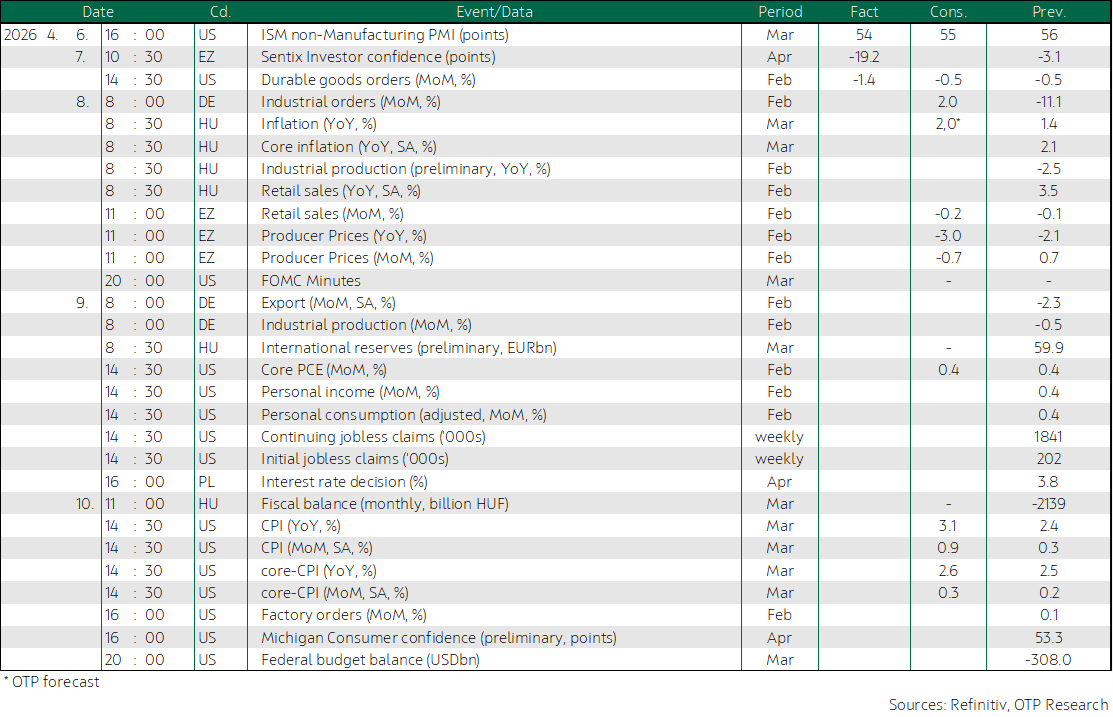
European indices fell yesterday following Donald Trump’s targeted threats against Iran; the Sentix confidence index deteriorated significantly in April. U.S. stock markets were mixed on Tuesday as the deadline of Donald Trump’s ultimatum approached, while negotiations between the parties continued in parallel; U.S. durable goods orders declined more than expected, but the index reflecting underlying trends increased. Today, Hungarian inflation, industrial output, and retail sales data will be released; from Germany, industrial orders data are due, while retail sales and producer prices will be published for the euro area. In addition, the Fed will release the minutes of its most recent interest rate decision meeting later in the evening.
European indices fell yesterday following Donald Trump’s targeted threats against Iran; the Sentix confidence index deteriorated significantly in April
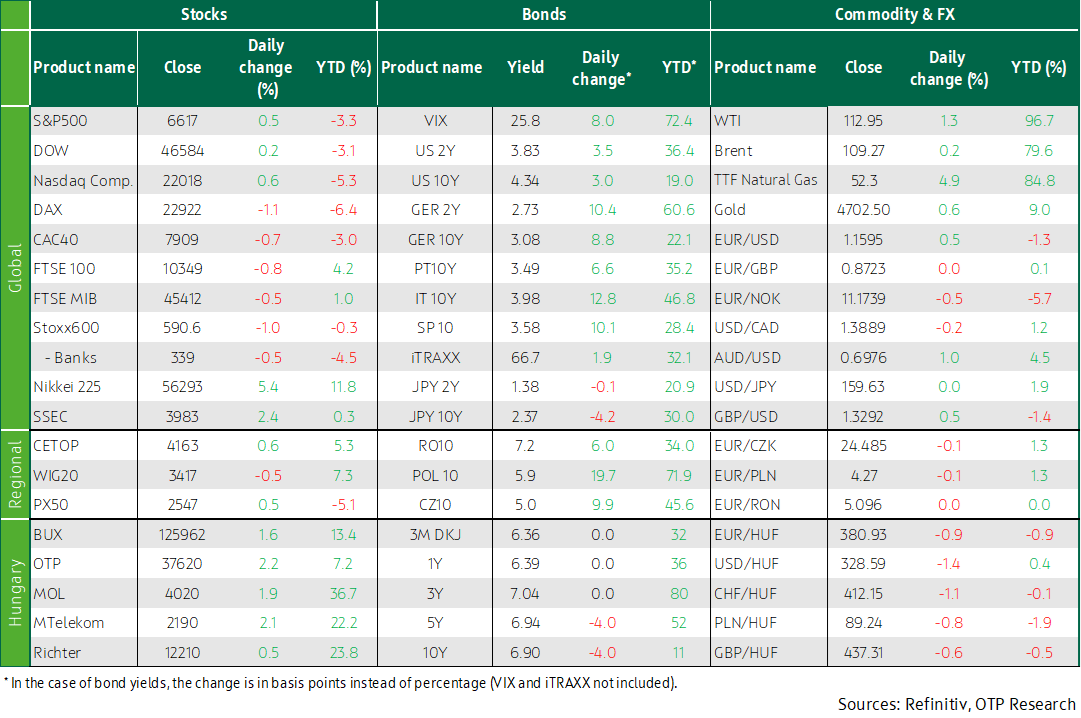
European stock markets weakened yesterday as investors became more cautious ahead of U.S. President Donald Trump’s ultimatum to Iran regarding the reopening of the Strait of Hormuz. The Stoxx 600 index fell by 1%, giving up early gains, and most sectors and major European exchanges closed in negative territory following the four-day Easter break. Markets were pressured by contradictory communication from the U.S. administration: Trump simultaneously threatened attacks on Iranian civilian infrastructure while speaking of good-faith negotiations, then in a subsequent message issued a sharply worded warning about the importance of the Strait of Hormuz. In company-specific news, Commerzbank stated that it does not see sufficient value-creation potential in the takeover offer made by UniCredit.
The Sentix index fell sharply to -19.2 points in April from -3.1 points in March. Following the outbreak of the war in Iran, the first signs of rising uncertainty had already appeared in the sentiment indicator in early March, which was followed by a further pronounced decline by April. The Sentix economic sentiment index deteriorated significantly, driven in particular by the drop in the expectations component. The euro area’s overall indicator declined markedly, while the risk of another recession once again moved to the forefront among investors. A clear deterioration was also visible in Germany, where expectations fell to their lowest level since autumn 2024. The unfavorable sentiment has become a global phenomenon: outlooks worsened for both developed and emerging economies, and global expectations sank to levels last seen in spring 2025.
Stocks in the CEE region closed mixed yesterday: the BUX and the Prague Stock Exchange managed to post gains, while the Warsaw market declined. All domestic blue-chip stocks closed in positive territory.
U.S. stock markets were mixed on Tuesday as the deadline of Donald Trump’s ultimatum approached, while negotiations between the parties continued in parallel; U.S. durable goods orders fell by more than expected, although the index reflecting underlying trends increased
With the exception of the Dow, the major U.S. equity indices moved into positive territory by the close on Tuesday as the deadline set by President Donald Trump for Iran to reopen the Strait of Hormuz approached, while markets were betting on a last-minute deal. This ultimately materialized overnight, when the parties agreed to a two-week ceasefire and the temporary reopening of the Strait of Hormuz. The president had earlier extended the deadline until 8:00 p.m. Eastern Time on Tuesday (2:00 a.m. Wednesday in Budapest), threatening Iran with U.S. strikes against the country’s energy and infrastructure facilities if no agreement were reached. Geopolitical tensions intensified further as the deadline approached: according to U.S. media reports, the United States carried out strikes overnight on Kharg Island, which belongs to Iran.Oil prices fell sharply on news of the ceasefire, both for U.S. WTI and Brent crude.
In the United States, new orders for durable consumer goods declined by 1.4% month on month in February, marking the third consecutive monthly decrease and coming in worse than the market consensus, which had expected a more moderate decline of around -0.5%. The drop was largely driven by a 5.4% fall in orders for transportation equipment; within this category, orders for non-defense aircraft and parts—known for their high volatility—plunged by nearly 29%. At the same time, the picture is significantly nuanced by the fact that excluding transportation equipment, orders rose by 0.8%, exceeding expectations that had been centered around stagnation.
Among individual names, Broadcom stood out as a positive exception: its shares climbed 6.2% after the company entered into artificial intelligence-related agreements with Google and Anthropic. Universal Music Group’s share price surged by 11.4% after Pershing Square made a USD 64 billion acquisition offer and announced the creation of a new company to be listed on the New York Stock Exchange.
Developed market bond yields were mixed on Tuesday; the euro strengthened against the U.S. dollar
Oil prices corrected slightly from their recent peaks yesterday, which had been driven by Donald Trump’s ultimatum directed at Iran. U.S. Treasury yields fell by a few basis points, with the 10-year yield edging down toward 4.3%. In contrast, yields rose sharply in Europe after Pierre Wunsch, a Belgian policymaker at the ECB, suggested that multiple interest rate hikes could be needed this year—potentially starting as early as April—if energy prices remain persistently high. The hawkish tone strengthened the euro against the U.S. dollar, rising by around half a percent to the 1.16 level.
The forint also strengthened, with the EUR/HUF exchange rate slipping below 380 in the early morning hours on news of the ceasefire. In the bond market, yields declined by a few basis points, with the 10-year yield falling to 6.9%. The announced HUF 20 billion worth of Treasury bills was sold successfully amid adequate demand, at an average yield of 6.44%.
Today, the Debt Management Agency is offering six-month Treasury bills, with an announced amount of HUF 20 billion. In addition, the market may obtain 2037/A and 2038/A government bonds through switch auctions in exchange for bonds maturing this year.
Today's highlights
Asian indices posted strong gains this morning following the overnight announcement of the ceasefire. The rally was led by the South Korean market, while Japan’s Nikkei also rose by more than 5%.
Today brings the most eagerly awaited macroeconomic data of the week in Hungary: the March inflation figures. According to our own forecast, the pace of price increases may have accelerated to 2.0% from 1.4% in February, while the Bloomberg market consensus expects 2.2%. Also due today are Hungary’s February industrial production and retail sales figures. In addition, data on German industrial orders will be released, while in the euro area February retail sales figures are scheduled for publication, where the market expects a 0.2% monthly decline following a 0.1% drop in January. Furthermore, the euro area producer price index and the minutes of the Fed’s most recent interest rate decision meeting will also be published.
Get more out of your investments!
Global Markets Services
OTP Global Markets offers a broad range of services in the field of local and international money and capital markets.
Read morePrivate Banking Services
Personal care and expertise with OTP Private Banking, along with the knowledge, security, and innovations of a multinational banking group.
Read more