
OTP Morning Brief: A broad selling wave swept through stock markets on Thursday
Related content
OTP Morning Brief: US producer price index came in above expectations, yet the US 10-year Treasury yield still declined
Western European equities continued to advance despite ongoing pressure on the technology sector. Wall Street indices also rebounded, recovering some ground after Wednesday’s sell-off. Healthcare was the standout performer on both sides of the Atlantic. Eurozone industrial production declined by 0.5% month-on-month in August. In the US, the producer price index accelerated to 6.3%, delivering another upside surprise in inflation developments. US retail sales increased by 0.8% compared to August. The US 10-year Treasury yield declined by more than 10 basis points. The long end of the Hungarian government bond yield curve also declined by 7-9 basis points. In Hungary, August wage data will be released today, while in the US, September industrial production figures are due.
OTP Morning Brief: US CPI data came in above expectations
European equity markets advanced, supported by strong results from ASML and the outstanding performance of the healthcare sector. US equity markets came under pressure following higher-than-expected September CPI data. The annual CPI rate accelerated to 3.7%, driven primarily by a surge in gasoline prices, while core CPI rose by 0.3% month-on-month, supported by higher housing costs and rising transportation service prices. Oil prices rose amid escalating tensions in the Middle East and the impact of the IEA's oil market report. US Treasury yields retreated after an initial increase, driven by Fed commentary, while European bond yields generally moved higher. The US macro calendar will be busy today, with investors focusing on September retail sales and producer price index data, as well as the New York Fed Manufacturing Index, weekly jobless claims, and business inventories. August industrial production data from the euro area will be released today.
A broad selling wave and risk aversion swept through stock markets on Thursday. Although the ECB did not cause surprise, Western Europe’s markets fell due to mixed earnings reports and concerns about software companies. The BUX also ended the day deep in the red. Concerns about AI and worse-than-expected labour market data dragged down US markets. The price of gold, silver, and oil slid; Bitcoin fell below 70,000 USD. The EUR/HUF remained below 380, but the decline in domestic yields halted. Industrial production data from Hungary and Germany, as well as consumer confidence statistics from the USA are in focus today.
Although the ECB did not cause surprise, Western Europe’s stock markets fell due to mixed earnings reports and concerns about software companies; the BUX ended the day deep in the red
Western Europe’s markets closed slipped as investors focused on corporate earnings reports and central banks’ decisions (ECB, BoE), while global risk sentiment continued to be overshadowed by the early-to-mid-week tech/software sell-off in the USA.
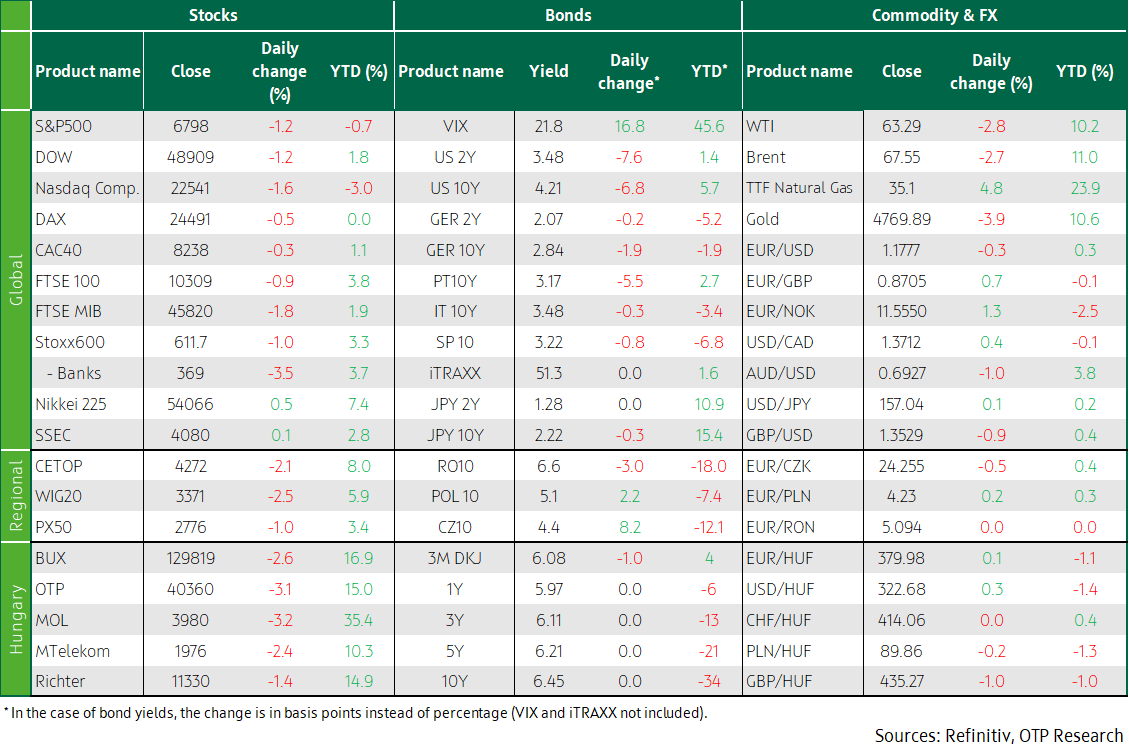
By the end of Thursday’s trading, the sentiment had clearly shifted towards risk aversion: the Stoxx 600 fell by 1%, and virtually all major European stock exchanges closed subsided (DAX: -0.5%, CAC40: -0.3%, FTSE 100: -0.9%, FTSEMIB -1.8%). Among sectors, IT, media, food and consumer staples held up slightly, while the others fell, with the biggest declines (around -3.5%) in the banking and materials sectors.
Among banks, BBVA plunged 8.8%, dragging down Spain's IBEX index, as higher-than-expected costs offset the bank's stronger quarterly revenue. In contrast, BNP Paribas rose 1.2% after the eurozone's largest bank by assets reported stronger-than-expected fourth-quarter profit.
Among mining stocks, Aurubis slid 2.9% after Europe's largest copper producer reported weaker-than-expected quarterly operating core profit. Meanwhile, Glencore shares dived 7%, while Rio Tinto's London-listed shares slumped 2.6% after the latter announced it was no longer in talks with Glencore over a takeover that would have created the world's largest mining company. British oil giant Shell lost 3.4% as its fourth-quarter net profit missed analysts' expectations.
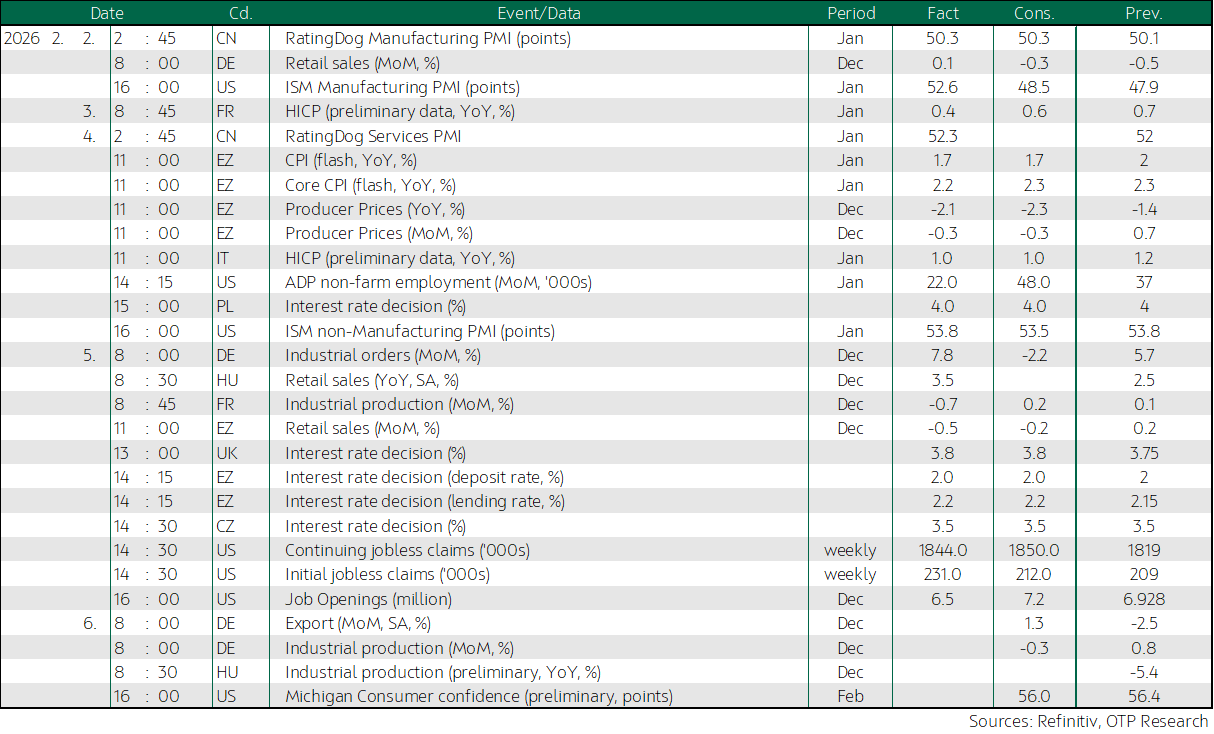
On the macro front, central banks did not cause surprise: the ECB left its deposit rate unchanged at 2%, and its communications continued to suggest a data-driven, meeting-by-meeting approach. The Bank of England also kept its base rate at 3.75%, but its communications indicated that there could be room for further cuts this year.
Amid the negative international sentiment, CEE markets lost 1-2% on Thursday. Hungary’s BUX dropped by 2.6%, led by MOL (-3.2%) and OTP (-3.1%), but MTelekom (-2.4%) and Richter (-1.4%) also ended trading in the red.
Concerns about AI and weaker-than-expected labour market data dragged down US markets; gold, silver, and oil slipped; Bitcoin fell below USD 70,000
Wall Street’s indexes fell sharply on Thursday, with the Nasdaq hitting its lowest level since November 2025 due to losses at Microsoft, Amazon and other tech heavyweights after Alphabet announced it could double its capital spending on artificial intelligence. Alphabet shares fell 0.5% after Google’s parent company said it plans to invest up to USD 185 billion in 2026. The company and its Big Tech rivals are expected to collectively invest more than USD 500 billion in artificial intelligence this year. Microsoft (-5%), Palantir (-6.8%), and Oracle (-7%) all suffered painful losses. Amazon lost 4.4% in normal trading, before diving 11% deeper in after-hours trading, following the publication of its earnings report; the giant also plans a massive capital expenditure for 2026. Nvidia shares declined by 1.4%; the chipmaker is expected to benefit from the industry’s increased AI spending.
Investors also worried this week that rapidly developing AI tools could stifle demand for traditional software, squeezing the industry’s profit margins. As software and data companies continued to decline, ServiceNow (-7.6%) and Salesforce (-5%) decreased. The S&P500’s software and services index fell 4.6%, marking its seventh consecutive day of losses.
The S&P and Dow fell 1.2%, while the Nasdaq was down 1.6%. Nine of the S&P500’s eleven sector indexes fell, headed by the materials sector (-2.8%), followed by the consumer discretionary sector (-2.6%).
Macro data also spooked investors: in the USA, initial jobless claims rose more than expected in the week ending 31 January, while the number of vacant jobs fell to the lowest in more than five years in December.
Developed markets’ bond yields fell, the dollar strengthened against the euro; the EUR/HUF remained below 380, but the decline in Hungary’s yields halted
Weaker-than-expected data came from the US labour market, where the number of initial jobless claims jumped, while the number of vacant positions unexpectedly and significantly decreased. As a result, expectations of a US interest rate cut strengthened, the yield curve shifted down by about 10 basis points; the ten-year yield sank below 4.2%. While the ECB did not cause any surprise, European yields also dropped, but to a lesser extent than the US ones. Due to increasing risk aversion, the dollar strengthened by a quarter of a percent against the euro, thus the EUR/USD sank below 1.18, despite the labour market data and the decline in yields.
The forint initially strengthened further, sending the EUR/HUF closer to 378, but it weakened in the afternoon. The EUR/HUF closed below 380.
ÁKK offered 3Y, 5Y, and 10Y bonds at Thursday's auctions. Demand was extremely strong, especially for the ten-year maturity: bids amounted to HUF 100bn, 100bn, and 150 billion for the announced volumes of HUF 20bn, 25bn, and 25 billion, respectively. The ÁKK did not waste the opportunity and sold a total of HUF 155 billion worth of bonds. The drop in yields stopped yesterday; the ten-year yield was at 6.45%.
Today’s highlights
Asia’s indices inched up this morning, Japan’s Nikkei (+0.5%) and China’s SSEC (+0.1%) both rose. Index futures for Europe and America are down around half a percent, gold and silver prices are falling further, while the price of WTI picked up.
Today, the December reading of industrial production will be released in Hungary and in Germany. On the other side of the Atlantic, the University of Michigan consumer sentiment index will be published – unlike the January gauge of US jobs report, which was originally scheduled for release on Friday, but is being postponed to next week, due to the government shutdown earlier this week.
Get more out of your investments!
Global Markets Services
OTP Global Markets offers a broad range of services in the field of local and international money and capital markets.
Read morePrivate Banking Services
Personal care and expertise with OTP Private Banking, along with the knowledge, security, and innovations of a multinational banking group.
Read more