
OTP Morning Brief: Fed rate decision may drive markets
Related content
OTP Morning Brief: US producer price index came in above expectations, yet the US 10-year Treasury yield still declined
Western European equities continued to advance despite ongoing pressure on the technology sector. Wall Street indices also rebounded, recovering some ground after Wednesday’s sell-off. Healthcare was the standout performer on both sides of the Atlantic. Eurozone industrial production declined by 0.5% month-on-month in August. In the US, the producer price index accelerated to 6.3%, delivering another upside surprise in inflation developments. US retail sales increased by 0.8% compared to August. The US 10-year Treasury yield declined by more than 10 basis points. The long end of the Hungarian government bond yield curve also declined by 7-9 basis points. In Hungary, August wage data will be released today, while in the US, September industrial production figures are due.
OTP Morning Brief: US CPI data came in above expectations
European equity markets advanced, supported by strong results from ASML and the outstanding performance of the healthcare sector. US equity markets came under pressure following higher-than-expected September CPI data. The annual CPI rate accelerated to 3.7%, driven primarily by a surge in gasoline prices, while core CPI rose by 0.3% month-on-month, supported by higher housing costs and rising transportation service prices. Oil prices rose amid escalating tensions in the Middle East and the impact of the IEA's oil market report. US Treasury yields retreated after an initial increase, driven by Fed commentary, while European bond yields generally moved higher. The US macro calendar will be busy today, with investors focusing on September retail sales and producer price index data, as well as the New York Fed Manufacturing Index, weekly jobless claims, and business inventories. August industrial production data from the euro area will be released today.
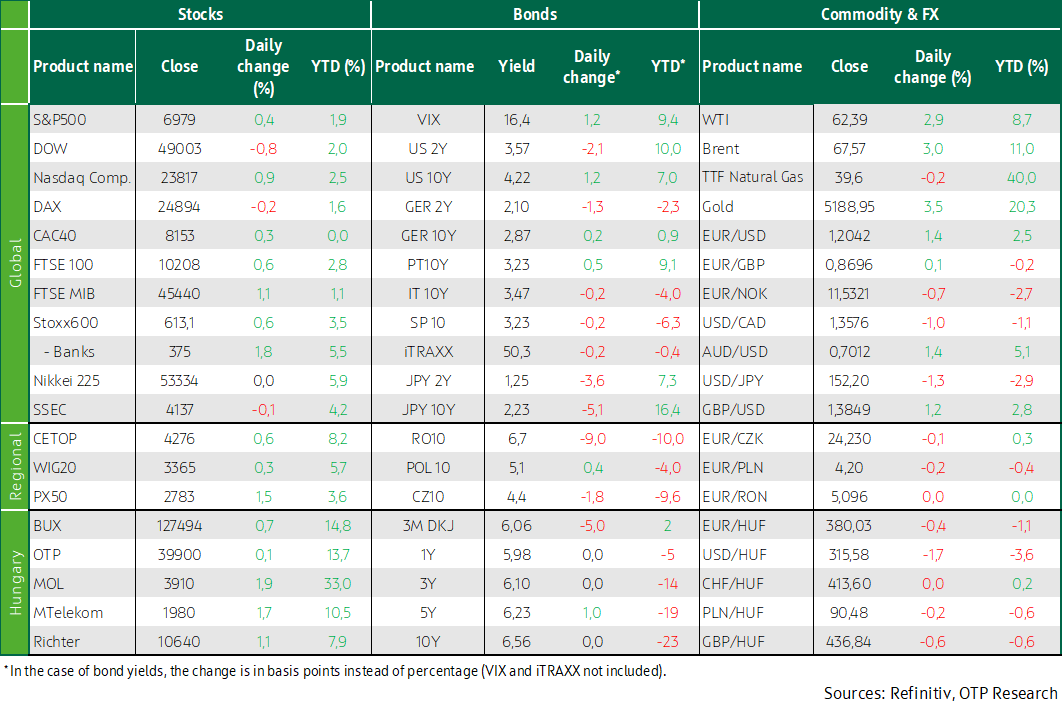
The EU and India struck landmark trade deal. Most stock markets in Western Europe rose on Tuesday. CEE stock markets also climbed higher; all Hungarian blue chips rose. US indices increased, except the Dow. Brent and WTI prices grew. The dollar’s continued weakening pushed the EUR/USD to 1.2. Gold prices reached a new high, the price is nearing 5,200 USD/oz. The MNB’s Monetary Council left its base rate at 6.5%, as expected. Investors await the Fed's interest rate decision today. The earnings season continues with reports from heavyweights such as Microsoft, Meta, Tesla, and IBM.
Most of Western Europe’s stock indices rose on Tuesday; a historic trade agreement was inked
Negotiations on a landmark free trade agreement (FTA) between the European Union and India have been concluded, strengthening relations between the two economic powers and bringing significant tariff reductions. The EU expects the block’s exports to India to double by 2032, as 96.6% of India’s tariffs will be eliminated or reduced, allowing European companies to save around EUR 4 billion annually. India has undertaken the most ambitious market opening in its history: tariffs on motor vehicles, for example, will be reduced from 110% to 10%, and tariffs on parts will be eliminated over a period of 5-10 years. Significant tariff reductions are also expected for machinery, chemical products, and pharmaceuticals. In the EU, small and medium-sized enterprises will receive extra help to utilize the new export opportunities.
Overall, markets welcomed the trade deal. Western Europe’s leading indices rose, with the exception of the DAX; the Stoxx600 closed 0.6% higher. In addition to the FTA between India and the EU, the easing of trade tensions, which flared up again last week, and corporate news also supported the rise of Western European stock markets. At sector level, banking was the winner of the day, reaching highs last seen in 2008, as markets anticipate an upturn in lending. In line with this, HSBC's market value briefly reached USD 300 billion yesterday. BNP Paribas (+1.8%) also hit new high, as did Banco Santander (+1.4%). UBS and Deutsche Bank also climbed higher. The rally of mining companies that benefited from higher gold prices on Monday came to a halt yesterday. Automotive stocks gave back 0.9% as analysts remain sceptical about the momentum provided by the new trade agreement, given that European manufacturers will face serious local competition. Investors are also concerned about the long-term consequences of US tariff threats on global trade after Donald Trump announced that he would raise tariffs on South Korean cars and other imports, citing delays in the implementation of the pact signed last year. Puma's share price jumped 9% higher after China's Anta Sports bought a 29% stake in the sportswear manufacturer for EUR 1.5 billion, which is expected to strengthen the company's presence in China. Meanwhile, LVMH (+0.2%) reported better-than-expected fourth-quarter sales, raising hopes for a recovery in the luxury sector.
The CEE region’s stock markets also achieved gains. The BUX (+0.7%) ranked in the middle of the regional league table, as all of its blue chips advanced, particularly MOL and MTelekom. OTP's share price reached an all-time high, trading above HUF 40,000 at one point on Tuesday.
Wall Street’s major indices grew on Tuesday, except the Dow
Wall Street’s key indices climbed higher yesterday, with the exception of the Dow. The S&P 500 closed at a new high, drawing closer to 7,000 on Tuesday, as mixed corporate earnings and a sharp decline in health insurance shares offset optimism surrounding the expected reports of technology giants. UnitedHealth shares plummeted after the Trump administration proposed higher Medicare fees, further worsening the company's already pale 2026 revenue forecast, and insurance companies Humana and CVS followed suit. In contrast, UPS and FedEx rose on the back of favourable revenue prospects, while General Motors posted strong fourth-quarter profits. Tech giants, including Microsoft, Nvidia, Apple, Amazon, and Broadcom, were the engines of growth, pushing the NASDAQ to its highest level since October 2025. Corning's share price shot up (+15.6%) after the manufacturer of Gorilla Glass signed a six-billion-dollar contract with Meta to supply optical cables for artificial intelligence data centres. Boeing shares saw a choppy trading as the company reported profit for the fourth quarter thanks to unit sales, but reported higher-than-expected losses in its two largest business segments. Among airlines, American Airlines shares nosedived as the weekend’s winter storm is likely to negatively impact Q1 results, even if the 2026 earnings forecast exceeded expectations. JetBlue shares descended due to a larger-than-expected quarterly loss, which the company attributed to bad weather and the government shutdown. The January reading of consumer confidence unexpectedly fell to a level last seen in 2014.
Oil prices rose as the adverse weather caused disruptions to US production and completely halted crude oil exports from the Gulf of Mexico over the weekend. The price of Brent and WTI crude oil surged by 3% to USD 67.55 and USD 62.39, respectively. The storm caused US producers to lose up to 2 million barrels per day in production (roughly 15% of total national production), reinforcing market concerns about supply disruptions. The inclement weather may lead to a marked decline in inventories in the coming weeks. Supply-side problems are further exacerbated by the fact that Kazakhstan's largest oil field, Tengiz, is only slowly recovering from a fire and power outage. Meanwhile, geopolitical conflicts are intensifying due to the possibility of US intervention in the Middle East.
The dollar weakened further; gold price hit new high; the MNB left its base rate at 6.5%
The dollar was in freefall yesterday, breaking through several key technical levels. Continuing the recent days’ rapid dollar weakening, the EUR/USD rose by 0.8% yesterday, going beyond 1.2, to a 4.5-year high. The recent weakening of the greenback is related to the fact that the USA is losing geopolitical weight and the role of the USD as a global reserve currency is weakening, owing to the tariffs imposed on South Korea (following the tariff threat for selected European countries last week), which are disrupting America’s alliances, while concerns about the Fed's independence are intensifying. As the dollar lost strength, the price of gold surged 3.5% again, heading for the 5,200 mark. Another sign that reflects investors’ growing anxiety is that yields on developed economies’ ten-year maturities and beyond continued to rise, while those at the short end and the belly of the curve tended to sink. The 10Y US dollar yield remained above 4.2%, while the German one traded below 2.9%.
In Hungary, the MNB’s Monetary Council left its benchmark interest rate at 6.5%, and Governor Mihály Varga said that any rate cut by the Council, which had adopted a data-driven approach, would depend on corporate pricing decisions made at the beginning of the year. The market welcomed the rate decision: the forint strengthened by 0.4% against the euro, pushing the EUR/HUF to a two-year record low of 380, while the zloty (PLN) appreciated by 0.2% and the Czech koruna (CZK) weakened slightly. Hungary’s benchmark bond yields, fixed before the MNB's decision, showed no change from Monday's levels, but after the policy decision, long-term yields dipped 2-3 basis points, bucking global trends; the 10Y bond yield sank to around 6.5%. At the ÁKK's auction of 3M discount T-Bills, there was subdued demand, yet the ÁKK raised the allotted amount from HUF 30 billion to HUF 40 billion. The average yield at the auction was 6.12%.
Today’s highlights
Stock markets in the Asia-Pacific region moved mixed in the last hour of trading. South Korea's KOSPI was seen gaining more than 1.5% and awaiting the closing bell at a new high.
ASML’s earnings report gave account of orders exceeding expectations, and its sales forecasts for 2026 also beat estimates, as demand related to artificial intelligence continues to support the Dutch chip giant.
Index futures boded well for today’s trading on both sides of the Atlantic.
Today, the ÁKK is offering six-month discount Treasury Bills worth HUF 30 billion, and at its switch auction, investors can obtain HUF 10 billion worth of 2032/A and 2034/A bonds each, in exchange for securities maturing this year.
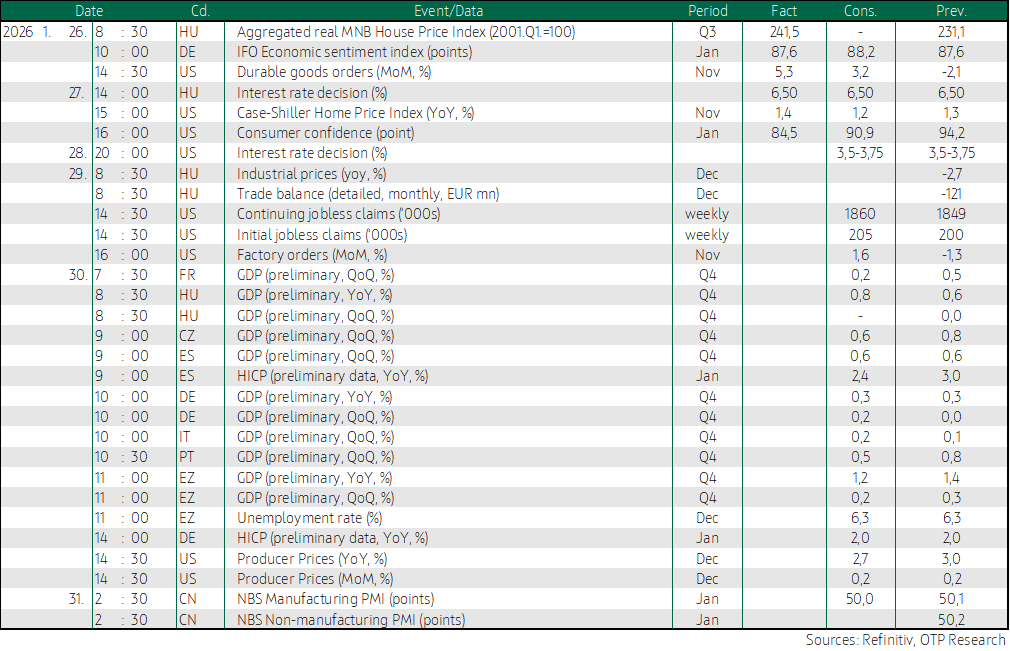
The most eagerly awaited event of the day is the Fed Open Market Committee's interest rate decision meeting. Fed funds rates are unlikely to change, but the big question is how Fed Chairman Jerome Powell will comment on the events since the latest meeting, including attacks on the Fed's independence and better-than-expected inflation figures.
The earnings season continues with reports from real heavyweights, including Microsoft, Meta, Tesla, and IBM.
Get more out of your investments!
Global Markets Services
OTP Global Markets offers a broad range of services in the field of local and international money and capital markets.
Read morePrivate Banking Services
Personal care and expertise with OTP Private Banking, along with the knowledge, security, and innovations of a multinational banking group.
Read more