
OTP Morning Brief: Stock markets fell again amid escalation risks
Related content
OTP Morning Brief: US producer price index came in above expectations, yet the US 10-year Treasury yield still declined
Western European equities continued to advance despite ongoing pressure on the technology sector. Wall Street indices also rebounded, recovering some ground after Wednesday’s sell-off. Healthcare was the standout performer on both sides of the Atlantic. Eurozone industrial production declined by 0.5% month-on-month in August. In the US, the producer price index accelerated to 6.3%, delivering another upside surprise in inflation developments. US retail sales increased by 0.8% compared to August. The US 10-year Treasury yield declined by more than 10 basis points. The long end of the Hungarian government bond yield curve also declined by 7-9 basis points. In Hungary, August wage data will be released today, while in the US, September industrial production figures are due.
OTP Morning Brief: US CPI data came in above expectations
European equity markets advanced, supported by strong results from ASML and the outstanding performance of the healthcare sector. US equity markets came under pressure following higher-than-expected September CPI data. The annual CPI rate accelerated to 3.7%, driven primarily by a surge in gasoline prices, while core CPI rose by 0.3% month-on-month, supported by higher housing costs and rising transportation service prices. Oil prices rose amid escalating tensions in the Middle East and the impact of the IEA's oil market report. US Treasury yields retreated after an initial increase, driven by Fed commentary, while European bond yields generally moved higher. The US macro calendar will be busy today, with investors focusing on September retail sales and producer price index data, as well as the New York Fed Manufacturing Index, weekly jobless claims, and business inventories. August industrial production data from the euro area will be released today.
Western European indices declined once more, as the positive sentiment seen earlier in the week was replaced by fears of escalation. Several key policymakers commented on the possibility of an ECB rate hike. In parallel with Europe, U.S. stocks also posted sharp losses. After the market closed, Trump eased pressure on Iran. It was a difficult day for the communications sector. Concerns about inflation and potential rate hikes pushed developed-market bond yields higher. Asian markets moved in an uncertain direction. Today, domestic labor market data and the balance of payments will be worth watching.
Western European markets closed in the red again
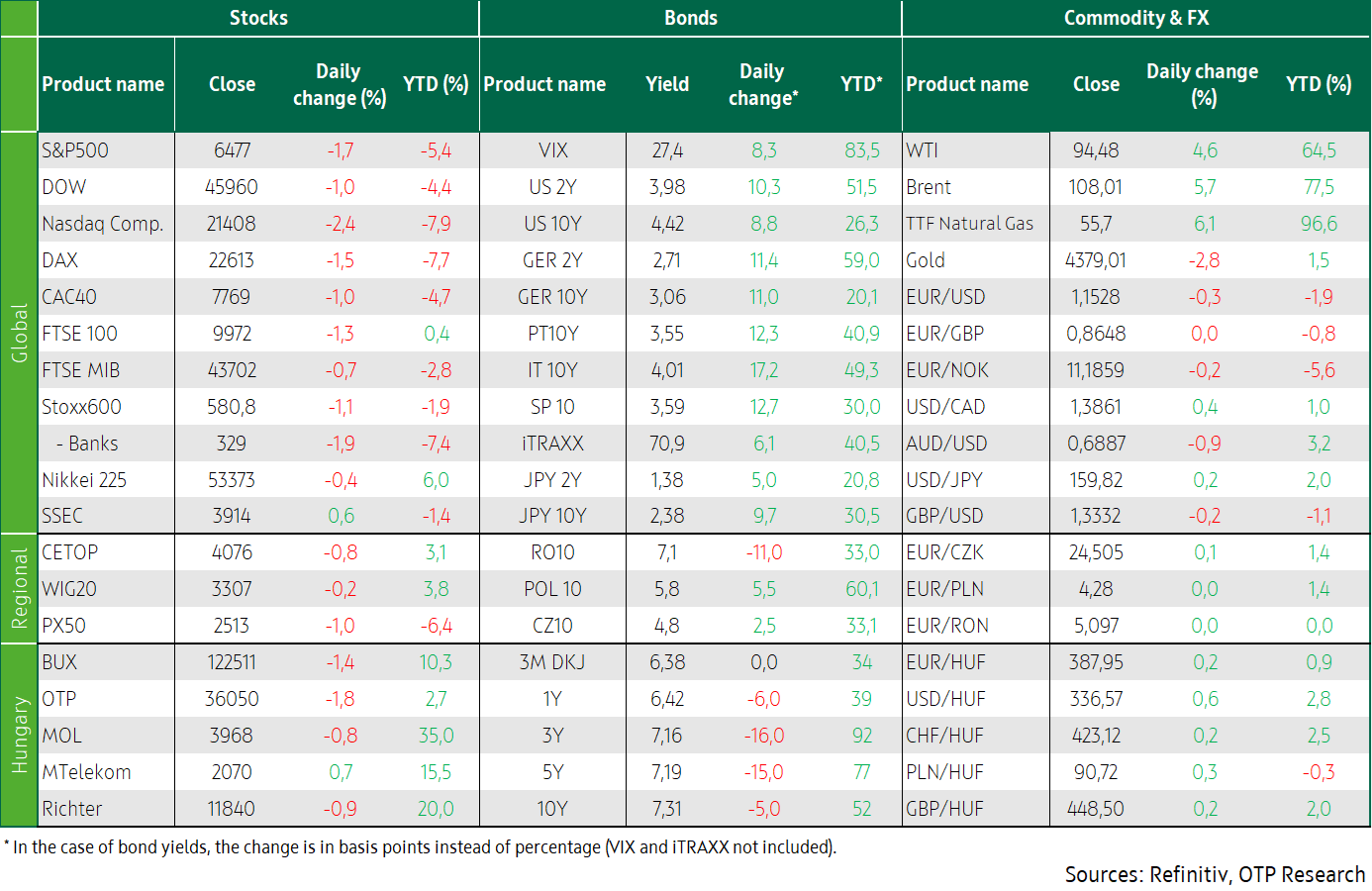
Western European markets fell again on Thursday as investors faced the possibility of an upcoming ECB rate hike and fading hopes for a swift resolution to the Middle Eastern conflict. According to Joachim Nagel, President of the German Bundesbank (and thus an ECB Governing Council member), a rate hike remains an option for the ECB. His remarks came just one day after President Christine Lagarde signaled that the central bank is prepared to act at any meeting to keep inflation close to its 2% target. The pan-European STOXX 600 index dropped 1.1%, breaking a three-day winning streak. Among the major national indices, the DAX saw the steepest decline, falling 1.5%. Industrial companies and banks, two cyclical and recession-sensitive sectors both slipped by nearly 2%, while the technology sector fell by 2.3%. However, the decline was led by mining companies: shares of Boliden plunged 19.9% after the company announced that exceptionally strong seismic activity was expected to hurt its quarterly results, while falling metal prices also weighed on the sector. Another notable mover was Sweden’s H&M, which dropped 3.6% after its quarterly revenue missed expectations.
The downturn also affected Central and Eastern Europe: the Polish index fell 0.2%, the Czech index 1%, and the Hungarian market declined by 1.4%. Most Hungarian blue chips ended in negative territory, with OTP posting the largest loss at 1.8%, while Magyar Telekom rose by 0.8%.
U.S. stocks tumbled on fears of Middle East escalation, though Trump may ultimately postpone the strike on energy infrastructure
The Nasdaq plunged 2.4% on Thursday, extending a downward trend that had briefly paused in recent days, while the S&P 500 fell 1.7% and the Dow declined 1.0%. Investors sought safe-haven assets amid fears that the U.S.-Israeli conflict with Iran could escalate further, driving oil prices higher and intensifying inflation concerns. As a result, equity indices erased Wednesday’s gains, when markets had still been pricing in a potential de-escalation of the conflict. President Donald Trump stated that Iran must reach a deal with the United States or face a continued series of attacks, and also warned that he could take control of Iran’s oil reserves. A senior Iranian official told Reuters that the U.S. proposal—which aims to end nearly four weeks of fighting—is “one-sided and unfair,”though he did not rule out the use of diplomacy. After the market closed, however, Trump announced that, at the request of the Iranian government, he would postpone strikes on Iran’s energy infrastructure by ten days, until April 6. He also said that negotiations with Tehran were “going very well.”
Among the S&P 500’s eleven major sectors, most ended the day lower. The energy sector was the biggest gainer, rising 1.6%, while the only other sector posting a percentage increase was the defensive utilities sector, which edged up 0.2%. The worst performers were communication services, which fell 3.5%, and technology, down 2.7%. The sharp decline in communication services was partly driven by a court ruling that found Meta and Alphabet liable for harms done to children by social media platforms, adding to a growing wave of lawsuits. Meta shares sank nearly 8%, while Alphabet dropped more than 3%. Brent and WTI crude prices surged by almost five percent on Thursday amid rising tensions in the Middle East.
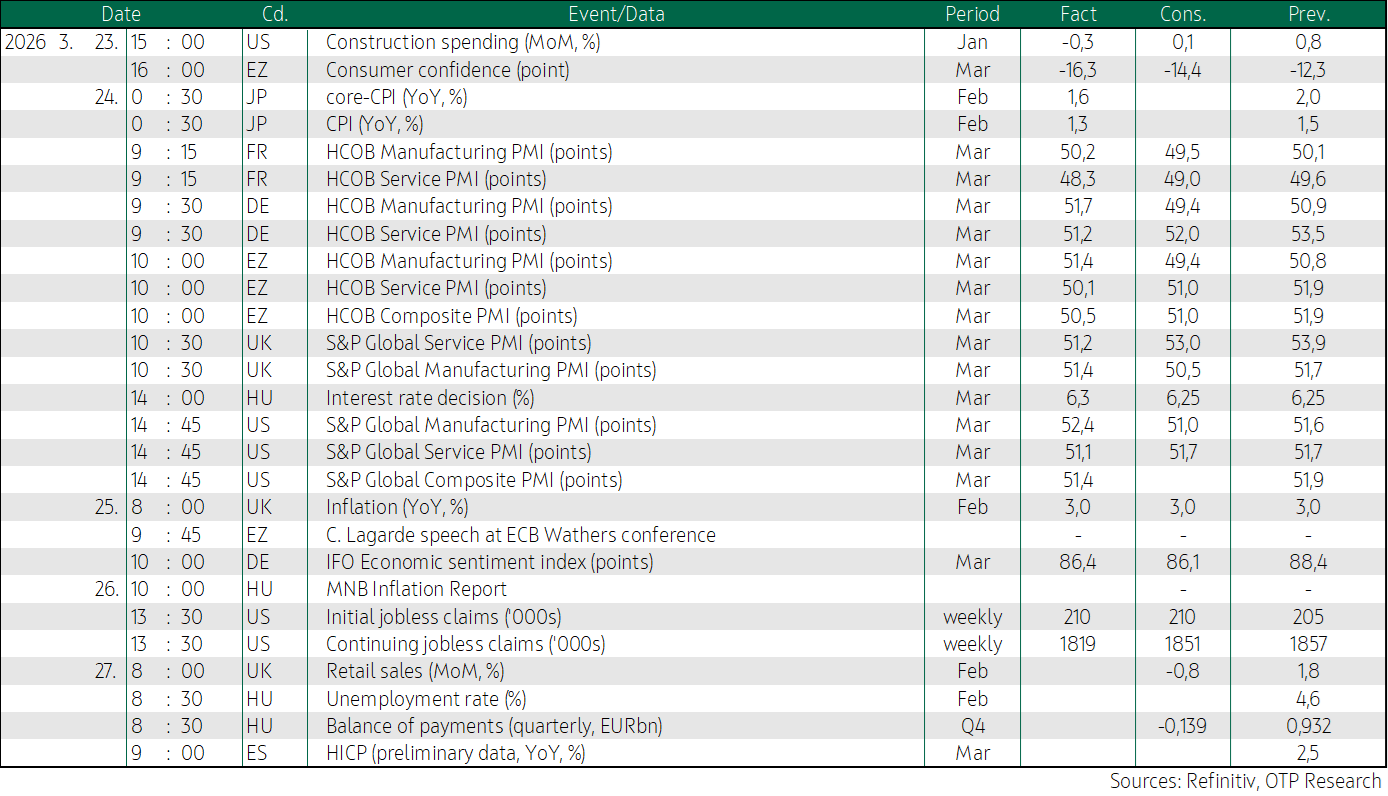
On the data front, initial jobless claims increased by 5,000 to 210,000, in line with expectations, while continuing claims dropped to their lowest level in nearly two years. This points to a still-resilient labor market despite the inflationary risks posed by the Middle Eastern conflict, potentially giving the Federal Reserve room to maintain current interest rate levels.
Developed-market bond yields rose on inflation and rate-hike fears
Surging oil prices on Thursday significantly heightened inflation concerns and expectations of further rate hikes. In the United States, market pricing began to shift toward the possibility that the Federal Reserve may even be forced to raise rates later this year. The U.S. 10-year Treasury yield climbed by nearly 10 basis points, surpassing 4.4%. Yields rose sharply in Europe as well: the German 10-year increased by 13 basis points, the French by 15, and the Italian by 19. The German 10-year yield is approaching 3.1%, reinforcing fears that it may break out of its previous trading range to the upside and remain above 3% on a more sustained basis. The U.S. dollar strengthened further, with the euro weakening 0.2% to around 1.154 in EUR/USD trading.
In regional FX markets, there were no major moves; Central and Eastern European currencies weakened by about 0.1–0.2%, while the forint remained below 388. On the domestic bond market, demand was strong for the 15-year fixed-rate bond, with HUF 50 billion sold at an average yield of 7.31%. By contrast, neither the discount treasury bill nor the floating-rate bond attracted investor interest: the debt agency managed to sell only HUF 8 billion of bills and a mere HUF 2.5 billion of the floating-rate bond. Reference yields recorded early in the afternoon declined compared with the previous day: the 3–5-year segment fell by 10–15 basis points, while the 10-year benchmark yield stood at 7.3%.
Today’s highlights
Geopolitical uncertainty led to mixed movements in Asian markets: the Nikkei and the Kospi both fell by 0.4%, while the SSEC rose by 0.5% and the Hang Seng gained 0.6%.
Today, attention will turn to the United Kingdom’s February retail sales data, while in Hungary the February labor market statistics and the balance of payments data for the fourth quarter of last year will be released.
Get more out of your investments!
Global Markets Services
OTP Global Markets offers a broad range of services in the field of local and international money and capital markets.
Read morePrivate Banking Services
Personal care and expertise with OTP Private Banking, along with the knowledge, security, and innovations of a multinational banking group.
Read more