
OTP Morning Brief: Stock markets rose on signs of easing tensions with Iran
Related content
OTP Morning Brief: US producer price index came in above expectations, yet the US 10-year Treasury yield still declined
Western European equities continued to advance despite ongoing pressure on the technology sector. Wall Street indices also rebounded, recovering some ground after Wednesday’s sell-off. Healthcare was the standout performer on both sides of the Atlantic. Eurozone industrial production declined by 0.5% month-on-month in August. In the US, the producer price index accelerated to 6.3%, delivering another upside surprise in inflation developments. US retail sales increased by 0.8% compared to August. The US 10-year Treasury yield declined by more than 10 basis points. The long end of the Hungarian government bond yield curve also declined by 7-9 basis points. In Hungary, August wage data will be released today, while in the US, September industrial production figures are due.
OTP Morning Brief: US CPI data came in above expectations
European equity markets advanced, supported by strong results from ASML and the outstanding performance of the healthcare sector. US equity markets came under pressure following higher-than-expected September CPI data. The annual CPI rate accelerated to 3.7%, driven primarily by a surge in gasoline prices, while core CPI rose by 0.3% month-on-month, supported by higher housing costs and rising transportation service prices. Oil prices rose amid escalating tensions in the Middle East and the impact of the IEA's oil market report. US Treasury yields retreated after an initial increase, driven by Fed commentary, while European bond yields generally moved higher. The US macro calendar will be busy today, with investors focusing on September retail sales and producer price index data, as well as the New York Fed Manufacturing Index, weekly jobless claims, and business inventories. August industrial production data from the euro area will be released today.
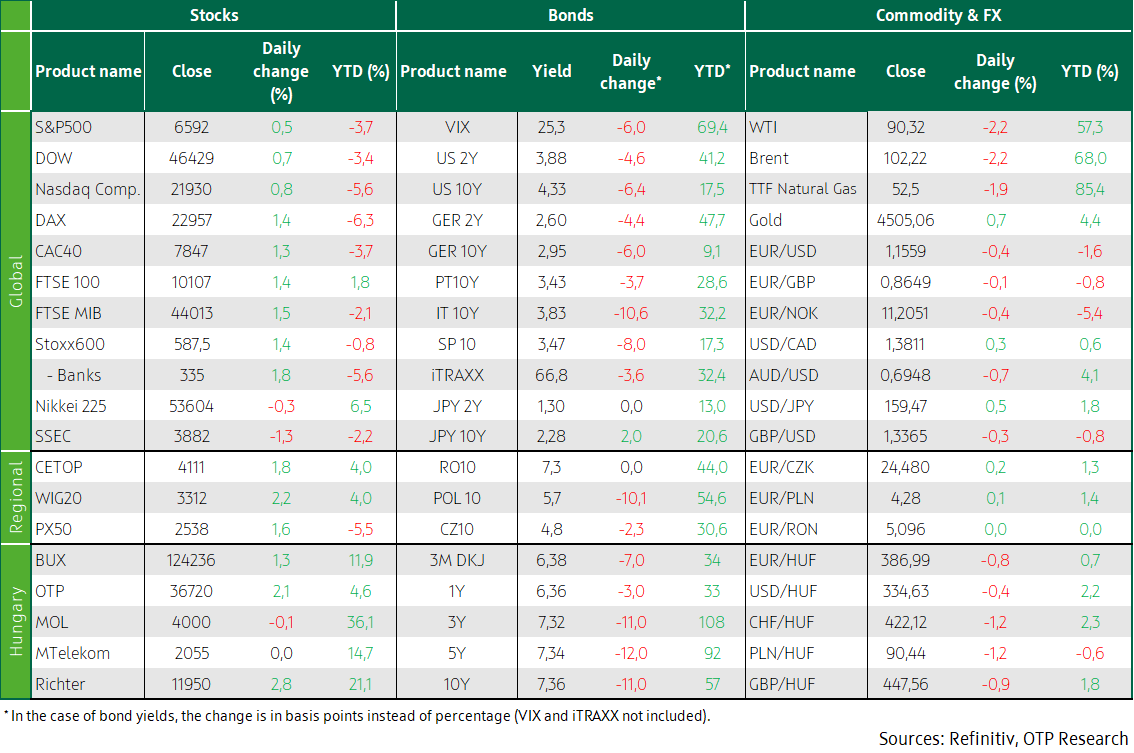
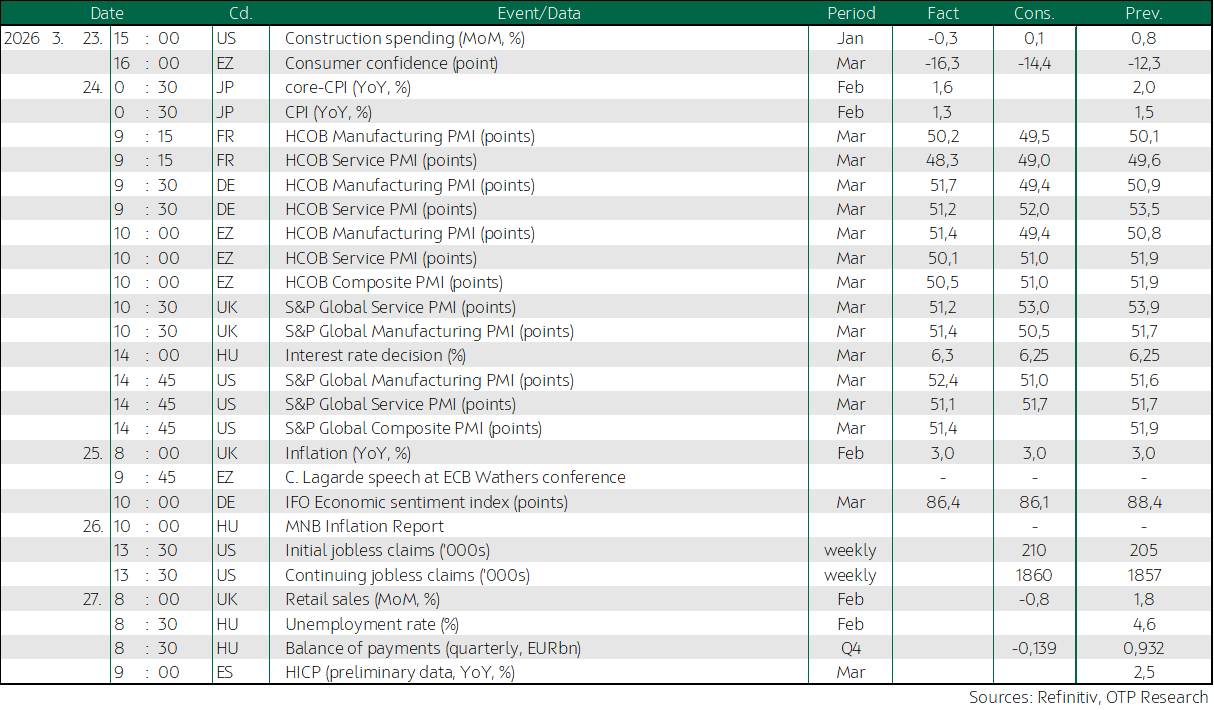
Europe’s stock indices rose yesterday. The UK's Februaryinflation matched expectations. The Ifo sentiment index fell in March as expectations worsened. US indices rose as chances of a negotiated settlement with Iran seem to increase. Developed markets’ bond yields fell; the USD and the HUF appreciated. Today the US releases weekly jobless claims figures, and Hungary’s MNB publishes its latest Inflation Report.
Europe’s stocks rose on Wednesday; UK February inflation matched expectations; Ifo sentiment index fell in March as expectations worsen
The stock markets in Europe climbed higher on Wednesday as investors priced in the possibility of an imminent de-escalation in the Middle East, although concerns about the economic impact of the war continued to dampen risk-taking. The STOXX 600 increased by 1.4%, in its third straight day of gains. Brent crude dropped after US President Donald Trump said there was progress in talks with Iran, even though Tehran denied direct negotiations and left closed the Strait of Hormuz, through which a fifth of the world's oil and gas passes. Macroeconomic uncertainty and Europe's dependence on oil imports continue to weigh on European stocks.
In the United Kingdom, annual inflation was 3% in February, matching the January figure and market expectations. The biggest upward impact came from a 0.9% month/month increase in clothing prices, while inflation slowed in several sectors, including transport (2.4% vs. 2.7% in January), food (3.3% vs. 3.6%) and services (4.3% vs. 4.4%). CPI rose by 0.4% month/month, in line with market expectations, while annual core inflation accelerated to 3.2% vs. 3.1%. However, the February data may be less market-moving this time, as it does not yet include the impact of the March oil price shock. In Germany, the Ifo business sentiment index dropped to 86.4 points in March, weaker than the previous month’s 88.4, but slightly above the expected 86.1 points. The decline was driven by a sharp deterioration in expectations, exacerbated by uncertainty over the Iran war, while the current situation component remained at 86.7. The decline was also broad-based across sectors, but the sentiment particularly weak in manufacturing, services, trade, and construction.
The CEE region’s stock indices rose yesterday. The picture was mixed for Hungary’s blue chips: OTP and Richter closed higher, while MTelekom ended flat, and MOL's share price slipped.
US indices rose as prospects for a negotiated settlement to the Iran conflict appear to be improving
America’s stock indices closed higher yesterday as investors continued to watch developments in the Middle East. Adding to the gloom was Iran’s foreign minister’s statement that Tehran was unwilling to negotiate with Washington, even though the leadership was considering a US plan to end the war. Iran’s state media reported that the country would reject the US ceasefire offer and propose its own five-point counter-proposal, including control over the Strait of Hormuz. Meanwhile, oil prices eased (WTI: -2.2% and Brent -2.17%), as the market began to price in the possibility of a near-term easing of the conflict. The key indices returned to positive territory after last week’s sharp decline, but analysts warned that the market may be overly optimistic about a quick resolution, while inflationary risks from an energy price shock and the possibility of a prolonged conflict persist.
Developed markets’ bond yields fell; the USD and the HUF strengthened
As confidence in a peace deal in Iran deal grew, fears surrounding energy prices, inflation, and interest rate hikes, as well as risk aversion all abated, helping developed economies’ bond yields retreat from previous peaks. The 10Y US bond yield sank by three basis points, to 4.35%, the German one declined comparably, to less than 3%, and the riskier French and Italian ones slipped by almost 10 basis points. At the same time, the dollar strengthened by almost 0.5% against the euro, pushing the EUR/USD to 1.155, after Germany’s IFO index fell sharply, while US export and import prices unexpectedly jumped markedly.
The sentiment was also benign in Hungary. The forint’s 0.7% appreciation drove the EUR/HUF to 387, and Hungary’s benchmark government bond yields eased by roughly ten basis points; the 10Y one dropped below 7.4%. At the auction of 6M discount T-Bills, barely HUF 5 billion worth of Treasury bills – a quarter of the announced amount – were allotted due to anaemic demand; the average yield was set at 6.38%. But there was strong interest at the switch auction of 2037/A and 2038/A bonds, where the amounts on offer (HUF 42 billion and HUF 22 billion respectively) were allotted, with the average yield slightly above 7.4%.
Today’s highlights
Asia’s indices moved mixed today, as it seemed that the end of the Iranian conflict might be even further away than had been hoped, as the leaders of the attacked country initially rejected America’s demands and the USA continued bombing Iran.
The USA releases the weekly jobless claims data, and Hungary’s MNB publishes its latest Inflation Report today.
Get more out of your investments!
Global Markets Services
OTP Global Markets offers a broad range of services in the field of local and international money and capital markets.
Read morePrivate Banking Services
Personal care and expertise with OTP Private Banking, along with the knowledge, security, and innovations of a multinational banking group.
Read more