
OTP Morning Brief: Europe’s stock markets closed at record highs
Related content
OTP Morning Brief: US producer price index came in above expectations, yet the US 10-year Treasury yield still declined
Western European equities continued to advance despite ongoing pressure on the technology sector. Wall Street indices also rebounded, recovering some ground after Wednesday’s sell-off. Healthcare was the standout performer on both sides of the Atlantic. Eurozone industrial production declined by 0.5% month-on-month in August. In the US, the producer price index accelerated to 6.3%, delivering another upside surprise in inflation developments. US retail sales increased by 0.8% compared to August. The US 10-year Treasury yield declined by more than 10 basis points. The long end of the Hungarian government bond yield curve also declined by 7-9 basis points. In Hungary, August wage data will be released today, while in the US, September industrial production figures are due.
OTP Morning Brief: US CPI data came in above expectations
European equity markets advanced, supported by strong results from ASML and the outstanding performance of the healthcare sector. US equity markets came under pressure following higher-than-expected September CPI data. The annual CPI rate accelerated to 3.7%, driven primarily by a surge in gasoline prices, while core CPI rose by 0.3% month-on-month, supported by higher housing costs and rising transportation service prices. Oil prices rose amid escalating tensions in the Middle East and the impact of the IEA's oil market report. US Treasury yields retreated after an initial increase, driven by Fed commentary, while European bond yields generally moved higher. The US macro calendar will be busy today, with investors focusing on September retail sales and producer price index data, as well as the New York Fed Manufacturing Index, weekly jobless claims, and business inventories. August industrial production data from the euro area will be released today.
Europe’s main stock indices rose to new highs on Wednesday. The sentiment was also buoyant in the CEE region, where the BUX was top gainer. On Wall Street, the AI sector helped the Nasdaq rise the most. Nvidia's earnings report reinforced optimism for the technology sector. A naval incident in Cuba added to geopolitical tensions. OPEC+ considers boosting production ahead of summer demand. The HUF has appreciated, and Hungarian bond yields fell notably. Hungary’s ÁKK raised additional USD 1.2 billion worth of financing in a private placement. Today, markets await the eurozone’s economic sentiment indicator and US jobless claims data.
Europe’s major indices closed at record highs
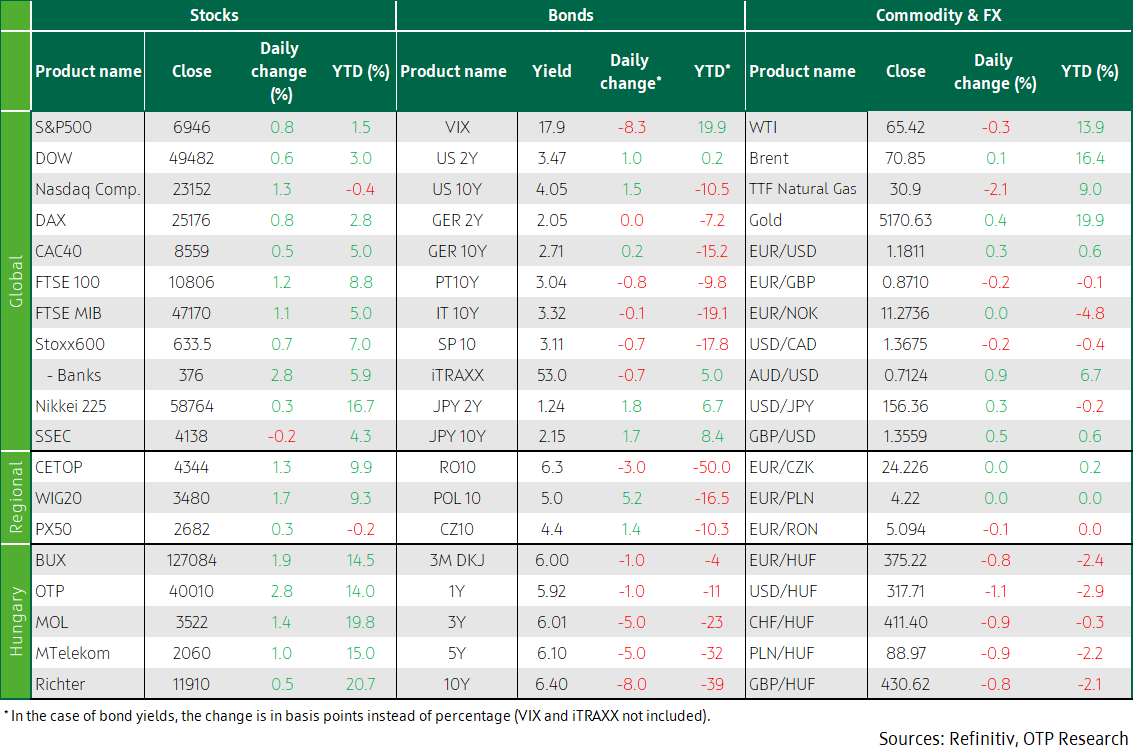
On Wednesday, most of the leading European indices went to record highs, including the DAX (+0.8%), the CAC 40 (+0.5%), the FTSE 100 (+1.2%) and the Stoxx 600 (+0.7%). The materials (+2.8%) sector posted the biggest gain. Banking shares surged by 2.6%, as global market sentiment improved after the US-based AI startup Anthropic entered into partnerships with several companies and launched new AI plug-ins. Some analysts opine that banks are exposed to the disruptive effects of AI innovations, so signs of successful integration alleviate concerns about margin squeeze. The performance of the financial sector also benefited from the jump in the share prices of HSBC (+8.0%) and Santander (+4.8%). The former's outstanding performance stemmed from raising its profit target after its annual profit exceeded expectations, despite recording a one-off USD 4.9 billion write-off. The worst-performing sector on Wednesday was the food sector (-1.9%), owing to Diageo's 12.7% dive after the drinks manufacturer had lowered its profit expectations for the second time in four months and also reduced its dividend.
The positive sentiment was also felt in the CEE region, where Czechia’s PX 50 (+0.3%), Poland’s WIG 20 (+1.7%), and Hungary’s BUX (+1.9%) all advanced on Wednesday. In Budapest, Mol (+1.4%) and OTP (+2.8%) bounced back from Tuesday’s weak performance.
The return of AI optimism helped the NASDAQ rise notably
Wall Street’s indices closed higher on Wednesday, continuing a rally led by technology stocks, and hitting two-week highs as concerns about AI faded in the face of renewed optimism about the potential benefits of the new technology. Nvidia, the engine of the rally, reported fourth-quarter revenue of USD 68.13 billion, beating analysts’ expectations. Its shares grew about 3% in after-hours trading, after rising 1.6% in premarket trading. The positive news about artificial intelligence helped the NASDAQ lead the pack with a 1.3% gain, followed by the S&P500 (+0.8%) and the Dow Jones (+0.6%). Within the S&P, the technology sector (+1.9%) was the best performer, second to it was financials (+1.7%). Companies such as SMC (+7.9%) and Intel (+1.7%) contributed to the former. Axon Enterprise shot up 17.6% after the manufacturer of stun guns and other law enforcement equipment reported better-than-expected fourth-quarter earnings. The bidding war between Netflix and Warner continued as the latter made a new bid to acquire Paramount, which caused Netflix shares to soar 6.0%.
Adding to geopolitical tensions, Cuban armed forces killed four people and wounded six on board a ship sailing from Florida, which had entered Cuban territorial waters on Wednesday and opened fire on a Cuban patrol boat. Prior to the unusual incident, the USA had blocked virtually all oil shipments to the island, increasing pressure on the Cuban government. Wednesday's incident could add fuel to the fire in the conflict between the two countries.
According to Reuters, OPEC+ may consider boosting its oil production by 137,000 barrels per day from April as peak summer consumption approaches, and higher oil prices due to tensions between the USA and Iran may make the move favourable. Brent rose by 0.3%.
The forint strengthened markedly, Hungary’s yields fell sharply; Hungary’s ÁKK raised additional USD 1.2 billion worth of FX financing in a private placement
Developed economies’ bond markets continued a directionless trading yesterday. The US 10Y yield remained at 4.05% and the German one near 2.7%. A slight dollar weakening drove the EUR/USD higher, to 1.18.
Although there was no significant movement in the other currency markets of the CEE region, the forint strengthened by almost 1% against the euro, thus the EUR/HUF sank to 375. The situation was similar in the bond market, even though developed markets’ yields stagnated and the direction was not clear in other CEE countries either – Czechia’s yields edged lower, Polish ones rose –, Hungary’s yields fell by 5-7 basis points at the belly of the curve, and by 10 basis points in the 10Y-20Y segment. The ten-year yield slid to a one-year low of 6.4%. Citing Bloomberg, the Portfolio.hu portal reported that Hungary’s ÁKK had raised USD 1.2 billion in foreign currency financing, in a private placement, following the 2035 bond issuance in mid-2025. The ÁKK has not announced the transaction so far, presumably because US regulations prohibit the publication of details until financial settlement has been completed. There was subdued demand at the ÁKK's auction of three-month discount Treasury Bills, where the planned amount, HUF 30 billion, was sold at an average yield of 6.03%.
Today’s highlights
Asia’s markets also fared well, thanks to the supportive international sentiment; Japan’s Nikkei upped 0.3%, and Korea’s Kospi surged 3.7%, to a new high. In China, however, the SSEC (-0.2%) and the Hang Seng (-1%) both sank.
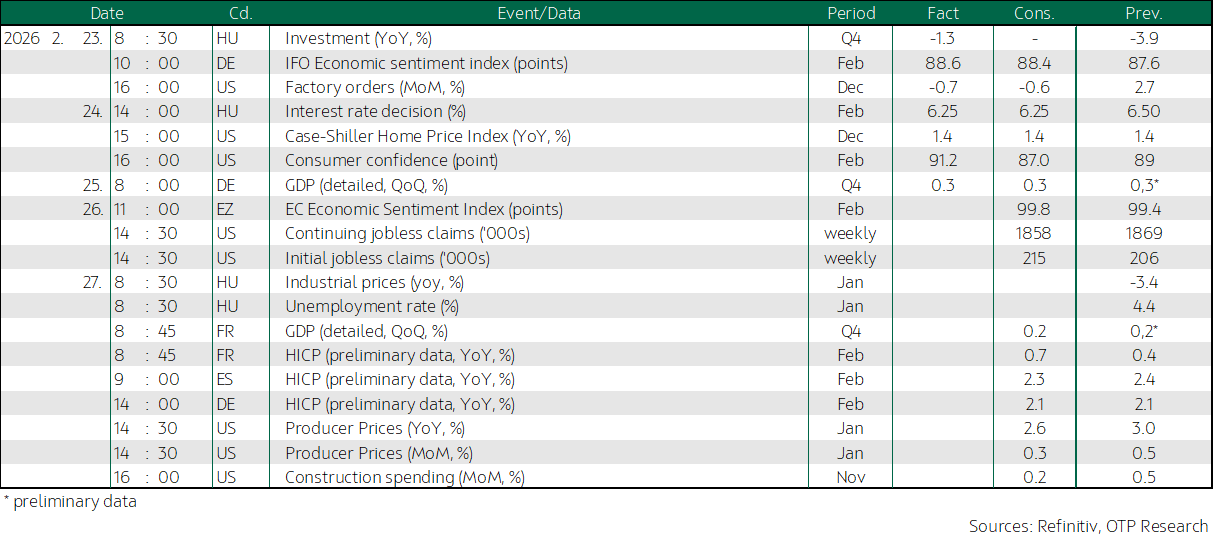
Today, the Eurozone Economic Sentiment Indicator (ESI) is worth checking, as is the weekly jobless claims statistics from the USA.
Get more out of your investments!
Global Markets Services
OTP Global Markets offers a broad range of services in the field of local and international money and capital markets.
Read morePrivate Banking Services
Personal care and expertise with OTP Private Banking, along with the knowledge, security, and innovations of a multinational banking group.
Read more