
OTP Morning Brief: March PMIs reflect the impact of the Iran conflict
Related content
OTP Morning Brief: US producer price index came in above expectations, yet the US 10-year Treasury yield still declined
Western European equities continued to advance despite ongoing pressure on the technology sector. Wall Street indices also rebounded, recovering some ground after Wednesday’s sell-off. Healthcare was the standout performer on both sides of the Atlantic. Eurozone industrial production declined by 0.5% month-on-month in August. In the US, the producer price index accelerated to 6.3%, delivering another upside surprise in inflation developments. US retail sales increased by 0.8% compared to August. The US 10-year Treasury yield declined by more than 10 basis points. The long end of the Hungarian government bond yield curve also declined by 7-9 basis points. In Hungary, August wage data will be released today, while in the US, September industrial production figures are due.
OTP Morning Brief: US CPI data came in above expectations
European equity markets advanced, supported by strong results from ASML and the outstanding performance of the healthcare sector. US equity markets came under pressure following higher-than-expected September CPI data. The annual CPI rate accelerated to 3.7%, driven primarily by a surge in gasoline prices, while core CPI rose by 0.3% month-on-month, supported by higher housing costs and rising transportation service prices. Oil prices rose amid escalating tensions in the Middle East and the impact of the IEA's oil market report. US Treasury yields retreated after an initial increase, driven by Fed commentary, while European bond yields generally moved higher. The US macro calendar will be busy today, with investors focusing on September retail sales and producer price index data, as well as the New York Fed Manufacturing Index, weekly jobless claims, and business inventories. August industrial production data from the euro area will be released today.
Western Europe’s leading stock indices rose yesterday, except the DAX. Brent rebounded by 4.6% on Tuesday, ending Monday’s slip. TTF natural gas prices eased again, by 5.6% on Tuesday. The Iran conflict is already reflected in March PMIs. Hungary’s MNB has left its base rate at 6.25%. Wall Street failed to sustain Monday’s impetus yesterday. Doubts about the resolution of the Iran conflict resurfaced on Tuesday. US and German yields barely changed on Tuesday. The UK’s inflation data and Germany IFO economic sentiment index are figures to watch today.
Western Europe’s major stock indices rose, except for the DAX
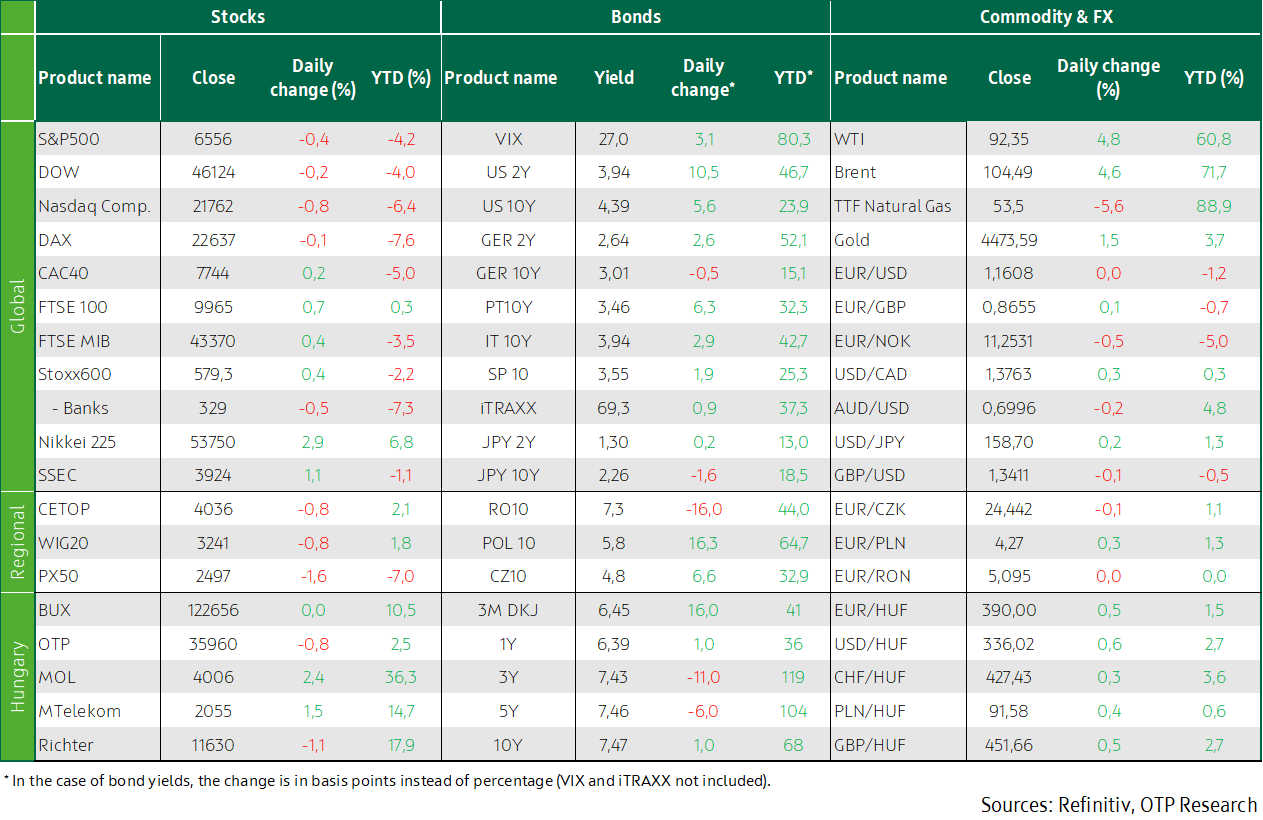
The key stock indices in Western European rose, with the exception of the trivially declining DAX. The STOXX600 (+0.4%), France’s CAC40 (+0.2%), and the FTSE100 (+0.7%) all closed higher yesterday; the latter picked up from Monday’s ailing. Telecommunications (+2.4%) and energy (+2.5%) stocks were top gainers. An important driver for the latter may have been that oil prices bounced back 4.6% on Tuesday, after Monday's easing when Brent closed slightly below USD 100. Defence stocks slid 1.1%, and the financial sector slipped 0.7%. In individual stocks, Italy’s largest mobile tower operator INWIT skyrocketed 9.9% on news of a takeover bid. Britain’s Bellway tumbled 17.5% after the homebuilder cut its forecast for the 2026 financial year. SAP lost 4% after J.P. Morgan downgraded the stock to Neutral from Overweight. Given the software maker’s weight of around 15%, this was also reflected in the weaker performance of Germany’s DAX index.
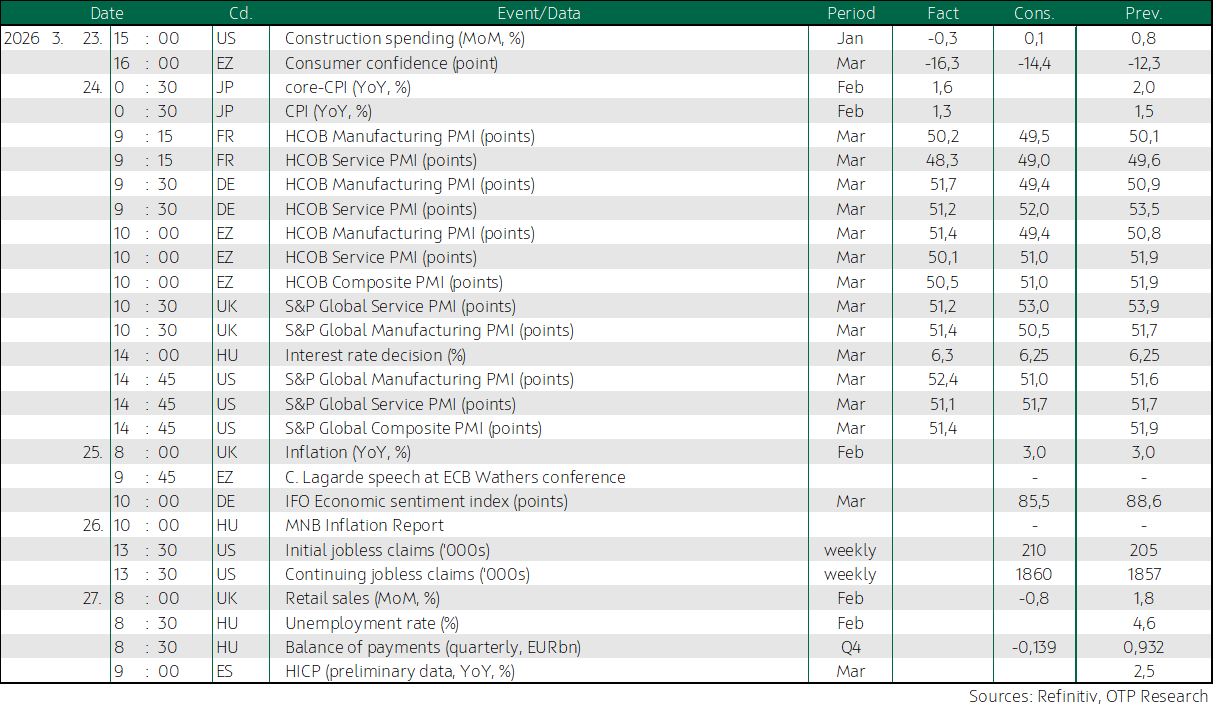
Preliminary purchasing managers’ indices for March were released for the eurozone and its major economies. Composite indicators in Germany, France, and the euro area all fell short of February’s figures as well as of analysts’ consensus. Manufacturing surprised on the upside in all three regions, but the services sector PMIs dragged down the composite indicators. The manufacturing boost is likely to be a temporary effect, driven by concerns about supply disruptions and brought forward purchases. In the eurozone, the composite PMI at 50.5 and the services sector at 50.1 were the lowest readings since May. The data is in line with the consumer confidence index released on Monday, which, at -16.3, was also worse than expected.
On Tuesday, Australia and the European Union signed a free trade agreement that will eliminate tariffs on almost all products and potentially ease the EU’s access to critical minerals from Australia. This is a response to both US tariffs and the reliance on critical minerals from China.
Hungary’s MNB left its base rate at 6.25% yesterday. Given the geopolitical tensions, Hungary’s central bank lowered its growth forecast for 2026 to 1.7%, from 2.4% in December’s Inflation Report. The MNB raised its inflation forecast for 2026 to 3.8%, from 3.2%. At the subsequent press conference, Governor Mihály Varga repeatedly pointed out that the MNB was operating in data-driven mode and that all options were on the table. He also emphasized that the situation is much better than during the energy crisis in 2022.
The price of TTF natural gas declined further, slipping 5.6% on Tuesday..
Wall Street ran out of momentum on Tuesday
US stock markets could not keep up Monday’s momentum: the S&P500 (-0.4%), the Dow Jones (-0.2%), and the Nasdaq Composite (-0.8%) all closed in the red on Tuesday. On Monday, Donald Trump's words (on ‘productive’ talks with Iran) brought some relief to the markets but doubts about the resolution of the conflict resurfaced on Tuesday. Iran vehemently denied that it had talks with the USA. Reportedly, the USA is to send elite airborne soldiers to the Middle East. But other reports said that there was contact between the two countries and that the US has proposed a 15-point peace plan to the Persian state.
Within the S&P 500, the communications services (-2.5%) and the technology (-0.7%) sectors were among the worst performers. The energy sector (+2.05%) was the strongest one. In individual names, Jefferies shares surged 2.5% after the Financial Times had reported that Japan’s Sumitomo Mitsui Financial Group is preparing a potential takeover bid for the US investment bank. Estée Lauder’s stocks nose-dived 9.8% when the cosmetics giant announced talks about a potential merger with Spain’s Puig; the latter’s share price shot up 13%.
In the USA, the preliminary readings of the S&P Global Services and Composite Purchasing Managers’ Indexes were disappointing, similarly to the ones in Europe. The latest survey showed the worst performance since May 2025.
US and German bond yields barely changed
Despite the lack of reassuring news from the Middle East, and although Iran denied the news of the negotiations, oil prices picked up only slightly by Tuesday’s close, while European gas prices fell by 6%, to EUR 53. American and German yields were little changed: the 10Y dollar yield remained below 4.4%, and the German ten-year one was above the 3% breakout level. Japan’s 10Y yield dropped by 5 basis points from its multi-decade peak of more than 2.3%, while Italy’s and France’s 10Y yields rose. The EUR/USD closed at 1.16.
In Hungary, investors kept an eye on the MNB. As expected, the Monetary Council left its base rate at 6.25% but raised its average inflation forecasts for this year and next from around 3% to 3.8% and 3.7%, respectively, and lowered this year's GDP forecast to 1.7%. The decision left currency and bond unaffected. The forint weakened by 0.75% against the euro: the EUR/HUF drew near 391. Government bond yields rose: in line with the growing expectations of interest rate hikes, 3Y–5Y bond yields eased by 6-10 basis points, while longer maturities were idle: these yields remained near 7.45%. At the ÁKK’s auction, HUF 20 billion worth of 3M discount T-Bills were sold, with the bid/cover ratio at 2, and an average yield of 6.35%.
Today, the ÁKK auctions 6M discount T-Bills, offering HUF 20 billion debt. In addition, investors can obtain 2037/A and 2038/A bonds worth HUF 10 billion each at the switch auction, in exchange for securities maturing this year.
Today’s highlights
Heading into the close, Asia’s markets were seen dynamically increasing. Japan’s Nikkei (+2.9), Korea’s KOSPI (+1.6%) China’s SSEC (+1.1%), and Hong Kong’s Hang Seng (+0.5%) all grew, mostly driven by cautious optimism regarding the resolution of the Iran conflict and by the related drop in oil prices today.
The United Kingdom’s February inflation data and the March reading of Germany’s IFO economic sentiment index will be released today. Christine Lagarde will give a speech at the “The ECB and Its Watchers” conference at 9:45 (CET).
Get more out of your investments!
Global Markets Services
OTP Global Markets offers a broad range of services in the field of local and international money and capital markets.
Read morePrivate Banking Services
Personal care and expertise with OTP Private Banking, along with the knowledge, security, and innovations of a multinational banking group.
Read more