
OTP Morning Brief: Trading sentiment brightened on Tuesday after Monday's losses
Related content
OTP Morning Brief: US producer price index came in above expectations, yet the US 10-year Treasury yield still declined
Western European equities continued to advance despite ongoing pressure on the technology sector. Wall Street indices also rebounded, recovering some ground after Wednesday’s sell-off. Healthcare was the standout performer on both sides of the Atlantic. Eurozone industrial production declined by 0.5% month-on-month in August. In the US, the producer price index accelerated to 6.3%, delivering another upside surprise in inflation developments. US retail sales increased by 0.8% compared to August. The US 10-year Treasury yield declined by more than 10 basis points. The long end of the Hungarian government bond yield curve also declined by 7-9 basis points. In Hungary, August wage data will be released today, while in the US, September industrial production figures are due.
OTP Morning Brief: US CPI data came in above expectations
European equity markets advanced, supported by strong results from ASML and the outstanding performance of the healthcare sector. US equity markets came under pressure following higher-than-expected September CPI data. The annual CPI rate accelerated to 3.7%, driven primarily by a surge in gasoline prices, while core CPI rose by 0.3% month-on-month, supported by higher housing costs and rising transportation service prices. Oil prices rose amid escalating tensions in the Middle East and the impact of the IEA's oil market report. US Treasury yields retreated after an initial increase, driven by Fed commentary, while European bond yields generally moved higher. The US macro calendar will be busy today, with investors focusing on September retail sales and producer price index data, as well as the New York Fed Manufacturing Index, weekly jobless claims, and business inventories. August industrial production data from the euro area will be released today.
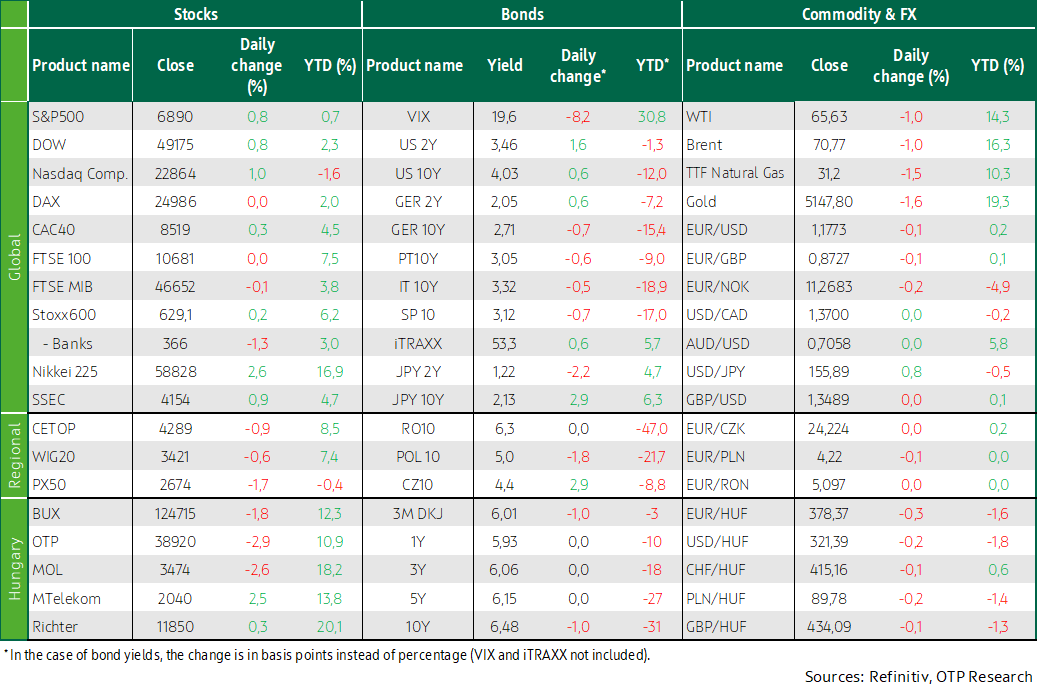
Europe’s key indices inched up and down on Tuesday, amid the twists and turns of the tariff war. The Trump administration announced a 10% global tariff instead of the country-specific ones that the Supreme Court found unconstitutional. The CEE region’s stock markets lagged behind their Western European peers. Wall Street’s indices climbed yesterday, primarily driven by the tech sector. Negotiations between Iran and the USA to avoid armed conflict will continue on Thursday. Advanced economies’ bond and currency markets barely changed. In Hungary, the MNB’s Monetary Council cut its base rate by 25 basis points, as expected. Donald Trump delivered the first State of the Nation speech of his second presidential term yesterday. Nvidia releases its earnings report today.
Europe’s key indices closed with tiny changes, amid the twists and turns of the tariff war
The benchmark stock exchanges of Europe closed Tuesday's trading with small movements, as the twists and turns of the tariff war still caused big waves yesterday. Last Friday, the US Supreme Court ruled that Donald Trump's country-specific tariffs were unconstitutional, whereupon the president spoke of introducing a general tariff of 10% and then 15%. On Tuesday, however, the Trump administration announced new 10% global tariffs; based on the legislation cited this time, they can be in effect for 150 days without being extended by the US legislature. However, this has called into the question the trade agreements concluded so far, thus the European Union suspended the ratification of the EU-US agreement.
The Stoxx Europe 600 inched up 0.2%, as carmakers and mining companies stood out from the sector indices, most of which closed in the red. The former sector fell sharply on Monday in response to news about tariffs, but rebounded yesterday, while the latter was fuelled by higher copper prices. At sector level, only banks, financial services, and media closed in the red.
In individual stocks, Unite Group (-14.3%) was the absolute loser of the day, as Britain's largest student accommodation provider announced that its annual revenue may fall by up to 13% in 2026. Forvia surged 3.8% as the car parts supplier forecast 6%-6.5% operating margin for 2026. Standard Chartered (-1.5%) saw its annual pre-tax profit grow by 16% year-on-year, missing expectations; the UK-based bank said it expected operating profit in 2026 to be at the lower edge of its 5%-7% growth forecast. France’s Edenred soared 4.0% as its 2025 core earnings beat market expectations.
Following Monday’s gains, CEE markets closed Tuesday’s trading with bigger losses than their Western European peers. Hungary’s BUX slipped 1.8%; its blue chips closed mixed, only Richter and MTelekom achieved gains.
Wall Street’s major indices picked up yesterday
On Tuesday, Wall Street’s indices rebounded from Monday's losses, largely powered by technology stocks, as concerns about the potential disruption of artificial intelligence in certain industries had subsided. Shares of semiconductor manufacturers and previously hit software companies fared particularly well. Following Monday's decline owing to blizzards, airlines and the travel sector rebounded. Market sentiment was shaped by news from the tech sector, tariff war developments, and Fed policymakers’ comments on the labour market. Lisa Cook said that artificial intelligence could lead to a possible increase in the unemployment rate, while Christopher Waller said that he does not expect AI to blow up the labour market.
Important announcements came from the technology sector yesterday. An important factor of Tuesday’s growth was news on Anthropic’s new AI plugins, developed in collaboration with several major partners, including Thomson Reuters, Salesforce and FactSet, and target areas such as investment banking and human resources. Meanwhile, Defence Secretary Pete Hegseth gave Dario Amodei, Anthropic’s CEO, until Friday to comply with demands to remove security measures from the manufacturer’s AI model, or else the Pentagon may terminate their contract. Pete Hegseth also threatened to put the company on a government blacklist. Docusign grew by 2.6% after Anthropic announced that Claude Cowork can now be integrated with Docusign as well as with other existing tools for organizations, such as Google Drive and Gmail. Shares in AMD jumped by 8.8% after Meta announced a multi-year deal with the semiconductor company, and Meta is also investing in AMD. Keysight Technologies skyrocketed 23.1% after the electronics equipment maker reported better-than-expected second-quarter earnings. Home Depot's stock advanced 2% as the home improvement retailer reported better-than-expected Q4 earnings and maintained its annual guidance.
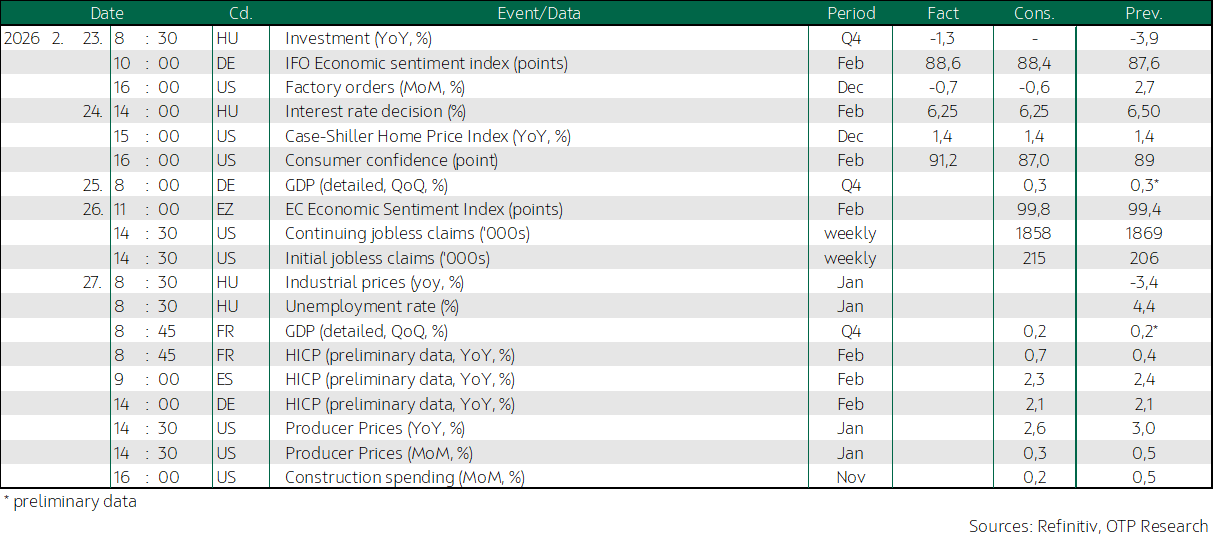
On the data front, February’s consumer confidence index rose, wrong-footing those expecting a decline.
Donald Trump delivered the first State of the Union address of his second presidential term last night. He praised the results achieved with his strict immigration policy, the decline in fuel prices and inflation, his tax policy, and the performance of the stock markets. Regarding tariffs, he said that Congressional action would not be necessary, and that he believes that tariffs will ‘substantially’ replace income taxes. Regarding Iran, the president spoke of a nuclear threat and accused the regime of killing and maiming thousands of American service members, and killing 32,000 local protesters.
Gold and silver prices descended yesterday, ending Monday's soaring. The VIX index, also known as the fear index, which indicates market volatility, fell on Tuesday. In addition to the uncertainty related to the tariff war, investors keep an eye on the conflict between the USA and Iran. Reportedly, there will be a crucial meeting between the parties on Thursday and in order to avoid a conflict, Iran may be willing to limit uranium enrichment. Brent and WTI prices edged lower yesterday. The prices of the most important industrial metals rose.
Developed economies’ bond and currency markets barely changed; Hungary’s MNB cut interest rates
There was no significant movement in the bond and currency markets of developed economies. The 10Y US bond yield remained below 4.05%, and the German one near 2.7%. The EUR/USD did not budge, either: it remained below 1.18.
In Hungary, the MNB’s Monetary Council reduced its key interest rate by 25 basis points, to 6.25%, for the first time in a year and a half. At the post-meeting press conference, Central Bank Governor Mihály Varga said that the Council discussed only this single proposal. The central bank governor pointed out that the Council would continue to make data-driven decisions on the interest rate level; in other words, Tuesday’s rate shall not be seen as the start of an easing cycle. The decision did not surprise the market: neither the EUR/HUF rate nor bond yields have changed. The EUR/HUF remained at the 379 level, and the 10Y bond yield below 6.5%. Despite the subdued demand, HUF 40 billion worth of Treasury bills were sold at the ÁKK's auction of three-month discount T-Bills, at an average yield of 6.07%.
Today’s highlights
Today’s trading in Asia-Pacific stock exchanges was buoyant, echoing Tuesday’s rally of the US tech sector seemed. Japan's Nikkei225 and South Korea's Kospi were seen at new highs.
Index futures were mostly pointing a positive opening on both sides of the Atlantic.
Today, the ÁKK auctions six-month discount-Treasury Bills, offering HUF 30 billion. The agency also holds a switch auction, making available HUF 15 billion forints in 2033 and 2037 bonds each, in exchange for securities maturing this year and next.
In the eurozone, the second estimate of January inflation data and Germany’s detailed GDP data are due today. A meaningful difference from the preliminary estimates may move markets.
Among others, Nvidia and HSBC publish their earnings reports today.
Get more out of your investments!
Global Markets Services
OTP Global Markets offers a broad range of services in the field of local and international money and capital markets.
Read morePrivate Banking Services
Personal care and expertise with OTP Private Banking, along with the knowledge, security, and innovations of a multinational banking group.
Read more