
OTP Morning Brief: Tension is growing in the Strait of Hormuz
Related content
OTP Morning Brief: US producer price index came in above expectations, yet the US 10-year Treasury yield still declined
Western European equities continued to advance despite ongoing pressure on the technology sector. Wall Street indices also rebounded, recovering some ground after Wednesday’s sell-off. Healthcare was the standout performer on both sides of the Atlantic. Eurozone industrial production declined by 0.5% month-on-month in August. In the US, the producer price index accelerated to 6.3%, delivering another upside surprise in inflation developments. US retail sales increased by 0.8% compared to August. The US 10-year Treasury yield declined by more than 10 basis points. The long end of the Hungarian government bond yield curve also declined by 7-9 basis points. In Hungary, August wage data will be released today, while in the US, September industrial production figures are due.
OTP Morning Brief: US CPI data came in above expectations
European equity markets advanced, supported by strong results from ASML and the outstanding performance of the healthcare sector. US equity markets came under pressure following higher-than-expected September CPI data. The annual CPI rate accelerated to 3.7%, driven primarily by a surge in gasoline prices, while core CPI rose by 0.3% month-on-month, supported by higher housing costs and rising transportation service prices. Oil prices rose amid escalating tensions in the Middle East and the impact of the IEA's oil market report. US Treasury yields retreated after an initial increase, driven by Fed commentary, while European bond yields generally moved higher. The US macro calendar will be busy today, with investors focusing on September retail sales and producer price index data, as well as the New York Fed Manufacturing Index, weekly jobless claims, and business inventories. August industrial production data from the euro area will be released today.
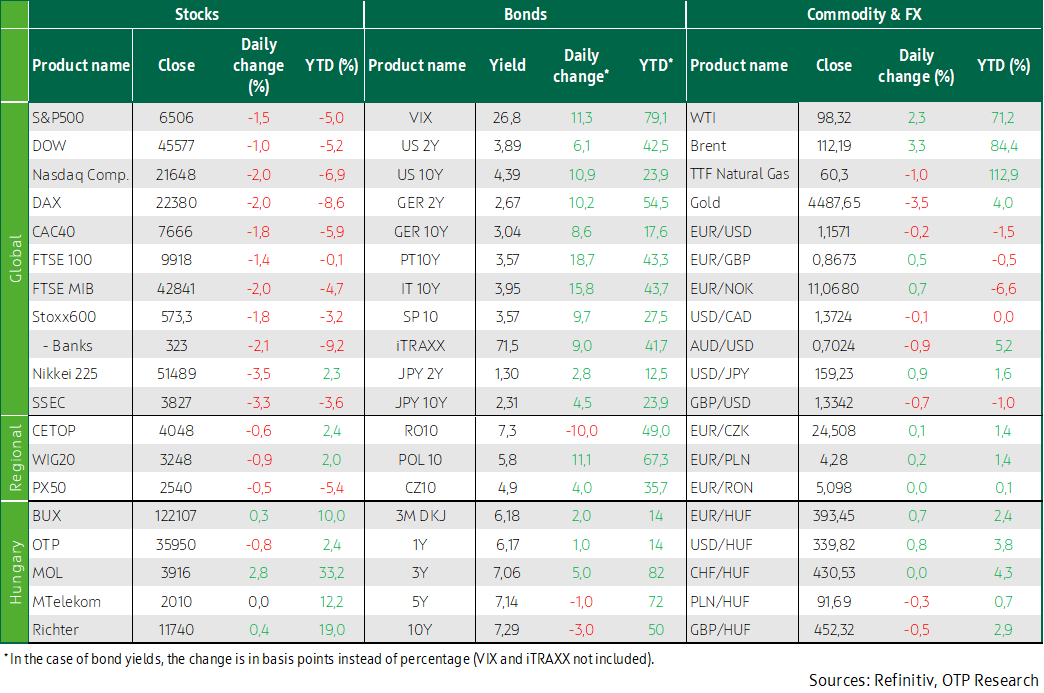
The Middle East conflict continues to rule market developments. Uncertainty over the control of the Strait of Hormuz is fuelling energy prices’ growth. WTI crude shot up almost 50%, nearing USD 100, and Brent jumped by 55%, beyond USD 112 in the past three weeks. The markets expect higher interest rate from the ECB and flat interest rate from the Fed this year. The USA’s and Europe’s key indices closed in the red on Friday and suffered hefty losses last week. On Friday, the BUX’s uptick was the best performance in the CEE region, where only Poland’s WIG20 declined week/week. Soaring energy prices are raising inflation risks, and the yield curve has shifted upwards in developed and developing countries alike. The dollar weakened slightly, while the forint has practically stagnated against the euro last week. The euro area’s March consumer confidence index is due today. Later this week, PMIs will be published in Europe and America, and Hungary’s MNB makes rate decision.
Tensions escalate in the Middle East; crude oil prices rose further
The Middle East conflict continues to rule market developments as the fight that started on 28 February is expanding geographically and the anxiety around the Strait of Hormuz is heating up. Donald Trump gave Iran a 48-hour ultimatum on Saturday evening (Sunday morning, CET) to open the strait, otherwise he threatened to obliterate Iranian power plants. In response, Iran said that if the enemy attacks its fuel and energy infrastructure, it will target all energy infrastructure, IT, as well as water purification and desalination facilities in the region. Earlier last week, President Trump called on his NATO allies to help protect tankers passing through the strait from Iranian attacks as Iran has attacked energy production facilities in the Persian Gulf. Iraq declared force majeure on Friday for all oil fields operated by foreign companies, citing the attacks. Reportedly, the Pentagon may send thousands more Marines to the Middle East, which points in the direction of ground strikes. WTI crude oil prices have jumped by almost 50%, to around 100 USD/barrel, while Brent has skyrocketed 55%, going beyond USD 112 in the past three weeks. In Europe’s natural gas market, TTF prices have reached 60 EUR/MWh, in an increase of more than 85% in three weeks. Meanwhile, the US domestic natural gas price (Henry Hub) has risen by around 8% from a low during this time. The soaring oil prices have revived inflation and growth concerns and have erased expectations of interest rate cuts – instead, expectations of interest rate hikes are building up.
Europe’s stock markets decline for the third consecutive week
Europe’s stock markets have slipped for the third week in a row. Oil prices grew in the second half of last week, as the attacks on energy facilities in the Middle East quickly dispelled the calm felt at the beginning of the week. The STOXX 600 slid 1.8% on Friday, bringing its weekly loss to 3.8%. Western Europe’s leading stock markets slumped 1.5%—2.0% on Friday, and their weekly loss was more than 3%. All sectors fell on Friday, in particular defence, utilities, and financial stocks – only the oil & gas sector posted weekly gain.
Last week’s most anticipated event was the ECB’s interest rate decision, where the key lending and deposit rates were left unchanged, as expected. Christine Lagarde’s comments made investors rather wary. The market is currently pricing in three 25-basis-point hikes by the ECB this year, with the first increase likely in June. Elsewhere, the Bank of England also left its key interest rate on hold last week, as expected.
On Friday, Hungary’s BUX (+0.3%) was top gainer in the CEE region, where Poland’s WIG20 and Czechia’s PX turned red. Of Hungarian blue chips, only MOL (+3%) and Richter (+0.4%) posted gains. In weekly comparison, the PX50 (+1%) performed best, the BUX added 0.3%, while the WIG20 eased by 0.8%.
Wall Street’s indices fell deeper; US rate cut expectations for this year have faded away
Wall Street’s indices plunged on Friday as oil prices increased further. The Dow (-1%), the S&P500 (-1.5%) and the NASDAQ (-2%) all slipped; the technology sector saw the worst losses. America’s major indices have been dropping for the fourth consecutive week, losing 2% last week.
Investors have practically priced out any rate cut this year in the USA – they were replaced by rate hike expectations. This comes despite Jerome Powell’s speech at the Fed's rate-setting meeting last week that energy price shocks typically have a temporary impact on inflation, and the dot plot (which summarizes policymakers' expectations) is consistent with a 25-basis-point reduction this year, but there is also significant support for holding interest rates; none of them expects a hike this year.
Developed economies’ bond yields rose further; Hungary’s yield curve has flattened
The events of the Middle East conflict influenced the sentiment in developed economies’ bond markets last week. Soaring energy prices add to inflation risks, and the yield curves in both developed and developing countries have shifted higher. Many central banks of advanced economies – including the Fed, the ECB, the Bank of England, the Swiss National Bank, the Bank of Japan, and the Reserve Bank of Australia – held monetary policy meetings last week, and although they left key interest rates on hold, policymakers raised their inflation forecasts, expressed concern about the already significant inflation risks due to higher energy prices, and committed themselves to achieving inflation targets. All of this ultimately led to a significant increase in developed economies’ bond yields on Friday. In the USA, the market has priced out the previously expected two rate cuts by the end of this year, and the 10Y US yield rose to almost 4.4% on Friday, which is a 13-basis-point yield increase in a single day, 15 bps rise in one week, and a 50-basis-point growth in three weeks. This brings the US 10Y bond yield closer to the middle of its post-covid trading range. In Europe, the money market yield curve is now consistent with three 25-basis-point interest rate hikes (whereas permanent hold was expected a few weeks ago); the first increase may happen as early as in April. The 10Y German yield jumped by nearly 10 basis points on Friday and rose above 3%, to its highest in the past 15 years; the Bund yield appears to be breaking above its post-covid trading range. The dollar weakened slightly from the eight-month peak of 1.14 reached in the previous week, closing in the vicinity of 1.155.
The CEE region’s currencies held up relatively well last week. The EUR/HUF closed at 393 on Friday, essentially flat week-on-week; neither did the zloty or the koruna weaken meaningfully. However, interest rate hike expectations stuck at elevated levels: the market expects three 25-basis-point interest rate hikes by the end of 2026 from all three regional central banks – as well as from the ECB. Hungary’s bond yields mostly declined on Friday; the curve flattened slightly over the past week: the 3Y yield rose, while yields at the long end of the curve shed about 10 basis points; the 10Y yield was at 7.3%.
Today’s highlights
The weekend’s threats from both sides over the Strait of Hormuz have further deepened investors’ concerns, so the major stock exchanges of the Asia-Pacific region are expected to close this morning's trading with painful losses. Index futures suggested that Europe and America would open in the red today.
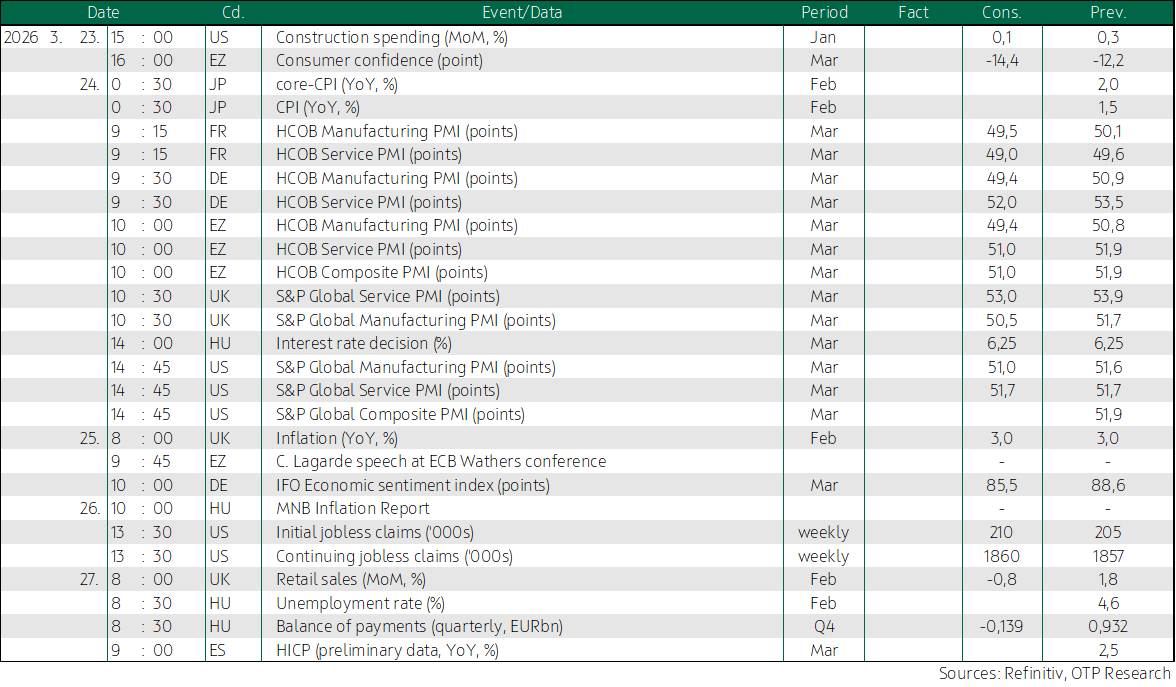
The March reading of the eurozone’s consumer confidence index is due today; it is expected to fall deeper.
Later in the week, purchasing managers’ indices (PMIs) will be published in Europe and in the USA. In Hungary, the MNB’s rate-setting meeting may move markets on Tuesday.
Get more out of your investments!
Global Markets Services
OTP Global Markets offers a broad range of services in the field of local and international money and capital markets.
Read morePrivate Banking Services
Personal care and expertise with OTP Private Banking, along with the knowledge, security, and innovations of a multinational banking group.
Read more